
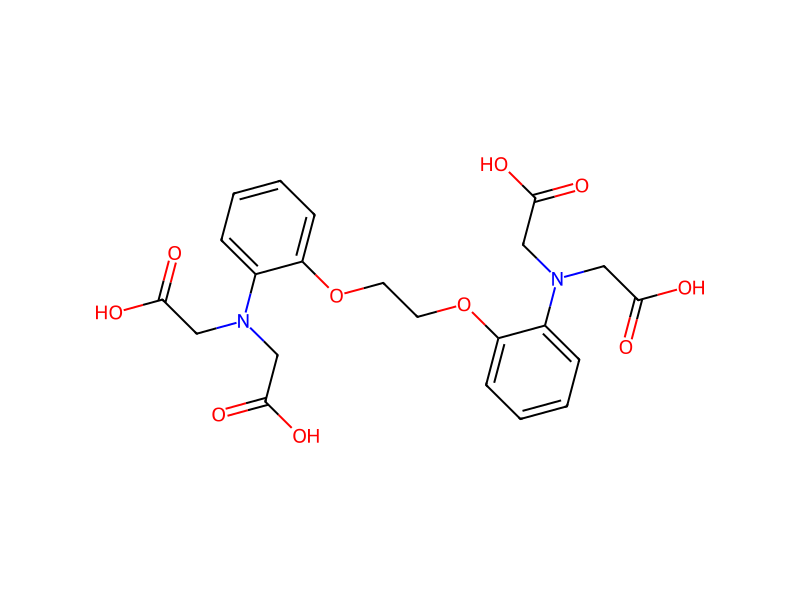
Basic information
- Standard SMILES
O=C(O)CN(CC(=O)O)c1ccccc1OCCOc1ccccc1N(CC(=O)O)CC(=O)O- InChIKey
FTEDXVNDVHYDQW-UHFFFAOYSA-N- Molecular formula
- C22H24N2O10
- Average molar mass
- 476.4 g/mol
- Monoisotopic mass
- 476.14309497
Overview
BAPTA is a polyamino carboxylic acid in which bis(carboxymethyl)nitrilo groups are bonded to C-2 and C-2' of 1,1'-[ethane-1,2-diylbis(oxy)]dibenzene. It has a role as a chelator. It is a tetracarboxylic acid and a polyamino carboxylic acid.
Names & identifiers
- Preferred name
- Bapta
- IUPAC
- 2-[2-[2-[2-[bis(carboxymethyl)amino]phenoxy]ethoxy]-N-(carboxymethyl)anilino]acetic acid
- English name
- BAPTA
- Molecular formula
- C22H24N2O10
- Molecular weight
- 476.43
Names & synonyms
BAPTA85233-19-8Bapeta1,2-Bis(2-aminophenoxy)ethane-N,N,N',N'-tetraacetic acid1,2-Bis(o-aminophenoxy)ethane-N,N,N',N'-tetraacetic acidK22DDW77C0DTXSID30234432Glycine, N,N'-(1,2-ethanediylbis(oxy-2,1-phenylene)bis(N-(carboxymethyl)-CHEBI:608882,2',2'',2'''-[ethane-1,2-diylbis(oxy-2,1-phenylenenitrilo)]tetraacetic acidGlycine, N,N'-(1,2-ethanediylbis(oxy-2,1-phenylene))bis(N-(carboxymethyl)-,tetrapotassium salt2,2',2'',2'''-(ethane-1,2-diylbis(oxy-2,1-phenylenenitrilo))tetraacetic acid
Show more names
Glycine, N,N'-[1,2-ethanediylbis(oxy-2,1-phenylene)]bis[N-(carboxyMethyl)-CS-2002BAPTA,97%BAPTA, >=98%BAPTA, Free AcidBAPTA, 10 mM in DMSO85233-19-8(free acid)BAPTA, extracellular calcium chelator1,2-BIS(2-AMINOPHENOXY)ETHANE-N,N,N',N'- TETRAACETI
RefChem:71704DTXCID30156923Glycine, N,N'-(1,2-ethanediylbis(oxy-2,1-phenylene))bis(N-(carboxymethyl))-,tetrapotassium salt629-173-6BAPTA free acidMFCD000362552,2',2'',2'''-(((Ethane-1,2-diylbis(oxy))bis(2,1-phenylene))bis(azanetriyl))tetraacetic acid1,2-Bis-(2-amino-phenoxy)ethane N,N,N',N'-tetraacetic
Database identifiers
- CAS
85233-19-8- PubChem CID
- 104751
- DTXSID
DTXSID30234432- ChEMBL
CHEMBL1590868- ChEBI
CHEBI:60888- UNII
- K22DDW77C0
- EC Number
- 629-173-6
- Nikkaji
- J330.680A
Properties
Computed structural properties
- XLogP
- 2.2
- Topological polar surface area
- 174 Ų
- Hydrogen bond donors
- 4
- Hydrogen bond acceptors
- 12
- Rotatable bonds
- 15
- Heavy atoms
- 34
- Formal charge
- 0
- Complexity
- 613
Physicochemical properties
- Melting point
- 177 · 177-179 °C
- Boiling point
- 575.89 °C · 575.89°C (rough estimate)
- Density
- 1.4482 · 1.4482 (rough estimate)
- refractive index
- 1.65 · 1.6500 (estimate)
- RTECS
- 423000 · MC0423000
- storage temp.
- 2 · 2-8°C
- solubility
- Soluble in dimethyl sulfoxide
- form
- Powder
- pka
- 1.4 · 1.40±0.10(Predicted)
- color
- White to off-white
- Appearance
- Solid Powder
- Water Solubility
- Soluble in water and sodium bicarbonate.
- λmax
- 209 nm, · 209 nm, 254 nm, 203 nm, 274 nm
- Merck
- 14 · 14,957
- BRN
- 5192406 · 5192406
- Stability
- 1 year · Stable for 1 year from date of purchase as supplied. Solutions in DMSO may be stored at -20°C for up to 1 month.
- Biological Applications
- Calcium indicators; zinc indicators; treating acute cell death,cerebral infarction,myocardial infarction,hepatonecrosis,kidney ischemic necrosis,necrotizing pancreatitis,amyloidosis,atherosclerosis,diseases characteriz
- InChIKey
- FTEDXVNDVHYDQW-UHFFFAOYSA-N
- SMILES
- OC(=O)CN(CC(O)=O)c1ccccc1OCCOc2ccccc2N(CC(O)=O)CC(O)=O
- CAS DataBase Reference
- 85233 · 85233-19-8(CAS DataBase Reference)
- FDA UNII
- 22 DDW77C0 · K22DDW77C0
- UNSPSC Code
- 12352112 · 12352112
- NACRES
- 23 · NA.23
- Symbol(GHS)
- 7 · GHS07
- Signal word
- Warning
- Hazard statements
- 315 · H315-H319-H335
- Precautionary statements
- 264 · P264-P280-P302+P352+P332+P313+P362+P364-P305+P351+P338+P337+P313-P261-P280a-P304+P340-P305+P351+P338-P405-P501a
- PPE
- 95 · dust mask type N95 (US), Eyeshields, Gloves
- Hazard Codes
- Xi
- Risk Statements
- 36 · 36/37/38
- Safety Statements
- 26 · 26-36-37/39
- WGK Germany
- 3 · 3
- HS Code
- 29225090 · 29225090
- Storage Class
- 11 · 11 - Combustible Solids
Safety & regulation
GHS classification
GHS Classification
Warning
H315 (100%): Causes skin irritation [Warning Skin corrosion/irritation]
P261, P264, P264+P265, P271, P280, P302+P352, P304+P340, P305+P351+P338, P319, P321, P332+P317, P337+P317, P362+P364, P403+P233, P405, and P501 (click each P-code to see the statement)
Aggregated GHS information provided per 43 reports by companies from 3 notifications to the ECHA C&L Inventory. Each notification may be associated with multiple companies.
Hazard information
Hazard Classes and CategoriesSkin Irrit. 2 (100%)
Safety data
- PPE
- dust mask type N95 (US), Eyeshields, Gloves
- wgk
- 3
- hs_code
- 29225090
- risk_code
- 36/37/38
- Signal word
- Warning
- Symbol(GHS)
- GHS07
- hazard_code
- Xi
- safety_code
- 26-36-37/39
- Storage Class
- 11 - Combustible Solids
- Hazard statements
- H315-H319-H335
- Precautionary statements
- P264-P280-P302+P352+P332+P313+P362+P364-P305+P351+P338+P337+P313-P261-P280a-P304+P340-P305+P351+P338-P405-P501a
Chemistry & industry
Pharmacology
MeSH Pharmacological Classification
Chemicals that bind to and remove ions from solutions. Many chelating agents function through the formation of COORDINATION COMPLEXES with METALS.
Substances used for the detection, identification, analysis, etc. of chemical, biological, or pathologic processes or conditions. Indicators are substances that change in physical appearance, e.g., color, at or approaching the endpoint of a chemical titration, e.g., on the passage between acidity and alkalinity. Reagents are substances used for the detection or determination of another substance by chemical or microscopical means, especially analysis. Types of reagents are precipitants, solvents, oxidizers, reducers, fluxes, and colorimetric reagents. (From Grant & Hackh's Chemical Dictionary, 5th ed, p301, p499)
Applications
DescriptionBAPTA free acid (85233-19-8) is a selective extracellular Ca2+ chelator. It is a widely used calcium sponge for chelating Ca2+outside of intact cells.1 It’s a useful tool to probe the involvement of extracellular Ca2+ in cellular signaling.2,3 Non-cell-permeable.
UsesBAPTA is a highly selective calcium chelating reagent. Lipophilic diesters of the chelating agent 1,2-Bis(2 aminophenoxy)ethane-N,N,N',N'-tetraacetic acid (BAPTA) are used for inhibition of proteolytic activities of certain metalloproteinases, calpain and TACE.
UsesAs calcium chelator; 19F labelled forms for measurement of intracellular calcium.
UsesHighly selective calcium chelating reagent. Suitable for the spectrophotometric monitoring of Ca2+ levels.
General DescriptionIn nature 1,2-Bis(2-Aminophenoxy)ethane-N,N,N′,N′-tetra acetic acid (BAPTA) is a main metabolic product of BAPTA -AM (BAPTA-tetra(actoxymethyl ester), a neuro protective agent in cerebral ischemia, in rats.BAPTA is an intercellular Ca2+ chelator.
Upstream & downstream products
Upstream raw materials
Suppliers50 total
国药集团化学试剂有限公司86-21-63210123 · [email protected]
梯希爱(上海)化成工业发展有限公司021-67121386 · [email protected]
上海阿拉丁生化科技股份有限公司400-6206333 13167063860 · [email protected]
南通飞宇生物科技有限公司0513-68819626 15152877458 · [email protected]
杭州鸿喜生物医药科技有限公司18989489206 · [email protected]
湖北万得化工有限公司15377098680 15377098680 · [email protected]
上海麦克林生化科技股份有限公司021-50706066 15221275939 · [email protected]
郑州德元凯化工有限公司17837139533 · [email protected]
上海迈瑞尔生化科技有限公司4006356688 18621169109 · [email protected]
武汉易泰科技有限公司上海分公司18930552037 · [email protected]
大连美仑生物技术有限公司0411-62910999 13889544652 · [email protected]
Hangzhou Sage Chemical Co., Ltd.+86057186818502 13588463833 · [email protected]
阿法埃莎(中国)化学有限公司400-6106006 · [email protected]
安耐吉化学&3A(安徽泽升科技股份有限公司)400-0056266 · [email protected]
上海瀚鸿科技股份有限公司021-54306202 13764082696 · [email protected]
南京圣亿来化工有限公司19951936396 · [email protected]
上海钰康生物科技有限公司18939844854 · [email protected]
MedBio脉铂医药021-69568360 18916172912 · [email protected]
上海隆盛化工有限公司58099637 13585536065 · [email protected]
ChemeGen 中国18818260767 · [email protected]
玛雅试剂+86 (573) 82222445 (0)18006601000 452520369 · [email protected]
天津希恩思生化科技有限公司400 638 7771 · [email protected]
苏州启航生物科技有限公司18151111370
湖南汇百侍生物科技有限公司0731-85526065 13308475853 · [email protected]
赛默飞世尔科技(中国)有限公司800-810-5118 · [email protected]
AdooQ BioScience, LLC+1 (866) 930-6790 · [email protected]
TCI AMERICA800-4238616 · [email protected]
TOKYO CHEMICAL INDUSTRY CO., LTD.03-36680489 · [email protected]
TCI Europe320-37350700 · [email protected]
上海柏懿化工有限公司+86-21-54380268
南京生利德生物科技有限公司025-57798810 18652991625 · [email protected]
上海毕得医药科技股份有限公司400-164-7117 18317119277 · [email protected]
Labnetwork lnc.+86-27-50766799 +86-18062016861 · [email protected]
天津普西唐生物医药科技有限公司010-60605840 · [email protected]
上海鑫圭生物科技有限公司15121041756 · [email protected]
杭州杰恒化工有限公司0571-87396432 · [email protected]
上海寰川实业有限公司021-61478794 · [email protected]
上海瑞诗化工有限公司86-021-54933292 · [email protected]
江苏艾康生物医药研发有限公司025-66028182 17714375163 · [email protected]
南京百鑫德诺生物科技有限公司025-58849295 · [email protected]
凯试(上海)科技有限公司021-50135380 · [email protected]
合肥纳禾生物科技有限公司0551-65629887 18010855303 · [email protected]
池州凯隆进出口贸易有限公司[email protected]
Sigma-Aldrich西格玛奥德里奇(上海)贸易有限公司021-61415566 800-8193336 · [email protected]
桦特昇生物科技(武汉)有限公司027-59207879 1972026995 18140587686 · [email protected]
TargetMol中国(陶术生物)021-021-33632979 15002134094 · [email protected]
上海陶术生物科技股份有限公司+1-781-999-5354; +1-00000000000 · [email protected]
上海谱振生物科技有限公司4001650900 13817534909 · [email protected]
开封明仁药业有限公司0371-65741762 · [email protected]
湖南汇百益新材料有限公司400-0909710 13319523173 · [email protected]
Additional notes
DefinitionChEBI: A polyamino carboxylic acid in which bis(carboxymethyl)nitrilo groups are bonded to C-2 and C-2' of 1,1'-[ethane-1,2-diylbis(oxy)]dibenzene.
Related reactions
2 records

Linked notes
Loading…