
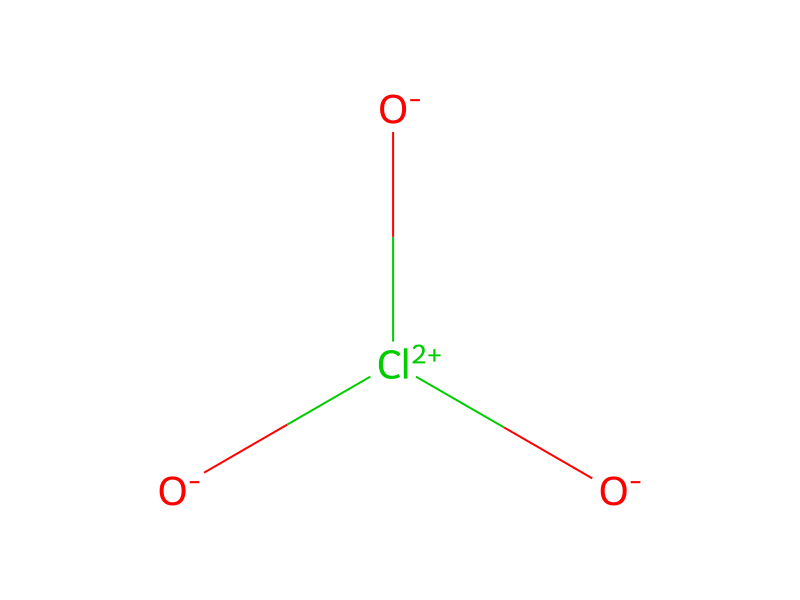
Basic information
- CAS
14866-68-3- Standard SMILES
[O-][Cl+2]([O-])[O-]- InChIKey
TYJXBNGPLHOYOB-UHFFFAOYSA-N- Molecular formula
- ClO3-
- Average molar mass
- 83.45 g/mol
- Monoisotopic mass
- 82.95414512
Overview
Chlorate, n.o.s., wet appears as a moist solid or slurry.
Names & identifiers
- Preferred name
- Chlorate ion
- IUPAC
- chlorate
- English name
- chloric acid
- Molecular formula
- ClHO3
- Molecular weight
- 83.45
Names & synonyms
ChlorateChlorate ion14866-68-3Chlorate(1-)trioxidochlorate(1-)CHLORATE ANIONClO3(-)DTXSID3073137CHEBI:4970908Z8093742(ClO3)(-)[ClO3](-)
Show more names
Anion Standard-Chlorate
RefChem:54774DTXCID3034824ChloratesChlorine oxide (ClO3(1-))Chlorate SolutionUNII-08Z8093742n.o.s., wetCHLORATE ION (CLO3-)
Database identifiers
- CAS
14866-68-3- PubChem CID
- 104770
- DTXSID
DTXSID3073137- ChEMBL
CHEMBL1161633- ChEBI
CHEBI:49709- UNII
- 08Z8093742
- Nikkaji
- J1.587.838J
Properties
Computed structural properties
- XLogP
- 1.5
- Topological polar surface area
- 57.2 Ų
- Hydrogen bond donors
- 0
- Hydrogen bond acceptors
- 3
- Rotatable bonds
- 0
- Heavy atoms
- 4
- Formal charge
- -1
- Complexity
- 36.5
Experimental & physicochemical properties
Food Contact Substances
FCS -> FDA Cumulative Estimated Daily Intake (CEDI)
FCS -> FDA Inventory of Food Contact Substances Listed in 21 CFR
Physical Description
Chlorate, n.o.s., wet appears as a moist solid or slurry.
Chlorate, inorganic, n.o.s. is a white crystalline. It is soluble in water. The material itself is noncombustible, but it can form a very flammable mixture with combustible materials, and this mixture may be explosive if the combustible material is very finely divided. The mixture can be ignited by friction. Contact with strong sulfuric acid can cause fires or explosions. When mixed with ammonium salts, spontaneous decomposition and ignition may result. Prolonged exposure of the material to heat or fire can result in an explosion.
Physicochemical properties
- Indirect Additives used in Food Contact Substances
- CHLORATE
- FDA 21 CFR
- 178.101 · 178.1010
- FDA UNII
- 8 Z8093742 · 08Z8093742
- EPA Substance Registry System
- Chlorate (14866-68-3)
Safety & regulation
Hazard information
Regulatory Information
Hazard Traits - Endocrine Toxicity
Regulation (EC) No 1331/2008
DOT Label
Oxidizer
Oxidizer
Fire Hazards
Excerpt from ERG Guide 140 [Oxidizers]:
Excerpt from ERG Guide 140 [Oxidizers]:
Health Hazards
Excerpt from ERG Guide 140 [Oxidizers]:
Excerpt from ERG Guide 140 [Oxidizers]:
Reactive Group
Oxidizing Agents, Strong
Oxidizing Agents, Strong
Reactivity Alerts
Strong Oxidizing Agent
Explosive
Reactivity Profile
CHLORATE, WET is an oxidizing agent. In the presence of strong acid can liberate explosive chlorine dioxide gas. Heating a moist metal chlorate and a dibasic organic acid liberates chlorine dioxide and carbon dioxide [Bretherick 1979 p. 100]. Mixtures of chlorates with ammonium salts, powdered metals, silicon, sulfur, or sulfides are readily ignited and potentially explosive [Bretherick 1979 p. 806]. A combination of finely divided aluminum with finely divided chlorates of barium, calcium, magnesium, potassium, sodium or zinc can explode by heat, percussion, and friction [Mellor 2:310 1946-47].
Metal chlorates are oxidants in the presence of strong acid; liberates explosive chlorine dioxide gas; liberates chlorine dioxide and carbon dioxide by heating a moist metal chlorate and a dibasic organic acid; mixtures of perchlorates with sulfur or phosphorus are explosives [Bretherick 1979 p. 100]; mixtures of the chlorate with ammonium salts, powdered metals, silicon, sulfur, or sulfides are readily ignited and potentially explosive [Bretherick 1979 p. 806]. A combination of finely divided aluminum with finely divided bromates (also chlorates and iodates) of barium, calcium, magnesium, potassium, sodium, or zinc can explode by heat, percussion, or friction [Mellor 2:310 1946-47].
Chemistry & industry
Uses & manufacturing
Use ClassificationFood Additives -> PRESERVATIVE -> JECFA Functional Classes
Applications
General DescriptionChlorate, inorganic, n.o.s. is a white crystalline. chloric acid is soluble in water. The material itself is noncombustible, but chloric acid can form a very flammable mixture with combustible materials, and this mixture may be explosive if the combustible material is very finely divided. The mixture can be ignited by friction. Contact with strong sulfuric acid can cause fires or explosions. When mixed with ammonium salts, spontaneous decomposition and ignition may result. Prolonged exposure of the material to heat or fire can result in an explosion.
Suppliers14 total
Hebei Chuanghai Biotechnology Co., Ltd+86-17732866630 · [email protected]
广州纳珑化工有限公司13192879270; 13192879270 · [email protected]
湖北成丰化工有限公司13125175253 · [email protected]
广东百科试剂有限公司13532366769 13686183698 · [email protected]
广东元丰化学试剂有限公司0751-2829979 13318593351 · [email protected]
广东顺奥化学试剂有限公司19928586137 · [email protected]
成都标样生物科技有限公司028-81700200 13308200041 · [email protected]
广东翁江化学试剂有限公司
Related reactions
15 records





Compound notes
Loading…