HomeMCPWorkbenchSkills
HomeWorkbenchNotificationsMe
llms.txt · MCP GuidePrivacy Policy · Terms of Service · Supportv1.8.0
  1. Home
  2. /Compound

Pyrazole

HCID 1048
New noteNew reactionRequest quotes
Print preview

Completing data — refresh the page later to see the latest
Basic informationOverviewNames & identifiersPropertiesSafety & regulationChemistry & industryRelated reactionsCompound notes
Substructure searchFind similar structures

Basic information

CAS
288-13-1
Standard SMILES
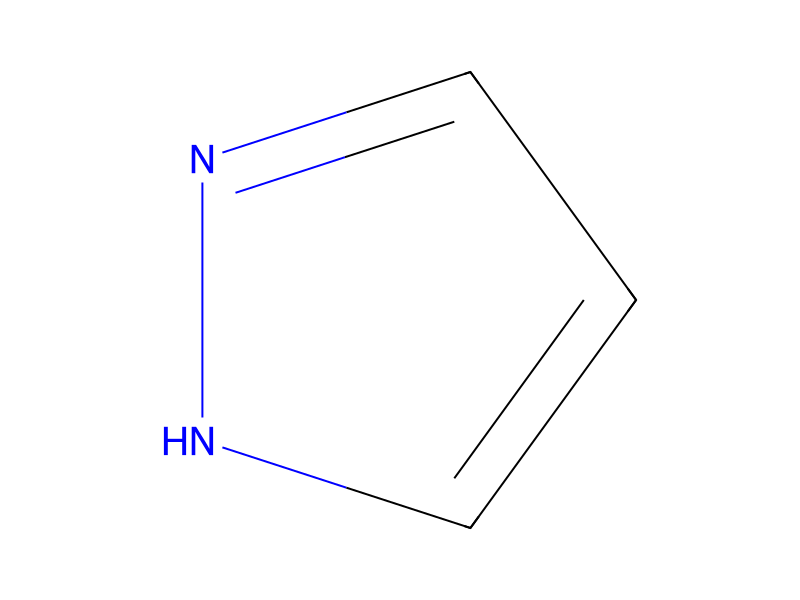
c1cn[nH]c1
InChIKey
WTKZEGDFNFYCGP-UHFFFAOYSA-N
Molecular formula
C3H4N2
Average molar mass
68.08 g/mol
Monoisotopic mass
68.03744813

Overview

1H-pyrazole is the 1H-tautomer of pyrazole. It is a conjugate base of a pyrazolium. It is a conjugate acid of a pyrazol-1-ide. It is a tautomer of a 3H-pyrazole and a 4H-pyrazole.

Names & identifiers

Preferred name
Pyrazole
IUPAC
1H-pyrazole
English name
Pyrazole
Molecular formula
C3H4N2
Molecular weight
68.08

Names & synonyms

pyrazole1H-Pyrazole288-13-11,2-diazolePyrazol1H-pyrazol3QD5KJZ7ZJDTXSID2059774NSC45410NSC-45410CHEBI:17241RefChem:6183
Show more names
Pyrrazoleα-yrromonazolePyrazole, pure, 98%Ryrazole1,2-DIAZOL
DTXCID4037873CHEBI:14973206-017-1MFCD00005234diazoleHpzEINECS 206-017-1UNII-3QD5KJZ7ZJ

Database identifiers

CAS
288-13-1
PubChem CID
1048
DTXSID
DTXSID2059774
ChEMBL
CHEMBL15967
ChEBI
CHEBI:17241
UNII
3QD5KJZ7ZJ
EC Number
206-017-1
Nikkaji
J5.452F

Properties

Computed structural propertiesFilling in

XLogP
0.3
Topological polar surface area
28.7 Ų
Hydrogen bond donors
1
Hydrogen bond acceptors
1
Rotatable bonds
0
Heavy atoms
5
Formal charge
0
Complexity
28.1

Experimental & physicochemical properties

Chemical ClassesNitrogen Compounds -> Pyrazoles
DrugsPharmaceuticals -> Listed in ZINC15
SpringerMaterials Properties15N nuclear magnetic resonance spectrum
LogP0.13
Vapor Pressure1.19 [mmHg]
Physical Description · 2 items

Liquid

Solid with an odor like pyridine; [Merck Index] Colorless crystalline solid; [Sigma-Aldrich MSDS]

Dissociation Constants2.48 (at 25 °C)
Collision Cross Section125.47 Ų [M+H]+ [CCS Type: DT; Method: stepped-field]

Physicochemical properties

Melting point

Safety & regulation

Safety information is for reference only and does not replace the supplier’s Safety Data Sheet (SDS), applicable regulations, or professional assessment.

GHS classification

GHS Classification · 5 items

This chemical does not meet GHS hazard criteria for 0.4% (1 of 265) of reports.

Danger

H302 (98.9%): Harmful if swallowed [Warning Acute toxicity, oral]

P260, P261, P262, P264, P264+P265, P270, P271, P273, P280, P301+P317, P302+P352, P304+P340, P305+P351+P338, P305+P354+P338, P316, P317, P319, P321, P330, P332+P317, P337+P317, P361+P364, P362+P364, P403+P233, P405, and P501 (click each P-code to see the statement)

Aggregated GHS information provided per 265 reports by companies from 21 notifications to the ECHA C&L Inventory. Each notification may be associated with multiple companies.

Hazard information

Regulatory Information · 4 items

Chemical: 1H-Pyrazole

1H-Pyrazole is listed on the EPA's Chemical Data Reporting (CDR) system. Manufacturers and importers of 1H-Pyrazole are required to report information about their production and use of this chemical to the EPA under the Toxic Substances Control Act (TSCA). (40 eCFR Part 711)

Status: Active Update: 26-02-2019 https://echa.europa.eu/registration-dossier/-/registered-dossier/23403

Pyrazole: Does not have an individual approval but may be used under an appropriate group standard

Hazards Summary · 1 item

Equivocal evidence of teratogenicity in mice; Teratogenic effects observed in intraperitoneal study of rats (route of administration not relevant to humans); [REPROTOX] Causes zonal hepatitis and coma in oral lethal-dose studies of rats; [RTECS] A skin and strong eye irritant; Harmful by ingestion; Teratogenicity observed in rats; [Sigma-Aldrich MSDS]

Hazard Classes and CategoriesAcute Tox. 4 (98.9%)

Toxicology

Chemistry & industry

Pharmacology

MeSH Pharmacological ClassificationCompounds or agents that combine with an enzyme in such a manner as to prevent the normal substrate-enzyme combination and the catalytic reaction.

Uses & manufacturing

UsesUsed as a chelating agent and in organic synthesis; [Merck Index]
U.S. Production2023: 75,000 - <500,000 lb
Consumer UsesEtching agent
Industry UsesOther
General Manufacturing Information · 2 items

All Other Chemical Product and Preparation Manufacturing

1H-Pyrazole: ACTIVE

Applications

UsesPyrazole is used in organic synthesis and asa chelating agent.

General DescriptionPyrazine is a heterocyclic crystalline aromatic compound with a five-membered ring containing three carbon atoms and two nitrogen atoms. It is a symmetricdiazine.

Upstream & downstream products

Upstream raw materials

5-Methyl-2-phenyl-1,2-dihydropyrazol-3-one

Downstream products

(6-(1H-Pyrazol-1-yl)pyridin-3-yl)methanol3-(1H-Pyrazol-1-yl)aniline

Related reactions

1,293 records
New reaction record
HRID 1066 reaction equation
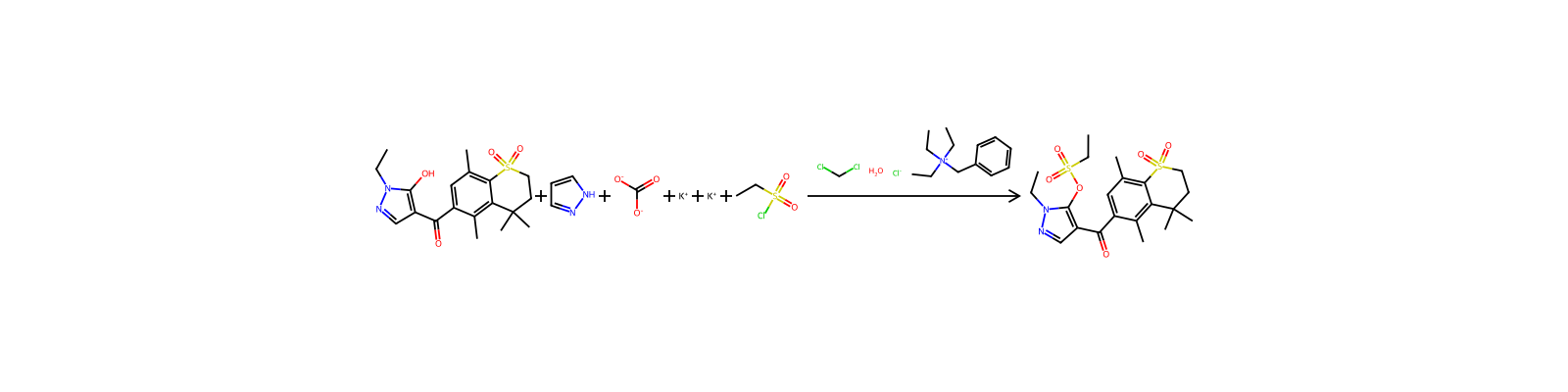
HRID 1066As reactantuspto-grants-1998_03
HRID 1067 reaction equation
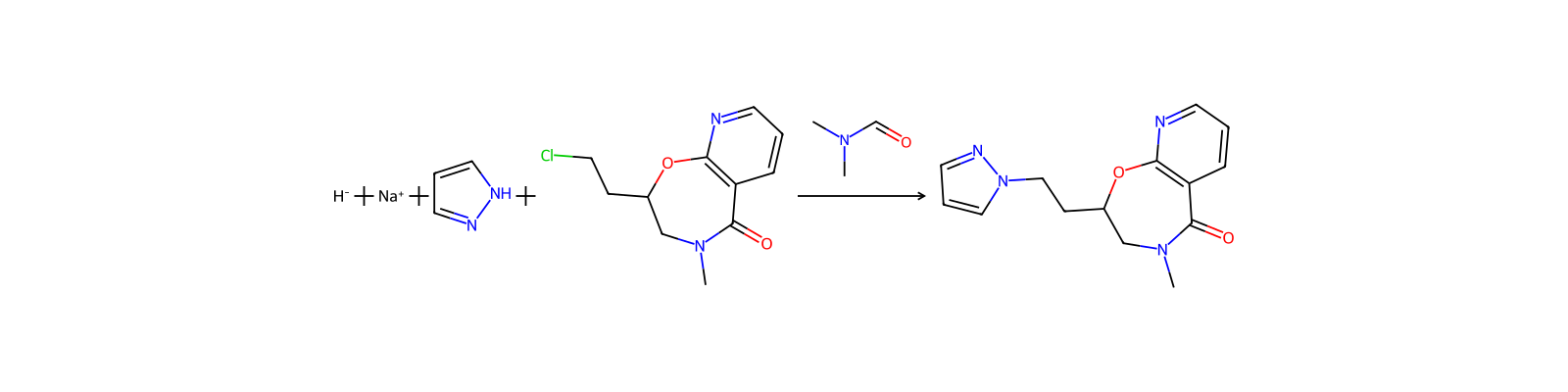
HRID 1067As reactantuspto-grants-1998_03
HRID 1069 reaction equation
HRID 1069As reactantuspto-grants-1998_03
HRID 4839 reaction equation
HRID 4839As reactantuspto-grants-1988_02
HRID 4847 reaction equation
HRID 4847As reactantuspto-grants-1988_02
HRID 7744 reaction equation
HRID 7744As reactantuspto-grants-2006_08
HRID 8926 reaction equation
HRID 8926As reactantuspto-grants-2006_08
HRID 9468 reaction equation
HRID 9468As reactantuspto-grants-2006_08
Page 1 of 162

Compound notes

Loading…

On this pageBasic informationOverviewNames & identifiersPropertiesSafety & regulationChemistry & industryRelated reactionsCompound notes
More actions
New noteNew reactionRequest quotes
67 · 67-70 °C (lit.)
Boiling point
186 · 186-188 °C (lit.)
Density
1.4088 · 1.4088 (rough estimate)
vapor pressure
21 Pa · 21Pa at 20℃
refractive index
1.4203 · 1.4203
Flash point
186 · 186-188°C
storage temp.
30 °C · Store below +30°C.
solubility
Chloroform, Methanol
form
Crystals or Crystalline Powder
pka
2.49 · 2.49(at 25℃)
color
White to yellow
Water Solubility
SOLUBLE
Specific Heat Capacity
1.19 J/ · Cp(crystal): 1.19 J/(g·K), at 25℃
Sensitive
Hygroscopic
Merck
14 · 14,7960
BRN
103775 · 103775
InChI
1S/C3H4N2/c1-2-4-5-3-1/h1-3H,(H,4,5)
InChIKey
WTKZEGDFNFYCGP-UHFFFAOYSA-N
SMILES
c1cn[nH]c1
LogP
0.33 at · 0.33 at 25℃
CAS DataBase Reference
288 · 288-13-1(CAS DataBase Reference)
EWG's Food Scores
1 · 1
FDA UNII
3 QD5KJZ7ZJ · 3QD5KJZ7ZJ
NIST Chemistry Reference
1 H-Pyrazole · 1H-Pyrazole(288-13-1)
EPA Substance Registry System
Pyrazole (288-13-1)
UNSPSC Code
12352100 · 12352100
NACRES
22 · NA.22
Symbol(GHS)
5 · GHS05,GHS06,GHS08
Signal word
Danger
Hazard statements
302 · H302-H311-H315-H318-H373-H412
Precautionary statements
273 · P273-P280-P301+P312-P302+P352+P312-P305+P351+P338-P314
target organs
spleen,Thyroid
Hazard Codes
Xn
Risk Statements
22 · 22-36/37/38-52-20/21/22
Safety Statements
26 · 26-36/37-61-37/39-36
RIDADR
2811 · 2811
WGK Germany
1 · 1
RTECS
4900000 · UQ4900000
TSCA
TSCA listed
HazardClass
6.1 · 6.1(b)
PackingGroup
III
HS Code
29331990 · 29331990
Storage Class
6.1 C · 6.1C - Combustible acute toxic Cat.3toxic compounds or compounds which causing chronic effects
Hazard Classifications
3 DermalAcute · Acute Tox. 3 DermalAcute Tox. 4 OralAquatic Chronic 3Eye Dam. 1Skin Irrit. 2STOT RE 1
Toxicity
50 · LD50 (24 hr) in rats, mice (mmol/kg): 19, 21 i.v.; 21, 22 orally (Magnussen)
REACH Registrations
Active
Limited Quantities
5 kg · 5.0 kg (11 lbs) (solid)
Excepted Quantities
Max Inner Pack (30g or 30ml) and Max Outer Pack (1Kg or 1L)
Adverse EffectsOccupational hepatotoxin - Secondary hepatotoxins: the potential for toxic effect in the occupational setting is based on cases of poisoning by human ingestion or animal experimentation.

Safety data

wgk
1
tsca
TSCA listed
rtecs
UQ4900000
ridadr
2811
hs_code
29331990
Toxicity
LD50 (24 hr) in rats, mice (mmol/kg): 19, 21 i.v.; 21, 22 orally (Magnussen)
risk_code
22-36/37/38-52-20/21/22
Signal word
Danger
Symbol(GHS)
GHS05,GHS06,GHS08
hazard_code
Xn
safety_code
26-36/37-61-37/39-36
hazard_class
6.1(b)
Storage Class
6.1C - Combustible acute toxic Cat.3toxic compounds or compounds which causing chronic effects
packing_group
III
target organs
spleen,Thyroid
Hazard statements
H302-H311-H315-H318-H373-H412
Limited Quantities
5.0 kg (11 lbs) (solid)
Excepted Quantities
Max Inner Pack (30g or 30ml) and Max Outer Pack (1Kg or 1L)
REACH Registrations
Active
Hazard Classifications
Acute Tox. 3 DermalAcute Tox. 4 OralAquatic Chronic 3Eye Dam. 1Skin Irrit. 2STOT RE 1
Precautionary statements
P273-P280-P301+P312-P302+P352+P312-P305+P351+P338-P314
1-(1H-pyrazol-1-yl)propan-2-amine
2-Bromo-6-(1H-pyrazol-1-yl)pyridine
4-Pyrazol-1-yl-benzaldehyde
5-Amino-3-cyano-1-(2,6-dichloro-4-trifluoromethylphenyl)pyrazole
Metazachlor
Pyraclofos
2-(1H-Pyrazol-1-yl)benzoic acid
3-(1H-Pyrazol-3-yl)benzoic acid
tert-Butyl 4-[[[(E)-[(1,3-Dimethyl-5-phenoxy-1H-pyrazol-4-yl)methylene]amino]oxy]methyl]benzoate
Methyl 6-(1H-pyrazol-1-yl)pyridine-3-carboxylate
6-(1H-Pyrazol-1-yl)nicotinonitrile
6-(1H-Pyrazol-1-yl)nicotinic acid
4-(1H-Pyrazol-1-yl)phenyl isothiocyanate
Fipronil
5-Chloromethyl-2-(pyrazol-1-yl)pyridine
4-Pyrazolecarboxylic acid
N-Methyl-6-(1H-pyrazol-1-yl)nicotinamide
3-Phenyl-1H-pyrazole
3-(1H-Pyrazol-1-yl)benzaldehyde
Climbazole
Pyrazole-3-boronic acid
[6-(1H-Pyrazol-1-yl)pyridin-3-yl]methylamine

Additional notes

DefinitionChEBI: 1H-pyrazole is the 1H-tautomer of pyrazole. It is a conjugate base of a pyrazolium. It is a conjugate acid of a pyrazol-1-ide. It is a tautomer of a 3H-pyrazole and a 4H-pyrazole.