
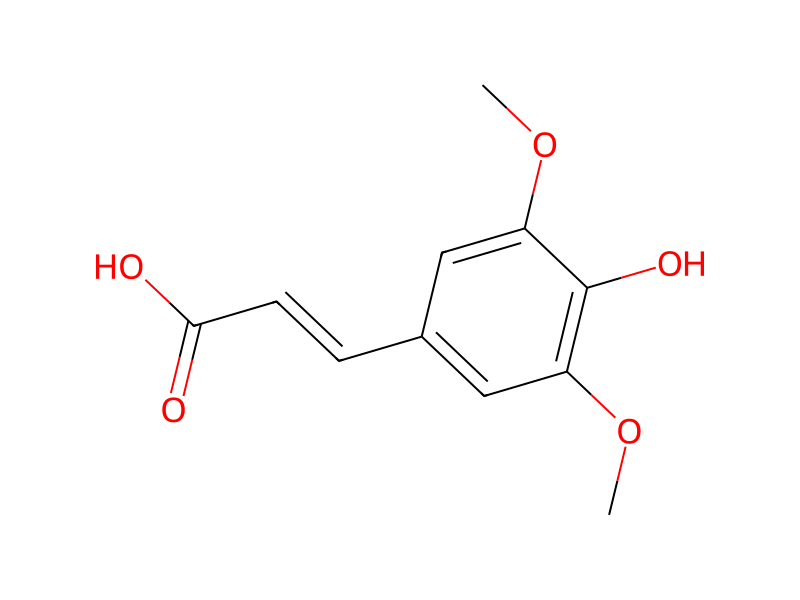
Basic information
- CAS
530-59-6- Standard SMILES
COc1cc(C=CC(=O)O)cc(OC)c1O- InChIKey
PCMORTLOPMLEFB-UHFFFAOYSA-N- Molecular formula
- C11H12O5
- Average molar mass
- 224.21 g/mol
- Monoisotopic mass
- 224.06847348
Overview
Sinapic acid is a matrix for matrix-assisted laser desorption technique for protein MW determination. It is also a constituent of propolis.
Names & identifiers
- Preferred name
- Sinapic acid
- IUPAC
- 3-(4-hydroxy-3,5-dimethoxyphenyl)prop-2-enoic acid
- English name
- 4-Hydroxy-3,5-dimethoxycinnamic acid
- Molecular formula
- C11H12O5
- Molecular weight
- 224.21
Names & synonyms
530-59-6UNII-P0I60993ECCHEBI:77131NSC-59261RefChem:50015208-487-32-Propenoic acid, 3-(4-hydroxy-3,5-dimethoxyphenyl)-, (E)-3,5-Dimethoxy-4-hydroxycinnamic acidSinapic acid4-Hydroxy-3,5-dimethoxycinnamic acidMFCD000044013-(4-hydroxy-3,5-dimethoxyphenyl)prop-2-enoic acid
Show more names
SINAPINIC ACID(E)-3-(4-hydroxy-3,5-diMethoxyphenyl)acrylic acidtrans-3,5-Dimethoxy-4-hydroxycinnamic acidNSC 59261Dimethoxy MSSynapoic acidSynapitic AcidSIMPLEXOLIN(RG)
(EZ)-sinapic acidSCHEMBL37313orb1303795DTXSID40862129WLZ4748PCMORTLOPMLEFB-UHFFFAOYSA-NHMS3372O09HAA36237
Database identifiers
- CAS
530-59-6、7362-37-0- PubChem CID
- 10743
- DTXSID
Properties
Computed structural properties
- XLogP
- 1.5
- Topological polar surface area
- 76 Ų
- Hydrogen bond donors
- 2
- Hydrogen bond acceptors
- 5
- Rotatable bonds
- 4
- Heavy atoms
- 16
- Formal charge
- 0
- Complexity
- 249
Experimental & physicochemical properties
Chemical ClassesOther Classes -> Organic Acids
Flavoring AgentsEU Flavoring substances
Physical DescriptionLight yellow powder; [Sigma-Aldrich MSDS]
Physicochemical properties
- Melting point
- 202 °C · ~202 °C
- Boiling point
- 285.61 °C · 285.61°C (rough estimate)
- Density
- 1.1478 · 1.1478 (rough estimate)
- refractive index
- 1.472 · 1.4720 (estimate)
- FLAVIS Number
- 8.088 · 08.088 | 4-Hydroxy-3,5-dimethoxycinnamic acid (mixture of isomers)
- storage temp.
- Keep in dark place,Sealed in dry,Room Temperature
- solubility
- 2 O: · H2O: slightly soluble
- form
- powder
- pka
- 4.53 · 4.53±0.10(Predicted)
Safety & regulation
GHS classification
GHS Classification
Warning
H315 (99.5%): Causes skin irritation [Warning Skin corrosion/irritation]
P261, P264, P264+P265, P271, P280, P302+P352, P304+P340, P305+P351+P338, P319, P321, P332+P317, P337+P317, P362+P364, P403+P233, P405, and P501 (click each P-code to see the statement)
Aggregated GHS information provided per 200 reports by companies from 10 notifications to the ECHA C&L Inventory. Each notification may be associated with multiple companies.
Hazard information
Regulatory Information
Commission Regulation (EC) No 1565/2000 (Repealed by Com. Implementing Reg. (EU) No 872/2012)
2-Propenoic acid, 3-(4-hydroxy-3,5-dimethoxyphenyl)-: Does not have an individual approval but may be used under an appropriate group standard
Hazards SummaryA skin and strong eye irritant; [Sigma-Aldrich MSDS] See trans-Ferulic acid.
Hazard Classes and CategoriesSkin Irrit. 2 (99.5%)
Safety data
- PPE
- dust mask type N95 (US), Eyeshields, Gloves
- wgk
- 3
- hs_code
- 29189900
- risk_code
- 36/37/38
- Signal word
- Warning
- Symbol(GHS)
- GHS07
- hazard_code
- Xi
- hazard_note
- Irritant
- safety_code
- 26-36-37/39
- Storage Class
- 11 - Combustible Solids
- target organs
- Respiratory system
Chemistry & industry
Uses & manufacturing
Uses
A matrix for matrix-assisted laser desorption technique for protein MW determination; a constituent of propolis. [ChemIDplus]
Synthetic Polymer MALDI Matrix Compounds
Applications
Uses4-Hydroxy-3,5-dimethoxycinnamic acid is a commonly used matrix in MALDI mass spectrometry. It is a useful matrix for a wide variety of peptides and proteins. It serves well as a matrix for MALDI due to its ability to absorb laser radiation and to also donate protons (H+) to the analyte of interest.
UsesSinapic acid was suitable as phenolic standard for HPLC analysis in determination of Sinapic acid derivatives in Canola extracts. 10 g/L of sinapinic acid with solvent was suitable as matrix for ultraviolet laser desorption mass spectrometric determination of proteins. It was also suitable to use as matrix for MALDI-TOFMS and MALDI-ion mobility-TOFMS to determine phospholipids in tissue.
General DescriptionSinapic acid is an hydroxycinnamic acid derivative that occurs naturally in Brassicaceae species.
Upstream & downstream products
Upstream raw materials
Downstream products
Related reactions
6 records


Compound notes
Loading…