
Daidzin
Completing data — refresh the page later to see the latest
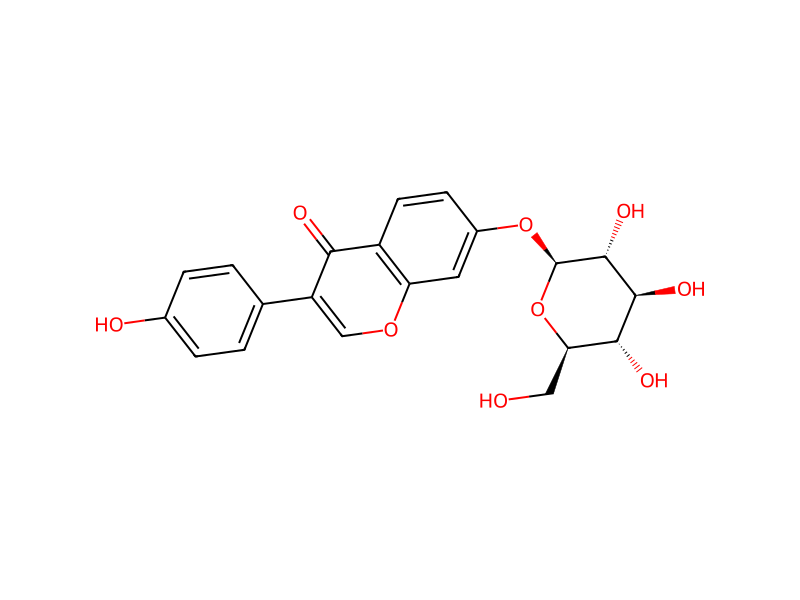
Basic information
- CAS
552-66-9- Standard SMILES
O=c1c(-c2ccc(O)cc2)coc2cc(O[C@@H]3O[C@H](CO)[C@@H](O)[C@H](O)[C@H]3O)ccc12- InChIKey
KYQZWONCHDNPDP-QNDFHXLGSA-N- Molecular formula
- C21H20O9
- Average molar mass
- 416.4 g/mol
- Monoisotopic mass
- 416.11073222
Overview
Daidzein 7-O-beta-D-glucoside is a glycosyloxyisoflavone that is daidzein attached to a beta-D-glucopyranosyl residue at position 7 via a glycosidic linkage. It is used in the treatment of alcohol dependency (antidipsotropic). It has a role as a plant metabolite. It is a 7-hydroxyisoflavones 7-O-beta-D-glucoside, a hydroxyisoflavone and a monosaccharide derivative. It is functionally related to a daidzein.
Names & identifiers
- Preferred name
- Daidzin
- IUPAC
- 3-(4-hydroxyphenyl)-7-[(2S,3R,4S,5S,6R)-3,4,5-trihydroxy-6-(hydroxymethyl)oxan-2-yl]oxychromen-4-one
- English name
- Daidzin
- Molecular formula
- C21H20O9
- Molecular weight
- 416.38
Names & synonyms
Daidzin552-66-9DaidzosideDaidzein 7-O-glucosideDaidzein 7-glucosideDaidzein-7-glucosidedaidzein 7-O-beta-D-glucoside4R2X91A5M53-(4-hydroxyphenyl)-7-[(2S,3R,4S,5S,6R)-3,4,5-trihydroxy-6-(hydroxymethyl)oxan-2-yl]oxychromen-4-oneCHEBI:422023-(4-hydroxyphenyl)-7-{[(2S,3R,4S,5S,6R)-3,4,5-trihydroxy-6-(hydroxymethyl)oxan-2-yl]oxy}-4H-chromen-4-one7-(beta-D-glucopyranosyloxy)-3-(4-hydroxyphenyl)-4H-chromen-4-one
Show more names
dadzinDaidziNPI 031DDaidzin>Daidzin-RMDAIDZIN(RG)DAIDZIN(SH)Daidzin(AS)
7-O-glucosyl-4'-hydroxyisoflavone3-(4-hydroxyphenyl)-7-(((2S,3R,4S,5S,6R)-3,4,5-trihydroxy-6-(hydroxymethyl)oxan-2-yl)oxy)-4H-chromen-4-one3-(4-hydroxyphenyl)-7-((2S,3R,4S,5S,6R)-3,4,5-trihydroxy-6-(hydroxymethyl)oxan-2-yl)oxychromen-4-oneRefChem:34445611-245-3MFCD000174667-(beta-D-Glucopyranosyloxy)-3-(4-hydroxyphenyl)-4H-1-benzopyran-4-one3-(4-hydroxyphenyl)-7-(((2S,3R,4S,5S,6R)-3,4,5-trihydroxy-6-(hydroxymethyl)tetrahydro-2H-pyran-2-yl)oxy)-4H-chromen-4-one
Properties
Computed structural propertiesFilling in
- XLogP
- 0.7
- Topological polar surface area
- 146 Ų
- Hydrogen bond donors
- 5
- Hydrogen bond acceptors
- 9
- Rotatable bonds
- 4
- Heavy atoms
- 30
- Formal charge
- 0
- Complexity
- 644
Experimental & physicochemical properties
DrugsPharmaceuticals -> Listed in ZINC15
LipidsPolyketides [PK] -> Flavonoids [PK12] -> Isoflavonoids [PK1205]
LogP0.32
Endocrine DisruptorsPotential endocrine disrupting compound
Melting Point233 - 235 °C
Physical DescriptionSolid
Physicochemical properties
- Melting point
- 234 · 234-236°C
- alpha
- -24 · -24 º (C=0.1g/100ml,dimethylsulfoxide)
- Boiling point
- 727.6 · 727.6±60.0 °C(Predicted)
- Density
- 1.572 · 1.572±0.06 g/cm3(Predicted)
- storage temp.
- -20 °C · -20°C
- solubility
- DMSO (Slightly, Sonicated), Methanol (Slightly, Heated)
Safety & regulation
Safety information is for reference only and does not replace the supplier’s Safety Data Sheet (SDS), applicable regulations, or professional assessment.
GHS classification
GHS Classification
This chemical does not meet GHS hazard criteria for 50% (1 of 2) of reports.
Warning
H315 (50%): Causes skin irritation [Warning Skin corrosion/irritation]
P261, P264, P264+P265, P271, P280, P302+P352, P304+P340, P305+P351+P338, P319, P321, P332+P317, P337+P317, P362+P364, P403+P233, P405, and P501 (click each P-code to see the statement)
Aggregated GHS information provided per 2 reports by companies from 2 notifications to the ECHA C&L Inventory. Each notification may be associated with multiple companies.
Hazard information
Regulatory Information
4H-1-Benzopyran-4-one, 7-(.beta.-D-glucopyranosyloxy)-3-(4-hydroxyphenyl)-: Does not have an individual approval but may be used as a component in a product covered by a group standard. It is not approved for use as a chemical in its own right.
Hazard Classes and CategoriesSkin Irrit. 2 (50%)
Safety data
- F
- 10
- wgk
- 3
- rtecs
- DJ3094000
- hs_code
- 29389090
- Toxicity
- mouse,LD50,intraperitoneal,> 2gm/kg (2000mg/kg),Pharmaceutical Chemistry Journal Vol. 13, Pg. 51, 1979.
- Signal word
- Warning
- Symbol(GHS)
- GHS07
- safety_code
- 24/25
- Storage Class
- 11 - Combustible Solids
- Hazard statements
- H315-H319-H335
Chemistry & industry
Pharmacology
MeSH Pharmacological Classification
Substances interfering with the metabolism of ethyl alcohol, causing unpleasant side effects thought to discourage the drinking of alcoholic beverages. Alcohol deterrents are used in the treatment of alcoholism.
Compounds or agents that combine with an enzyme in such a manner as to prevent the normal substrate-enzyme combination and the catalytic reaction.
Cellular LocationsCytoplasm
Applications
UsesA derivative of Daidzein. Inhibitor
UsesA metabolite of isoflavone derivatives. A derivative of Daidzin. Inhibitor.
General DescriptionDaidzin is a plant isoflavone glycoside and a potent inhibitor of human mitochondrial aldehyde dehydrogenase (ALDH-I).
Additional notes
DefinitionChEBI: Daidzein 7-O-beta-D-glucoside is a glycosyloxyisoflavone that is daidzein attached to a beta-D-glucopyranosyl residue at position 7 via a glycosidic linkage. It is used in the treatment of alcohol dependency (antidipsotropic). It has a role as a plant metabolite. It is a hydroxyisoflavone, a monosaccharide derivative and a 7-hydroxyisoflavones 7-O-beta-D-glucoside. It is functionally related to a daidzein.
Related reactions
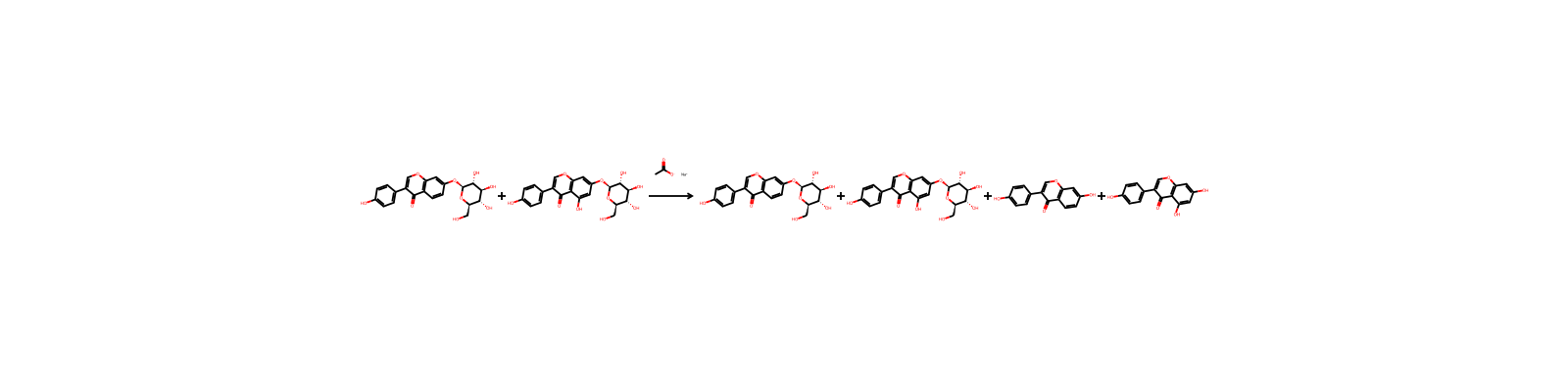
9 records



Compound notes
Loading…