Basic information
- Standard SMILES
O=C1C=CC(=O)N1- InChIKey
PEEHTFAAVSWFBL-UHFFFAOYSA-N- Molecular formula
- C4H3NO2
- Average molar mass
- 97.07 g/mol
- Monoisotopic mass
- 97.01637834
Overview
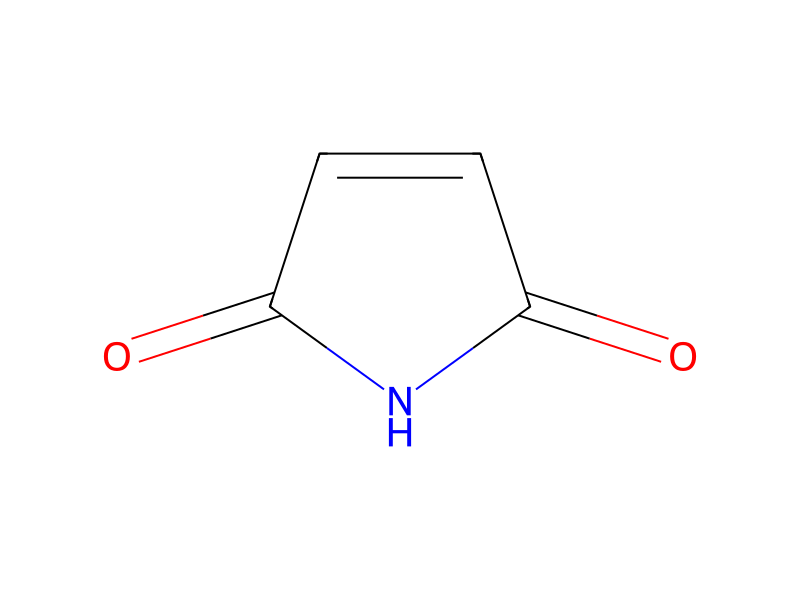
Maleimide is a cyclic dicarboximide in which the two carboacyl groups on nitrogen together with the nitogen itself form a 1H-pyrrole-2,5-dione structure. It has a role as an EC 5.99.1.3 [DNA topoisomerase (ATP-hydrolysing)] inhibitor. It is a dicarboximide and a member of maleimides. It is functionally related to a maleic acid. It derives from a hydride of a 1H-pyrrole.
Names & identifiers
- Preferred name
- Maleimide
- IUPAC
- pyrrole-2,5-dione
- English name
- Maleimide
- Molecular formula
- C4H3NO2
- Molecular weight
- 97.07
Names & synonyms
MALEIMIDE541-59-31H-Pyrrole-2,5-dionePyrrole-2,5-dione2,5-PyrroledioneMaleic imideDTXSID30494172519R1UGP8NSC-13684DTXCID2029377CHEBI:16072RefChem:800776
Show more names
MaleiMide, 98% 10GRNSC 13684maleicimideMaleimide>
208-787-4Maleinimide3-Pyrroline-2,5-dione2,5-dihydro-1H-pyrrole-2,5-dioneMFCD00005494maleic acid imideSMR000857346CCRIS 3408
Database identifiers
- CAS
541-59-3- PubChem CID
- 10935
- DTXSID
DTXSID3049417- ChEMBL
CHEMBL201511、CHEMBL387762- ChEBI
CHEBI:16072- UNII
- 2519R1UGP8
- EC Number
- 208-787-4
- Nikkaji
- J6.395I
Properties
Computed structural properties
- XLogP
- -0.3
- Topological polar surface area
- 46.2 Ų
- Hydrogen bond donors
- 1
- Hydrogen bond acceptors
- 2
- Rotatable bonds
- 0
- Heavy atoms
- 7
- Formal charge
- 0
- Complexity
- 132
Experimental & physicochemical properties
Chemical ClassesNitrogen Compounds -> Other Nitrogen Compounds
SpringerMaterials PropertiesSchoenflies notation
PesticidesEnvironmental transformation -> Pesticide transformation products (metabolite, successor)
Solubility9 [ug/mL] (The mean of the results at pH 7.4)
Vapor Pressure0.00000277 [mmHg]
Physical DescriptionWhite crystalline powder; [Alfa Aesar MSDS]
Physicochemical properties
- Melting point
- 91 · 91-93 °C (lit.)
- Boiling point
- 97 · 97-103°C 5mm
- Density
- 1 · 1,2493 g/cm3
- refractive index
- 1.4543 · 1.4543 (estimate)
- Flash point
- 97 · 97-103°C/5mm
- storage temp.
- Inert atmosphere,Room Temperature
- solubility
- soluble in Methanol
- form
- Fine Crystalline Powder
- pka
- 8.52 · 8.52±0.20(Predicted)
- color
- White to slightly yellow
- Water Solubility
- SOLUBLE
- λmax
- 280 nm · 280nm(EtOH)(lit.)
- BRN
- 106910 · 106910
- InChI
- 1S/C4H3NO2/c6-3-1-2-4(7)5-3/h1-2H,(H,5,6,7)
- InChIKey
- PEEHTFAAVSWFBL-UHFFFAOYSA-N
- SMILES
- O=C1NC(=O)C=C1
- CAS DataBase Reference
- 541 · 541-59-3(CAS DataBase Reference)
- EWG's Food Scores
- 1 · 1
- FDA UNII
- 2519 R1UGP8 · 2519R1UGP8
- NIST Chemistry Reference
- 1 H-pyrrole-2,5-dione · 1H-pyrrole-2,5-dione(541-59-3)
- EPA Substance Registry System
- 1 H-Pyrrole-2,5-dione · 1H-Pyrrole-2,5-dione (541-59-3)
- UNSPSC Code
- 12352100 · 12352100
- NACRES
- 22 · NA.22
- Symbol(GHS)
- 5 · GHS05,GHS06
- Signal word
- Danger
- Hazard statements
- 300 · H300-H314-H317
- Precautionary statements
- 260 · P260-P270-P280-P303+P361+P353-P304+P340+P310-P305+P351+P338
- PPE
- 3 · Eyeshields, Faceshields, Gloves, type P3 (EN 143) respirator cartridges
- Hazard Codes
- T,C
- Risk Statements
- 25 · 25-34-43-36/37/38-36
- Safety Statements
- 26 · 26-36/37/39-45-37/39-28A-7/9
- RIDADR
- 2923 · UN 2923 8/PG 2
- WGK Germany
- 3 · 3
- RTECS
- 4800000 · ON4800000
- TSCA
- TSCA listed
- HazardClass
- 8 · 8
- PackingGroup
- III
- HS Code
- 29251995 · 29251995
- Storage Class
- 6.1 A · 6.1A - Combustible acute toxic Cat. 1 and 2very toxic hazardous materials
- Hazard Classifications
- 2 OralEye · Acute Tox. 2 OralEye Dam. 1Skin Corr. 1BSkin Sens. 1
- Limited Quantities
- 1 Kg · 1 Kg (2.2 lbs) (solid)
- Excepted Quantities
- Max Inner Pack (30g or 30ml) and Max Outer Pack (500g or 500ml)
Safety & regulation
GHS classification
GHS Classification
Danger
H301 (98%): Toxic if swallowed [Danger Acute toxicity, oral]
P260, P261, P264, P270, P272, P280, P301+P316, P301+P330+P331, P302+P352, P302+P361+P354, P304+P340, P305+P354+P338, P316, P321, P330, P333+P317, P362+P364, P363, P405, and P501 (click each P-code to see the statement)
Aggregated GHS information provided per 50 reports by companies from 8 notifications to the ECHA C&L Inventory. Each notification may be associated with multiple companies.
Hazard information
Regulatory InformationMaleimide: Does not have an individual approval but may be used under an appropriate group standard
Hazards SummaryCauses burns; May cause skin sensitization; Toxic by ingestion; [Alfa Aesar MSDS] Search for (541-59-3[EC/RN Number]) AND (allergic OR dermatitis OR sensitizer OR sensitization): no reported allergic contact dermatitis; [PubMed]
Hazard Classes and CategoriesAcute Tox. 3 (98%)
Toxicology
Adverse EffectsDermatotoxin - Skin burns.
Safety data
- PPE
- Eyeshields, Faceshields, Gloves, type P3 (EN 143) respirator cartridges
- wgk
- 3
- tsca
- TSCA listed
- rtecs
- ON4800000
- ridadr
- UN 2923 8/PG 2
- hs_code
- 29251995
- risk_code
- 25-34-43-36/37/38-36
- Signal word
- Danger
- Symbol(GHS)
- GHS05,GHS06
- hazard_code
- T,C
- safety_code
- 26-36/37/39-45-37/39-28A-7/9
- hazard_class
- 8
- Storage Class
- 6.1A - Combustible acute toxic Cat. 1 and 2very toxic hazardous materials
- packing_group
- III
- Hazard statements
- H300-H314-H317
- Limited Quantities
- 1 Kg (2.2 lbs) (solid)
- Excepted Quantities
- Max Inner Pack (30g or 30ml) and Max Outer Pack (500g or 500ml)
- Hazard Classifications
- Acute Tox. 2 OralEye Dam. 1Skin Corr. 1BSkin Sens. 1
- Precautionary statements
- P260-P270-P280-P303+P361+P353-P304+P340+P310-P305+P351+P338
Chemistry & industry
Uses & manufacturing
Use ClassificationEnvironmental transformation -> Pesticide transformation products (metabolite, successor)
General Manufacturing Information1H-Pyrrole-2,5-dione: ACTIVE
Applications
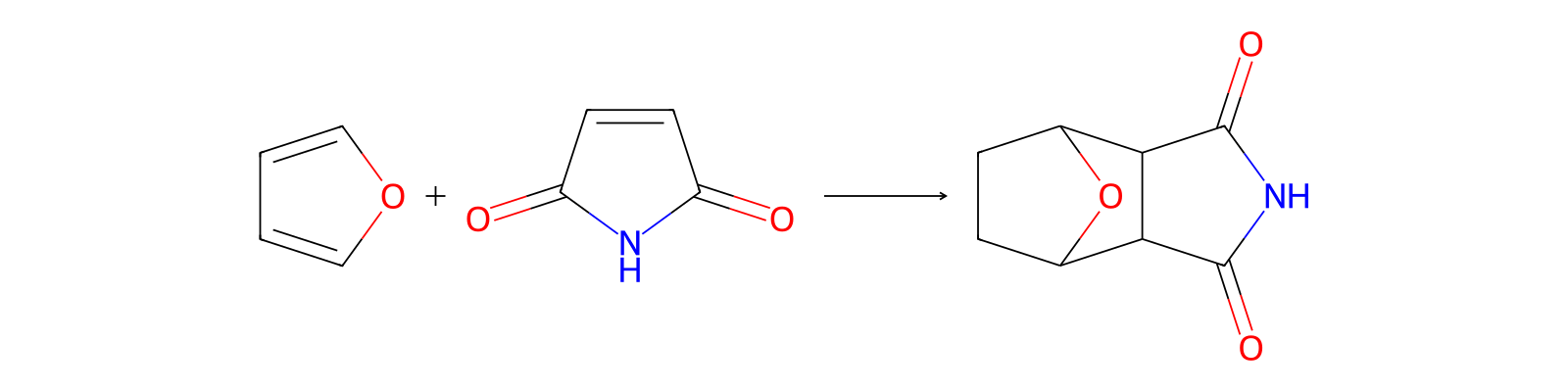
UsesReacts quantitatively with sulfhydryl groups.Maleimide is used to immobilize the bovine serum albumin-boronic acid conjugates in association with silica beads. Its nanoparticle surface favors the conjugation with cell penetration peptides. It is involved in Rhodium-catalyzed conjugate arylation with arylboronic acids. It is actively involved in Michael additions and Diels-Alder reactions by the addition across the double bond. It acts as crosslinking reagents in polymer chemistry.
UsesRhodium-catalyzed conjugate arylation with arylboronic acids.1
General DescriptionMaleimide (2,5-Pyrroledione) is a new nanoparticle surface functional group which favors easy conjugation with cell penetration peptides. The conjugation is enabled via click chemistry to preserve its biofunctions.
Upstream & downstream products
Upstream raw materials
Downstream products
Suppliers50 total
国药集团化学试剂有限公司86-21-63210123 · [email protected]
北京华美互利生物化工010-56205725 · [email protected]
梯希爱(上海)化成工业发展有限公司021-67121386 · [email protected]
上海阿拉丁生化科技股份有限公司400-6206333 13167063860 · [email protected]
青岛融合融化学科技有限公司15224422002
济南新坐标科技发展有限公司0531-88870058 13188878598
山东兴润达化工有限公司0534-18615348689 18615348689
上海亚兴生物医药科技有限公司021-58956006,021-58950017 15800617331 · [email protected]
科瑞迪化学400-821-5857 021-64326257 · [email protected]
上海超悦化学科技有限公司(原上海斯比德化学)21-65679720 · [email protected]
上海将来实业股份有限公司400-0066400 13621662912 · [email protected]
Syntechem Co.,Ltd[email protected]
上海迈瑞尔生化科技有限公司4006356688 18621169109 · [email protected]
阿法埃莎(中国)化学有限公司400-6106006 · [email protected]
安耐吉化学&3A(安徽泽升科技股份有限公司)400-0056266 · [email protected]
浦拉司科技(上海)有限责任公司21-58661250 18217085189 · [email protected]
上海瀚鸿科技股份有限公司021-54306202 13764082696 · [email protected]
上海柯维化学技术有限公司021-64609169 18901607656 · [email protected]
济南德信佳生物科技有限公司0531-82375886 13001715031 · [email protected]
上海相辉医药科技有限公司13761987713 · [email protected]
嘉兴市艾森化工有限公司0573-85285100 18627885956 · [email protected]
上海隆盛化工有限公司58099637 13585536065 · [email protected]
武汉丰泰威远科技有限公司027-87465837 19945049750 · [email protected]
北京上草生物科技有限公司51288246 13366708252 · [email protected]
山东西亚化学有限公司13355009207 13355009207 · [email protected]
青岛格力斯药业有限公司189-4623-7973 13375559818 · [email protected]
四川库利南科技有限公司400-1166-196 18981987031 · [email protected]
天津希恩思生化科技有限公司400 638 7771 · [email protected]
天津佶品佳化工科技有限公司18622448868 · [email protected]
河南多贝化工有限公司0370-2785118 17550508557 · [email protected]
斯百全化学(上海)有限公司021-021-021-67601398-809-809-809 15221380277 · [email protected]
艾科试剂4008-755-333 18080918076 · [email protected]
上海思域化工科技有限公司86-21-34053660 · [email protected]
赛默飞世尔科技(中国)有限公司800-810-5118 · [email protected]
北京伊诺凯科技有限公司400-810-7969 010-59572699 · [email protected]
上海健超生物科技有限公司150-2103-5486 18017383231 · [email protected]
TCI AMERICA800-4238616 · [email protected]
TOKYO CHEMICAL INDUSTRY CO., LTD.03-36680489 · [email protected]
TCI Europe320-37350700 · [email protected]
上海贤鼎生物科技有限公司4009209199 · [email protected]
越林试剂021-62960152 · [email protected]
上海将来实业股份有限公司400-0066400 13621662912 · [email protected]
上海将来实业股份有限公司021-61552785 · [email protected]
安徽科迪达化工有限公司0554-2106669 · [email protected]
HBCChem, Inc.+1-510-219-6317 · [email protected]
上海石洋化工有限公司021-56795766 · [email protected]
重庆星灿医药科技有限公司13594048950 19923294409 · [email protected]
成都零六生物科技有限公司400-1166-196 13458535857 · [email protected]
雷丁试剂0510-85629785 18013409632 · [email protected]
上海馨远医药科技有限公司021-24206007 13764915196 · [email protected]
Additional notes
DefinitionChEBI: A cyclic dicarboximide in which the two carboacyl groups on nitrogen together with the nitogen itself form a 1H-pyrrole-2,5-dione structure.
Related reactions
201 records


Linked notes
Loading…