HomeMCPWorkbenchSkills
HomeWorkbenchNotificationsMe
llms.txt · MCP GuidePrivacy Policy · Terms of Service · Supportv1.8.3
  1. Home
  2. /Compound

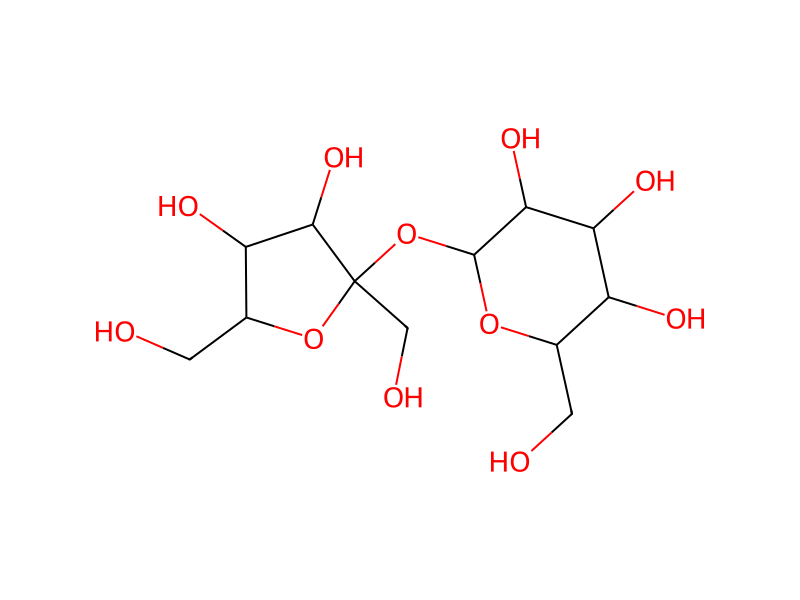
Hex-2-ulofuranosyl hexopyranoside

HCID 1115
New reaction
Print
Basic informationOverviewNames & identifiersPropertiesSafety & regulationChemistry & industryRelated reactionsCompound notes
Substructure searchFind similar structures

Basic information

CAS
57-50-1
Standard SMILES
OCC1OC(OC2(CO)OC(CO)C(O)C2O)C(O)C(O)C1O
InChIKey
CZMRCDWAGMRECN-UHFFFAOYSA-N
Molecular formula
C12H22O11
Average molar mass
342.3 g/mol
Monoisotopic mass
342.11621151

Overview

2-{[3,4-dihydroxy-2,5-bis(hydroxymethyl)oxolan-2-yl]oxy}-6-(hydroxymethyl)oxane-3,4,5-triol is a glycoside.

Names & identifiers

Preferred name
Hex-2-ulofuranosyl hexopyranoside
IUPAC
2-[3,4-dihydroxy-2,5-bis(hydroxymethyl)oxolan-2-yl]oxy-6-(hydroxymethyl)oxane-3,4,5-triol
English name
Sucrose
Molecular formula
C12H22O11
Molecular weight
342.3

Names & synonyms

Hex-2-ulofuranosyl hexopyranoside2-[3,4-dihydroxy-2,5-bis(hydroxymethyl)oxolan-2-yl]oxy-6-(hydroxymethyl)oxane-3,4,5-triol2-(3,4-dihydroxy-2,5-bis(hydroxymethyl)oxolan-2-yl)oxy-6-(hydroxymethyl)oxane-3,4,5-triolGlyTouCan:G70561XMRefChem:1048311CHEBI:87442G70561XMMFCD02067130SUCROSE, ULTRA PURE1192061-43-0.alpha.-D-Glucopyranoside, .beta.-D-fructofuranosylBETA-D-FRUCTOFURANOSYL-ALPHA-D-GALACTOPYRANOSIDE
Show more names
SUGARSACCHAROSECANE SUGARWhite sugarGranulated sugarb-D-Fructofuranosyl-a-D-glucopyranoside(2R,3R,4S,5S,6R)-2-(((2S,3S,4S,5R)-3,4-dihydroxy-2,5-bis(hydroxyMethyl)tetrahydrofuran-2-yl)oxy)-6-(hydroxyMethyl)tetrahydro-2H-pyran-3,4,5-triolSucrose BPD(+)-SACCHAROSESUCROSE STANDARD
3h-sucrosealpha-D-Glc-(1-->2)-beta-D-Fru13322-96-8D-(+)-Sucrose2-{[3,4-dihydroxy-2,5-bis(hydroxymethyl)oxolan-2-yl]oxy}-6-(hydroxymethyl)oxane-3,4,5-triolSUCROSE, ACSZuckerSucrose,ultrapure

Properties

Computed structural properties

XLogP
-3.7
Topological polar surface area
190 Ų
Hydrogen bond donors
8
Hydrogen bond acceptors
11
Rotatable bonds
5
Heavy atoms
23
Formal charge
0
Complexity
395

Experimental & physicochemical properties

Collision Cross Section172.1 Ų [M+Na-H2O]+ [CCS Type: DT; Method: stepped-field]

Physicochemical properties

Melting point
185 · 185-187 °C (lit.)
alpha
67 · 67 º (c=26, in water 25 ºC)
Boiling point
397.76 °C · 397.76°C (rough estimate)
bulk density
800 · 800-950kg/m3
Density
1.5805 · 1.5805
refractive index
66.5 ° · 66.5 ° (C=26, H2O)
Flash point
93.3 °C · 93.3°C
storage temp.
Inert atmosphere,Room Temperature
solubility
2 O: · H2O: 500 mg/mL
form
Liquid
pka
12.7 · 12.7(at 25℃)
color
White
PH

Safety & regulation

Safety information is for reference only and does not replace the supplier’s Safety Data Sheet (SDS), applicable regulations, or professional assessment.

Safety data

F
3
OEB
B
OEL
TWA: 10 mg/m3 (total)
wgk
2
tsca
TSCA listed
rtecs
WN6500000
hs_code
17019910
Toxicity
LD50 orally in Rabbit: 29700 mg/kg
risk_code
36/37/38
Signal word
Warning
Symbol(GHS)
GHS07
hazard_code
Xi
safety_code
24/25-37/39-26
Storage Class
11 - Combustible Solids
Hazard statements
H315-H319-H335
Precautionary statements
P261-P271-P280
Hazardous Substances Data
57-50-1(Hazardous Substances Data)

Chemistry & industry

Applications · 8 items

UsesSucrose (C12H22O11) is one of many forms of sugars (carbohydrates) that are important organic compounds for maintaining life.

HistorySucrose is the white granulated compound referred to as sugar. Sucrose is a disaccharide made of glucose and fructose. The main sources of sucrose for the production of commercial sugar are sugarcane and sugar beets. Sugarcane is a tall perennial grass of the genus Saccharum native to Southeast Asia and the South Pacifi c. It has been consumed by chewing the stalk in areas where it grows for thousands of years. Sugarcane spread to India where it was processed to extract crude sugar as early as 2,500 years ago. Persian invaders discovered sugar after invading India and the plant and sugar production spread into the Middle East around 600 c.e. Europeans were introduced to sugar around 1100 c.e. when the first crusaders returned with knowledge of the sweet spice and the Arab Empire spread into Spain.The use of sugar beet to obtain sugar began when the German chemist Andreas Sigismund Marggraf (1709 1782) extracted sucrose from sugar beets using alcohol. The amount of sucrose obtained by Marggraf did not warrant commercial use of beets as a sucrose source. During the late 18th century, Franz Karl Archard (1753 1821), a student of Marggraf, selectively bred beets to increase the sucrose content to 5 6% and developed a commercial method to extract sucrose. Sucrose is predominantly associated with the food industry, but it does have industrial uses in other areas. Sucrose fatty acid esters are a mixture of mono, di, and tri esters of sucrose with fatty acids. Th ese are use in cosmetics, shampoos, resins, inks, paper processing, and pesticides. Sucrose benzoate is used as an emulsifi er and in nail polishes. Sucrose has also been used in making glues and treating leather.

UsesSaccharum is the Latin word for sugar and the derived term saccharide is the basis of a system of carbohydrate classification. The simplest sugars belong to the carbohydrate class, monosaccharide; they include fructose and glucose. Hydrolysis of sucrose yields D-glucose and D-fructose; the process is called inversion and the sugar mixture produced is known as invert sugar because, although sucrose itself rotates plane-polarized light to the right, the mixture inverts this light by rotating to the left. The carbohydrate class, polysaccharide, represents compounds in which the molecules contain many units of monosaccharides joined together by glycoside links. Upon complete hydrolysis, a polysaccharide yields monosaccharides. Starch is the most valuable polysaccharide. The starch molecules (amylose and anylopectin) are tree-like, containing 250 to 1000 or more glucose units per molecule joined together through alpha linkages. In commercial usage, the term sugar usually refers to sucrose. Sucrose is a disaccharide sugar that occurs naturally in every fruit and vegetable. It is a major product of photosynthesis, the process by which plants transform the energy of the sun into food. Sugar occurs in greatest quantities in sugarcane and sugar beets from which it is separated for commercial use.

Related reactions

12 records
New reaction record
HRID 91439 reaction equation
HRID 91439As reactant
HRID 105893 reaction equation
HRID 105893As reactant
HRID 125645 reaction equation
HRID 125645As reactant
HRID 147260 reaction equation
HRID 147260As reactant
HRID 148158 reaction equation
HRID 148158As reactant
HRID 825463 reaction equation
HRID 825463As productAs reactant
HRID 832633 reaction equation
HRID 832633As reactant
HRID 1561382 reaction equation
HRID 1561382As productAs reactant
PreviousPage 1 of 2

Compound notes

On this pageBasic informationOverviewNames & identifiersPropertiesSafety & regulationChemistry & industryRelated reactionsCompound notes

Database identifiers

CAS
57-50-1
PubChem CID
1115
DTXSID
DTXSID301355853
ChEBI
CHEBI:193884
5 · 5.0-7.0 (25℃, 1M in H2O)
Odor
Odorless
PH Range
5.5 · 5.5 - 7 at 342 g/l at 25 °C
biological source
sugar cane
optical activity
25 · [α]25/D +66.3 to +66.8°(lit.)
Water Solubility
1970 g/L · 1970 g/L (15 ºC)
λmax
260 nm · λ: 260 nm Amax: 0.11λ: 280 nm Amax: 0.08
Merck
14 · 14,8881
BRN
90825 · 90825
Exposure limits
10 mg/m3OSHA:PEL-TWA · ACGIH:TLV-TWA 10 mg/m3OSHA:PEL-TWA 15 mg/m3 (total dust),5 mg/m3 (respirable fraction)NIOSH:REL-TWA 10 mg/m3 (total dust),5 mg/m3 (respirable fraction)
Dielectric constant
3.3 · 3.3(Ambient)
Stability
Stable. Combustible. Incompatible with strong oxidizing agents. Hydrolyzed by dilute acids and by invertase.
Cosmetics Ingredients Functions
HUMECTANTSKIN CONDITIONINGSOOTHING
InChI
1S/C12H22O11/c13-1-4-6(16)8(18)9(19)11(21-4)23-12(3-15)10(20)7(17)5(2-14)22-12/h4-11,13-20H,1-3H2/t4-,5-,6-,7-,8+,9-,10+,11-,12+/m1/s1
InChIKey
CZMRCDWAGMRECN-UGDNZRGBSA-N
SMILES
OC[C@H]1O[C@H](O[C@]2(CO)O[C@H](CO)[C@@H](O)[C@@H]2O)[C@H](O)[C@@H](O)[C@@H]1O
LogP
-4.492 · -4.492 (est)
CAS DataBase Reference
57 · 57-50-1(CAS DataBase Reference)
SCOGS (Select Committee on GRAS Substances)
Invert SugarSucrose
Substances Added to Food (formerly EAFUS)
SUCROSE
FDA 21 CFR
101.12 · 101.12; 117.5; 169.179;184.1854; 310.545
EWG's Food Scores
1 · 1
FDA UNII
151 H8M554 · C151H8M554
NIST Chemistry Reference
Sucrose(57-50-1)
EPA Substance Registry System
Sucrose (57-50-1)
Absorption
0.1 at · ≤0.100 at 280nm≤0.120 at 260nm
UNSPSC Code
41116107 · 41116107
NACRES
79 · NA.79
Symbol(GHS)
7 · GHS07
Signal word
Warning
Hazard statements
315 · H315-H319-H335
Precautionary statements
261 · P261-P271-P280
Hazard Codes
Xi
Risk Statements
36 · 36/37/38
Safety Statements
24 · 24/25-37/39-26
OEB
B
OEL
10 mg/m3 · TWA: 10 mg/m3 (total)
WGK Germany
2 · 2
RTECS
6500000 · WN6500000
F
3 · 3
TSCA
TSCA listed
HS Code
17019910 · 17019910
Storage Class
11 · 11 - Combustible Solids
Hazardous Substances Data
57 · 57-50-1(Hazardous Substances Data)
Toxicity
50 orally · LD50 orally in Rabbit: 29700 mg/kg

UsesYuanzhen sugar is a polysaccharide polymer, containing a certain amount of fructooligosaccharides.

UsesSweetening agent and food. Starting material in the fermentative production of ethanol, butanol, glycerol, citric and levulinic acids. Used in pharmaceuticals as a flavor, as a preservative, as an antioxidant (in the form of invert sugar), as a demulcent, as substitute for glycerol, as granulation agent and excipient for tablets, as coating for tablets. In the plastics and cellulose industry, in rigid polyurethane foams, manufacture of ink and of transparent soaps.

Usessucrose (table sugar) is an emollient, mild emulsifier, and humectant. It can be used in place of glycerin.

UsesSucrose is a sweetener that is the disaccharide sucrose, consisting of one molecule of glucose and one molecule of fructose. It is obtained as cane or beet sugar. It has relatively constant solubility and is a universal sweetener because of its intense sweetness and solubility. It is available in various forms which include granulated, brown, and powdered. It is used in desserts, beverages, cakes, ice cream, icings, cereals, and baked goods. It is also termed beet sugar, cane sugar, and saccharose.

General DescriptionWhite odorless crystalline or powdery solid. Denser than water.

Upstream & downstream products

Downstream products

D-SorbitolInvertoseGibberellic acidFerrous lactatePalatinoseTanning agent,chromicPepsinsucrose polyoxypropylenePectinChlorophyll bXanthan gumMicrocrystalline cellulosecis-Aconitic acidXylitolDEXTRANASESucrose acetate isobutyrateBROWNSUGARhericium erinaceus extractChlorophyll AChlorophyllFumaric acidinsecticidal bacteria ``qingchongjun``PectinaseD(-)-FructoseL-Lysine hydrochlorideChromium sulfate,basic,solidCARAMEL6-O-alpha-D-Glucopyranosyl-D-glucitolFluorescein diphosphate, tetraammonium saltINVERTASED-Mannitolthyroid powderLactic acidPyridoxine18β-Glycyrrhetinic AcidDextranBacitracinCHROMIUM(III) NITRATE NONAHYDRATESucraloseYeast extract
Additional notes · 2 items

DefinitionChEBI: Sucrose is a disaccharide formed by glucose and fructose units joined by an acetal oxygen bridge from hemiacetal of glucose to the hemiketal of the fructose.

Definitionsaccharose: A sugar comprising onemolecule of glucose linked to a fructosemolecule. It occurs widely inplants and is particularly abundant insugar cane and sugar beet (15–20%),from which it is extracted andrefied for table sugar. If heated to200°C, sucrose becomes caramel.