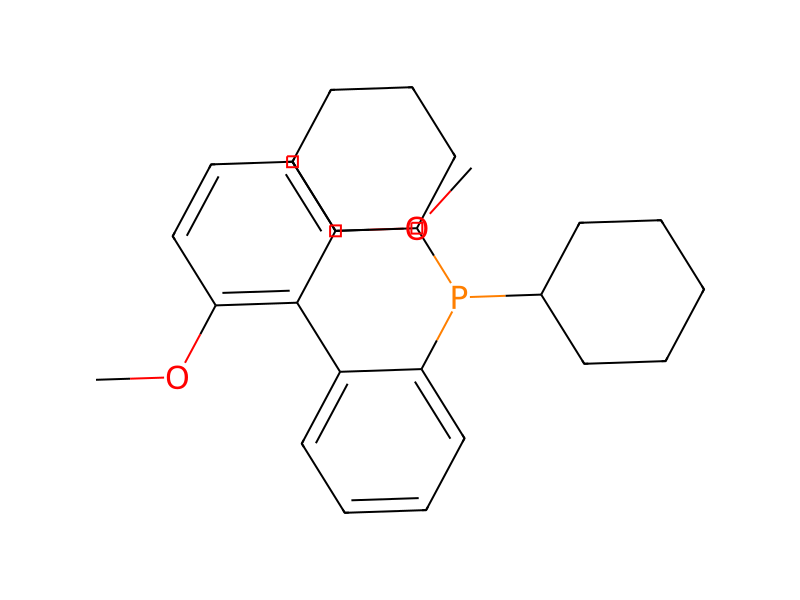
Basic information
- Standard SMILES
COc1cccc(OC)c1-c1ccccc1P(C1CCCCC1)C1CCCCC1- InChIKey
VNFWTIYUKDMAOP-UHFFFAOYSA-N- Molecular formula
- C26H35O2P
- Average molar mass
- 410.5 g/mol
- Monoisotopic mass
- 410.23746699
Names & identifiers
- Preferred name
- 2-Dicyclohexylphosphino-2',6'-dimethoxybiphenyl
- IUPAC
- dicyclohexyl-[2-(2,6-dimethoxyphenyl)phenyl]phosphane
- English name
- 2-Dicyclohexylphosphino-2',6'-dimethoxybiphenyl
- Molecular formula
- C26H35O2P
- Molecular weight
- 410.53
Names & synonyms
657408-07-62-Dicyclohexylphosphino-2',6'-dimethoxybiphenylSphos phosphine ligand [MI]XI1MQ32186UNII-XI1MQ32186Buchwald phosphine ligands, sphos phosphine ligand-DTXSID90460730Phosphine, dicyclohexyl(2',6'-dimethoxy(1,1'-biphenyl)-2-yl)-Phosphine, dicyclohexyl(2',6'-dimethoxy[1,1'-biphenyl]-2-yl)-RefChem:86777SPHOS PHOSPHINE LIGANDDTXCID30411549
Show more names
dicyclohexyl(2',6'-dimethoxy-[1,1'-biphenyl]-2-yl)phosphane98% SPhos2-Dicyclohexylphosphino-2',6'-dimethoxybipheny6´NS-PHOSSPhos 97%SPhos, >=98%SPhos ChemBeads
613-838-2SPhosS-PhosDicyclohexyl(2',6'-dimethoxy-[1,1'-biphenyl]-2-yl)phosphineDicyclohexyl-[2-(2,6-dimethoxyphenyl)phenyl]phosphaneMFCD058616112-Dicyclohexylphosphino-2',6'-dimethoxy-1,1'-biphenyl(1S)-Dicyclohexyl(2',6'-dimethoxy-[1,1'-biphenyl]-2-yl)phosphine
Database identifiers
- CAS
657408-07-6- PubChem CID
- 11269872
- DTXSID
DTXSID90460730- UNII
- XI1MQ32186
- EC Number
- 613-838-2
- Nikkaji
- J2.040.271G、J2.593.256K、J3.715.842I
Properties
Computed structural properties
- XLogP
- 6.7
- Topological polar surface area
- 18.5 Ų
- Hydrogen bond donors
- 0
- Hydrogen bond acceptors
- 2
- Rotatable bonds
- 6
- Heavy atoms
- 29
- Formal charge
- 0
- Complexity
- 441
Physicochemical properties
- Melting point
- 164 · 164-166°C
- Boiling point
- 513.3 · 513.3±40.0 °C(Predicted)
- storage temp.
- Inert atmosphere,Room Temperature
- solubility
- soluble in Chloroform
- form
- crystal
- color
- white
- Sensitive
- Air Sensitive
- InChI
- InChI=1S/C26H35O2P/c1-27-23-17-11-18-24(28-2)26(23)22-16-9-10-19-25(22)29(20-12-5-3-6-13-20)21-14-7-4-8-15-21/h9-11,16-21H,3-8,12-15H2,1-2H3
- InChIKey
- VNFWTIYUKDMAOP-UHFFFAOYSA-N
- SMILES
- P(C1CCCCC1)(C1CCCCC1)C1=CC=CC=C1C1=C(OC)C=CC=C1OC
- FDA UNII
- 1 MQ32186 · XI1MQ32186
- UNSPSC Code
- 12352200 · 12352200
- NACRES
- 22 · NA.22
- Symbol(GHS)
- 8 · GHS08
- Signal word
- Warning
- Hazard statements
- 351 · H351
- Precautionary statements
- 280 · P280
- Hazard Codes
- Xn
- Risk Statements
- 40 · 40
- Safety Statements
- 24 · 24/25-36/37
- WGK Germany
- 3 · 3
- TSCA
- No
- HS Code
- 2931499090 · 2931499090
- Storage Class
- 11 · 11 - Combustible Solids
Safety & regulation
GHS classification
GHS Classification
This chemical does not meet GHS hazard criteria for 7.1% (1 of 14) of reports.
Warning
H302 (50%): Harmful if swallowed [Warning Acute toxicity, oral]
P261, P264, P264+P265, P270, P271, P272, P280, P301+P317, P302+P352, P304+P340, P305+P351+P338, P317, P319, P321, P330, P332+P317, P333+P317, P337+P317, P362+P364, P403+P233, P405, and P501 (click each P-code to see the statement)
Aggregated GHS information provided per 14 reports by companies from 10 notifications to the ECHA C&L Inventory. Each notification may be associated with multiple companies.
Hazard information
Hazard Classes and CategoriesAcute Tox. 4 (50%)
Safety data
- wgk
- 3
- tsca
- No
- hs_code
- 2931499090
- risk_code
- 40
- Signal word
- Warning
- Symbol(GHS)
- GHS08
- hazard_code
- Xn
- safety_code
- 24/25-36/37
- Storage Class
- 11 - Combustible Solids
- Hazard statements
- H351
- Precautionary statements
- P280
Chemistry & industry
Applications
UsesSPhos [2-Dicyclohexylphosphino-2′,6′-dimethoxybiphenyl] is an air-stable, electron-rich biaryl phosphine ligand developed by the Buchwald group to enhance the reactivity of palladium catalysis during cross-coupling reactions. SPhos may be used as a ligand in the following processes: • Palladium catalyzed Suzuki-Miyaura cross-coupling reaction between Boc-protected aminomethyltrifluoroborate and aryl chlorides or hetaryl chlorides to form the corresponding aminomethylarenes.• Palladium catalyzed Suzuki-Miyaura cross-coupling reaction between 4-methyl-substituted piperidinylzinc reagent and different aryl or heteroaryl iodides to form various substituted piperidines.• Intramolecular Suzuki-Miyaura coupling to form the 18-membered macrocyclic ring during the multi-step synthesis of riccardin C. Utilized in conjunction with palladium to form a highly active catalyst for C-N bond formation. Highly universal ligand for Suzuki-Miyaura coupling; aryl chlorides, hindered biaryls, heterobiaryls.
UsesS-Phos is a catalyst that is used in the preparation of thiadiazoles as DGAT1 inhibitors with potential in metabolic diseases treatment.
Usessuzuki reaction
General DescriptionSPhos [2-Dicyclohexylphosphino-2′, 6′-dimethoxybiphenyl] is an air-stable, electron-rich biaryl phosphine ligand developed by the Buchwald group to enhance the reactivity of palladium catalysis during cross-coupling reactions.
Upstream & downstream products
Upstream raw materials
Downstream products
Suppliers50 total
梯希爱(上海)化成工业发展有限公司021-67121386 · [email protected]
衢州润东化工有限公司0570-8789886 18892685668 · [email protected]
上海阿拉丁生化科技股份有限公司400-6206333 13167063860 · [email protected]
山东雨禾医药科技有限公司15263077727
INTATRADE GmbH+49 3493/605464 · [email protected]
T&W GROUP021-61551611 13296011611 · [email protected]
韶远科技(上海)有限公司021-50795510 4000665055 · [email protected]
科瑞迪化学400-821-5857 021-64326257 · [email protected]
上海将来实业股份有限公司400-0066400 13621662912 · [email protected]
上海迈瑞尔生化科技有限公司4006356688 18621169109 · [email protected]
宇瑞(上海)化学有限公司02150456736 18602143071 · [email protected]
宁波亿诺化学品有限公司86-574-27787657 · [email protected]
阿法埃莎(中国)化学有限公司400-6106006 · [email protected]
上海德默医药科技有限公司400-021-7337 2355568890 · [email protected]
安耐吉化学&3A(安徽泽升科技股份有限公司)400-0056266 · [email protected]
上海柏卡化学技术有限公司400-026-1533/(021) 6478-0600 · [email protected]
上海瀚鸿科技股份有限公司021-54306202 13764082696 · [email protected]
上海相辉医药科技有限公司13761987713 · [email protected]
江苏欣诺科催化剂股份有限公司0512-67216630 67216634 · [email protected]
上海景颜化工科技有限公司13817811078 · [email protected]
嘉兴市艾森化工有限公司0573-85285100 18627885956 · [email protected]
维赛诺化学技术(北京)有限公司13811761079 · [email protected]
上海隆盛化工有限公司58099637 13585536065 · [email protected]
陕西瑞科新材料股份有限公司0917-8888777 18691786767
武汉丰泰威远科技有限公司027-87465837 19945049750 · [email protected]
上海忆嵘生物科技有限公司18049974220 · [email protected]
石家庄科诺达科技有限公司0311-85461665 13784393231 · [email protected]
杭州东帆化学有限公司86-0571-85151182
唐山默内德贸易有限公司0315-8309571 15633399667 · [email protected]
天津希恩思生化科技有限公司400 638 7771 · [email protected]
湖南汇百侍生物科技有限公司0731-85526065 13308475853 · [email protected]
南京辛西亚生物科技有限公司0550-5618439 15951861180 · [email protected]
武汉杂环科技有限公司027-88041443 13072715837 · [email protected]
武汉泰宇凯尚科技有限公司027-027-87680032 18963957250 · [email protected]
艾科试剂4008-755-333 18080918076 · [email protected]
上海先诺生物科技有限公司021-50718719 13918719472
苏州思变化学技术有限公司0512-65617459 18915409046 · [email protected]
赛默飞世尔科技(中国)有限公司800-810-5118 · [email protected]
天津尚德药缘科技有限公司13132578992 · [email protected]
上海遐瑞医药科技有限公司+86 21 61551611
南京诺利斯医药科技有限公司13901585132 · [email protected]
上海健超生物科技有限公司150-2103-5486 18017383231 · [email protected]
上海茵凯化学科技有限公司021-57603038 13601791340;13818007232 · [email protected]
TCI AMERICA800-4238616 · [email protected]
TOKYO CHEMICAL INDUSTRY CO., LTD.03-36680489 · [email protected]
TCI Europe320-37350700 · [email protected]
深圳康特腾科技有限公司86-0755-86635001 · [email protected]
越林试剂021-62960152 · [email protected]
南京拉瑞创新科技有限公司025-83726959 15851816062
北京格林凯默科技有限公司131-21959385 18804271668 · [email protected]
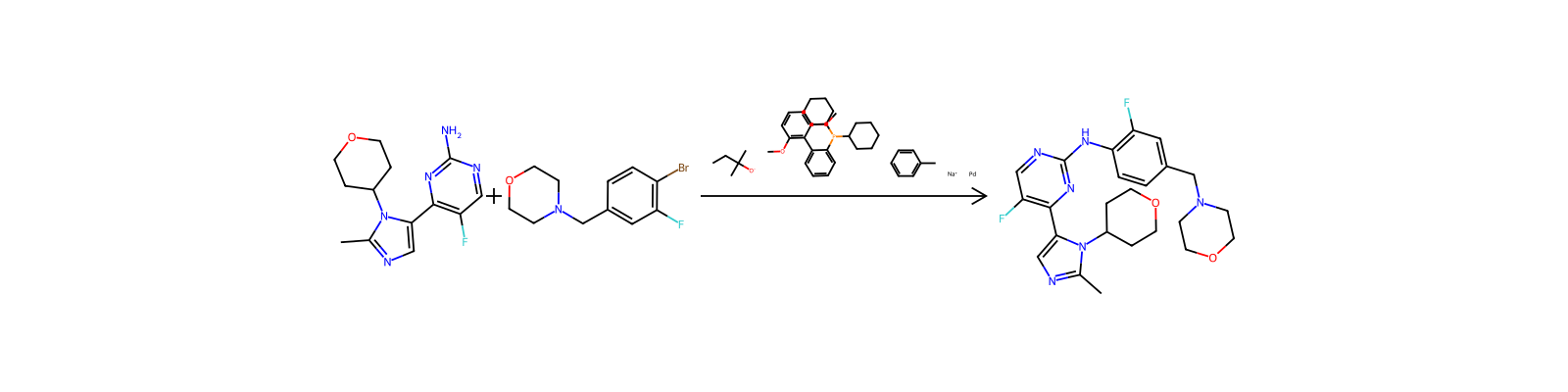
Related reactions
2,475 records







Linked notes
Loading…