
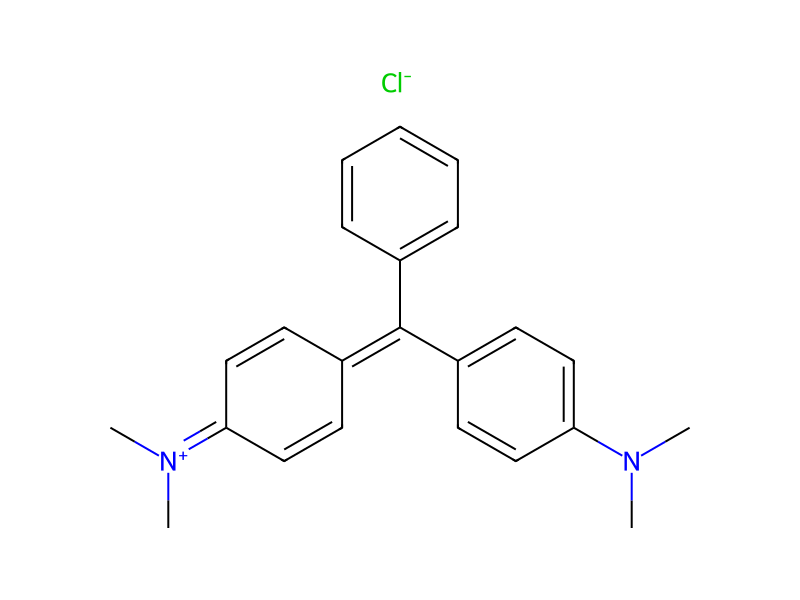
Basic information
- Standard SMILES
CN(C)c1ccc(C(=C2C=CC(=[N+](C)C)C=C2)c2ccccc2)cc1.[Cl-]- InChIKey
FDZZZRQASAIRJF-UHFFFAOYSA-M- Molecular formula
- C23H25ClN2
- Average molar mass
- 364.9 g/mol
- Monoisotopic mass
- 364.1706265
Names & identifiers
- Preferred name
- Malachite Green
- IUPAC
- [4-[[4-(dimethylamino)phenyl]-phenylmethylidene]cyclohexa-2,5-dien-1-ylidene]-dimethylazanium chloride
- English name
- Malachite Green
- Molecular formula
- C23H25N2.Cl
- Molecular weight
- 364.91
Names & synonyms
MALACHITE GREEN569-64-2Basic Green 4Malachite green chlorideAniline GreenChina GreenVictoria Green BGrenoble GreenDiamond Green BBenzaldehyde GreenVictoria GreenBenzal Green
Show more names
FAST GREENdichromiumMALACHITE GREEN HYDROCHLORIDEMALACHITE GREEN CARBINOL HYDROCHLORIDELc 6220Aizen MS NO 754CI 10000
Burma Green BDiamond Green BxLight Green NSolid Green OVictoria Green SFast Green OGreen MXCalcozine Green V
Database identifiers
- CAS
10309-95-2、13425-25-7、569-64-2- PubChem CID
- 11294
- DTXSID
DTXSID1025512- ChEMBL
CHEMBL186357- ChEBI
CHEBI:72449- UNII
- 12058M7ORO
- EC Number
- 209-322-8、603-805-0
Properties
Computed structural properties
- Topological polar surface area
- 6.3 Ų
- Hydrogen bond donors
- 0
- Hydrogen bond acceptors
- 2
- Rotatable bonds
- 3
- Heavy atoms
- 26
- Formal charge
- 0
- Complexity
- 516
Experimental & physicochemical properties
pH1% sol in water has a pH of 1.4
LogPlog Kow = 0.62
Color/FormGreen crystals with metallic luster
Solubility
Sol in alcohol, methanol, amyl alcohol
Sol 1 /part/ in 15 /parts/ of water and 1 /part/ in 15 /parts/ of alcohol.
Very soluble in ethanol
In water, 4.0X10+4 mg/L at 25 °C
DecompositionWhen heated to decomposition it emits very toxic fumes of /nitrogen oxide and hydrogen chloride/.
Vapor Pressure2.4X10-13 mm Hg at 25 °C /Estimated/
Physical Description
C.i. basic green 4 appears as green crystals with metallic luster. Water solutions are blue-green. Used in dyeing silk, wool, biological staining, etc.
Wet Solid; Liquid
Green metallic solid; [HSDB]
Ionization Efficiency
Positive
4.27
2.7
Agilent XCT
Electrospray ionization
formic acid (5.3nM)
Other Experimental PropertiesWater soln are blue-green; yellow below pH 2; as acid-base indicator; ph: 0.0 yellow; 2.0 green; 11.6 blue-green; 14 colorless.
Physicochemical properties
- Melting point
- 158 · 158-160°C
- Boiling point
- 520.91 °C · 520.91°C (rough estimate)
- Density
- 1.0448 · 1.0448 (rough estimate)
- refractive index
- 1.594 · 1.5940 (estimate)
- storage temp.
- Refrigerator
- solubility
- Very soluble in water; soluble in ethanol, methanol, amyl alcohol
- form
- Solid
- pka
- 6.9 · 6.90(at 25℃)
- Colour Index
- 42000 · 42000
- color
- Brown
- PH Range
- 0 · 0(green)-2(green-blue)
- λmax
- 615 nm, · 615nm, 425nm
- BRN
- 3580148 · 3580148
- Henry's Law Constant
- 5.2 · 5.2×108 mol/(m3Pa) at 25℃, HSDB (2015)
- Stability
- Stable. Substances to be avoided include strong oxidizing agents.
- Biological Applications
- Antiseptic formulation; detecting nucleic acids; early diagnosis of tuberculosis; identifying mammal genes; treating cancers,fungal diseases,pulmonary tuberculosis; medical device
- Major Application
- Photoresists, color filter, printed circuit board, sol-gel matrix, liquid crystal displays, decoder system, inks, highlighters, herbicides, disinfectants, cosmetics, identifying mammal genes, detecting nucleic acids, mycobacterial growth, radiochemotherapy, wound dressing materials, antitumor agents, treatment of patients with pulmonary tuberculosis Malachite Green
- Cosmetics Ingredients Functions
- HAIR DYEING
- InChI
- 1S/C23H25N2.ClH/c1-24(2)21-14-10-19(11-15-21)23(18-8-6-5-7-9-18)20-12-16-22(17-13-20)25(3)4;/h5-17H,1-4H3;1H/q+1;/p-1
- InChIKey
- FDZZZRQASAIRJF-UHFFFAOYSA-M
- SMILES
- [Cl-].CN(C)c1ccc(cc1)C(\c2ccccc2)=C3\C=CC(\C=C3)=[N+](\C)C
- LogP
- 0.62 · 0.620
- Toxicology and Carcinogenesis
- Toxicology and Carcinogenesis Studies of Malachite Green Chloride and Leucomalachite Green (CASRNs 569-64-2 and 129-73-7) in F344/N Rats and B6C3F1 Mice (Feed Studies)
- CAS DataBase Reference
- 569 · 569-64-2
- FDA UNII
- 12058 M7ORO · 12058M7ORO
- EPA Substance Registry System
- Malachite green (569-64-2)
- UNSPSC Code
- 85151701 · 85151701
- NACRES
- 24 · NA.24
- Symbol(GHS)
- 5 · GHS05,GHS07,GHS08,GHS09
- Signal word
- Danger
- Hazard statements
- 302 · H302-H318-H361d-H410
- Precautionary statements
- 201 · P201-P273-P280-P301+P312-P305+P351+P338-P308+P313
- PPE
- 95 · dust mask type N95 (US), Eyeshields, Faceshields, Gloves
- Hazard Codes
- Xn,N
- Risk Statements
- 22 · 22-41-50/53-63
- Safety Statements
- 26 · 26-36/37/39-46-60-61-39-36/37
- RIDADR
- 2811 · UN 2811 6.1/PG 3
- WGK Germany
- 3 · 3
- RTECS
- 1190000 · BQ1190000
- TSCA
- TSCA listed
- HazardClass
- 9 · 9
- PackingGroup
- III
- HS Code
- 29215900 · 29215900
- Storage Class
- 11 · 11 - Combustible Solids
- Hazard Classifications
- 4 OralAquatic · Acute Tox. 4 OralAquatic Acute 1Aquatic Chronic 1Eye Dam. 1Repr. 2
- Hazardous Substances Data
- 569 · 569-64-2(Hazardous Substances Data)
- Toxicity
- 50 oral · LD50 oral in mouse: 80mg/kg
Safety & regulation
GHS classification
GHS Classification
Danger
H302: Harmful if swallowed [Warning Acute toxicity, oral];H318: Causes serious eye damage [Danger Serious eye damage/eye irritation];H361d ***: Suspected of damaging the unborn child [Warning Reproductive toxicity];H400: Very toxic to aquatic life [Warning Hazardous to the aquatic environment, acute hazard];H410: Very toxic to aquatic life with long lasting effects [Warning Hazardous to the aquatic environment, long-term hazard]
P203, P264, P264+P265, P270, P273, P280, P301+P317, P305+P354+P338, P317, P318, P330, P391, P405, and P501 (click each P-code to see the statement)
Danger
Hazard information
Regulatory Information
Chemical: Methanaminium, N-[4-[[4-(dimethylamino)phenyl]phenylmethylene]-2,5-cyclohexadien-1-ylidene]-N-methyl-, chloride
Commission Regulation (EC) No 470/2009
Methanaminium, N-[4-[[4-(dimethylamino)phenyl]phenylmethylene]-2,5-cyclohexadien-1-ylidene]-N-methyl-, chloride (1:1) is listed on the EPA's Chemical Data Reporting (CDR) system. Manufacturers and importers of Methanaminium, N-[4-[[4-(dimethylamino)phenyl]phenylmethylene]-2,5-cyclohexadien-1-ylidene]-N-methyl-, chloride (1:1) are required to report information about their production and use of this chemical to the EPA under the Toxic Substances Control Act (TSCA). (40 eCFR Part 711)
Malachite green: Does not have an individual approval but may be used under an appropriate group standard
Other Safety InformationIMAP assessments - Malachite green and related chemicals: Human health tier II assessment
DOT LabelPoison
Fire Hazards
Excerpt from ERG Guide 154 [Substances - Toxic and/or Corrosive (Non-Combustible)]:;Non-combustible, substance itself does not burn but may decompose upon heating to produce corrosive and/or toxic fumes. Some are oxidizers and may ignite combustibles (wood, paper, oil, clothing, etc.). Corrosives in contact with metals may evolve flammable hydrogen gas. Containers may explode when heated. For electric vehicles or equipment, ERG Guide 147 (lithium ion or sodium ion batteries) or ERG Guide 138 (sodium batteries) should also be consulted. (ERG, 2024)
Health Hazards
Excerpt from ERG Guide 154 [Substances - Toxic and/or Corrosive (Non-Combustible)]:;TOXIC and/or CORROSIVE; inhalation, ingestion or skin contact with material may cause severe injury or death. Contact with molten substance may cause severe burns to skin and eyes. Avoid any skin contact. Fire may produce irritating, corrosive and/or toxic gases. Runoff from fire control or dilution water may be corrosive and/or toxic and cause environmental contamination. (ERG, 2024)
Hazards SummaryToxic by ingestion; [Hawley] Severe eye irritant; [ESIS] Toxic by ingestion; May damage eyes; Wear gloves and eye protection; Do not breathe dust; [MSDSonline]
Reactive GroupAmines, Phosphines, and Pyridines;Hydrocarbons, Aromatic;Hydrocarbons, Aliphatic Unsaturated;Conjugated Dienes;Quaternary Ammonium and Phosphonium Salts
FIFRA Requirements
Product registrations which once contained active ingredients /incl malachite green/ have previously been amended to remove the ingredient from the formula or have been cancelled for other reasons. ... These ingredients will be removed from Reregistration List D effective 90 days after publication of this notice ... and will not be considered further for reregistration.
As the federal pesticide law FIFRA directs, EPA is conducting a comprehensive review of older pesticides to consider their health and environmental effects and make decisions about their future use. Under this pesticide reregistration program, EPA examines health and safety data for pesticide active ingredients initially registered before November 1, 1984, and determines whether they are eligible for reregistration. In addition, all pesticides must meet the new safety standard of the Food Quality Protection Act of 1996. Pesticides for which EPA had not issued Registration Standards prior to the effective date of FIFRA '88 were divided into three lists based upon their potential for human exposure and other factors, with List B containing pesticides of greater concern and List D pesticides of less concern. Malachite green is found on List D. Case No: 4011; Case Status: No products containing the pesticide are actively registered. Therefore, we are characterizing the case as "cancelled." Under FIFRA, pesticide producers may voluntarily cancel their registered products. EPA also may cancel pesticide registrations if registrants fail to pay required fees or make/meet certain reregistration commitments, or if EPA reaches findings of unreasonable adverse effects.; Active ingredient (AI): malachite green; AI Status: The active ingredient is no longer contained in any registered products ... "cancelled."
Reactivity Profile
C.I. BASIC GREEN 4 neutralizes acids in exothermic reactions to form salts plus water. May be incompatible with isocyanates, halogenated organics, peroxides, phenols (acidic), epoxides, anhydrides, and acid halides. Flammable gaseous hydrogen may be generated in combination with strong reducing agents, such as hydrides.
Air and Water ReactionsVery soluble in water.
Hazard Classes and Categories
Acute Tox. 4 (100%);Eye Dam. 1 (100%)
Acute Tox. 3 (21.4%);Acute Tox. 4 (78.6%);Eye Dam. 1 (100%);Repr. 2 (99.5%);Aquatic Acute 1 (98.6%);Aquatic Chronic 1 (100%)
Germ cell mutagenicity - category 2;Eye damage - category 1;Reproductive toxicity - category 2;Hazardous to the aquatic environment (acute) - category 1;Hazardous to the aquatic environment (chronic) - category 1;Acute toxicity - category 4
Acute toxicity (Oral) - Category 3;Serious eye damage/eye irritation - Category 1;Specific target organ toxicity - Repeated exposure - Category 2 (blood);Hazardous to the aquatic environment (Acute) - Category 1;Hazardous to the aquatic environment (Long-term) - Category 1
Acute toxicity (Oral) - Category 3;Serious eye damage/eye irritation - Category 1;Germ cell mutagenicity - Category 1B;Carcinogenicity - Category 2;Specific target organ toxicity - Repeated exposure - Category 1 (thyroid), Category 2 (haemal system, liver);Hazardous to the aquatic environment (Acute) - Category 1;Hazardous to the aquatic environment (Long-term) - Category 1
Repr. 2;Acute Tox. 4 *;Eye Dam. 1;Aquatic Acute 1;Aquatic Chronic 1
Safety & protection
Fire Fighting
Excerpt from ERG Guide 154 [Substances - Toxic and/or Corrosive (Non-Combustible)]:;SMALL FIRE: Dry chemical, CO2 or water spray.;LARGE FIRE: Dry chemical, CO2, alcohol-resistant foam or water spray. If it can be done safely, move undamaged containers away from the area around the fire. Dike runoff from fire control for later disposal.;FIRE INVOLVING TANKS, RAIL TANK CARS OR HIGHWAY TANKS: Fight fire from maximum distance or use unmanned master stream devices or monitor nozzles. Do not get water inside containers. Cool containers with flooding quantities of water until well after fire is out. Withdraw immediately in case of rising sound from venting safety devices or discoloration of tank. ALWAYS stay away from tanks in direct contact with flames. (ERG, 2024)
First Aid
Excerpt from ERG Guide 154 [Substances - Toxic and/or Corrosive (Non-Combustible)]:;Refer to the "General First Aid" section. Specific First Aid: For corrosives, in case of contact, immediately flush skin or eyes with running water for at least 30 minutes. Additional flushing may be required. (ERG, 2024)
Cleanup Methods
Malachite green had 0% biodegradation after 5 days using a sewage inoculum and the BOD5 test(1). However, ready biodegradability tests, i.e. static flask screening test, Warburg respirometer, and a semicontinuous flow activated sludge system, using acclimated wastewater from a malachite green-producing workshop resulted in a removal rate of greater than 70%, indicating ready biodegradability(2). A Mycobacterium sp has been shown to decolorize a 20 mg/ml solution of malachite green 53% in 2 hrs at 24 °C; the solution was completed decolorized in 22 hrs when incubated at 32 °C(4). The pH remained at 6.8 and the number of cells did not increase(3).
Coagulation with ferrous sulfate, ferric sulfate, and ferric chloride and treatment with ozone were tested for CI Basic Green 4 in wastewater. Effect of coagulation depended largely on pH of solution.
Nonfire Spill Response
Excerpt from ERG Guide 154 [Substances - Toxic and/or Corrosive (Non-Combustible)]:;ELIMINATE all ignition sources (no smoking, flares, sparks or flames) from immediate area. Do not touch damaged containers or spilled material unless wearing appropriate protective clothing. Stop leak if you can do it without risk. Prevent entry into waterways, sewers, basements or confined areas. Absorb or cover with dry earth, sand or other non-combustible material and transfer to containers. DO NOT GET WATER INSIDE CONTAINERS. (ERG, 2024)
Disposal Methods
SRP: The most favorable course of action is to use an alternative chemical product with less inherent propensity for occupational exposure or environmental contamination. Recycle any unused portion of the material for its approved use or return it to the manufacturer or supplier. Ultimate disposal of the chemical must consider: the material's impact on air quality; potential migration in soil or water; effects on animal, aquatic, and plant life; and conformance with environmental and public health regulations.
A study was designed to (1) determine the type of filter and kind of carbon that was most efficient for removal of malachite green and (2) demonstrate that carbon filters can be used to remove malachite green from water used for egg incubation or to hold adult salmon before spawning. Minicolumn simulation studies showed that removing malachite green from water for 230 days at a flow rate of 500 gal/min for only 62 days at a flow rate of 1,000 gal/min. The removal capacity at the slower flow rate was 1.1 oz of malachite green per pound of carbon. A filter system that contained 20,000 lb of activated carbon in each of two chambers was effective for removal of malachite green from treated water in adult salmon holding ponds at flows of 500 gal/min (6.4 gal/min per sq ft) and greater. The removal efficiency was 99.8% after 105 hr of operation, and the adsorption capacity of the system was projected to be sufficient for 20 or more years of routine hatchery operation. A filter system that contained 2,000 lb of activated carbon in each of two chambers was effective for removal of malachite green from treated water in salmon egg incubation units at the designated flow rate of 50 gal/min (4.0 gal/min per sq ft) and also at faster flow rates. Removal efficiency decreased only slightly for faster flows in both filter systems, and the efficiency improved when treated water was passed through two filter chambers in series.
Preventive Measures
SRP: The scientific literature for the use of contact lenses in industry is conflicting. The benefit or detrimental effects of wearing contact lenses depend not only upon the substance, but also on factors including the form of the substance, characteristics and duration of the exposure, the uses of other eye protection equipment, and the hygiene of the lenses. However, there may be individual substances whose irritating or corrosive properties are such that the wearing of contact lenses would be harmful to the eye. In those specific cases, contact lenses should not be worn. In any event, the usual eye protection equipment should be worn even when contact lenses are in place.
Isolation and Evacuation
Excerpt from ERG Guide 154 [Substances - Toxic and/or Corrosive (Non-Combustible)]:;IMMEDIATE PRECAUTIONARY MEASURE: Isolate spill or leak area in all directions for at least 50 meters (150 feet) for liquids and at least 25 meters (75 feet) for solids.;SPILL: Increase the immediate precautionary measure distance, in the downwind direction, as necessary.;FIRE: If tank, rail tank car or highway tank is involved in a fire, ISOLATE for 800 meters (1/2 mile) in all directions; also, consider initial evacuation for 800 meters (1/2 mile) in all directions. (ERG, 2024)
Protective Action Criteria (PAC)
0.13 [mg/m3]
1.4 [mg/m3]
8.7 [mg/m3]
Personal Protective Equipment (PPE)
Excerpt from ERG Guide 154 [Substances - Toxic and/or Corrosive (Non-Combustible)]:;Wear positive pressure self-contained breathing apparatus (SCBA). Wear chemical protective clothing that is specifically recommended by the manufacturer when there is NO RISK OF FIRE. Structural firefighters' protective clothing provides thermal protection but only limited chemical protection. (ERG, 2024)
Toxicology
Ecotoxicity Values
LC50 Lepomis macrochirus (Bluegill) 0.0305 mg/L/96 hr. /Conditions of bioassay not specified in source examined/
LC50 Salmon 0.338 mg/L/96 hr. /Conditions of bioassay not specified in source examined/
LC50 Rainbow trout (Oncorhynchus mykiss) 0.0998 mg/L/96 hr. /Conditions of bioassay not specified in source examined/
LC50 Frog 0.173 mg/L/96 hr. /Conditions of bioassay not specified in source examined/
For more Ecotoxicity Values (Complete) data for MALACHITE GREEN (13 total), please visit the HSDB record page.
Environmental Fate
TERRESTRIAL FATE: Malachite green is a cationic dye(1) and cations generally adsorb more strongly to organic carbon and clay than their neutral counterparts Volatilization of malachite green from moist soil surfaces is not expected to be an important fate process(SRC) given an estimated Henry's Law constant of 1.9X10⁻¹⁴ atm-cu m/mole(SRC), using a fragment constant estimation method(2). Malachite green is not expected to volatilize from dry soil surfaces(SRC) based upon an estimated vapor pressure of 2.4X10⁻¹³ mm Hg(SRC), determined from a fragment constant method(3). A 0% degradation in 5 days using a sewage inoculum and the BOD5 test indicates(4) that biodegradation is not expected to be an important fate process in soil(SRC).
AQUATIC FATE: Malachite green is a cationic dye(1) and cations adsorb more strongly to organic carbon and clay than their neutral counterparts(2). Volatilization from water surfaces is not expected(3) based upon an estimated Henry's Law constant of 1.9X10⁻¹⁴ atm-cu m/mole(SRC), developed using a fragment constant estimation method(4). According to a classification scheme(5), an estimated BCF of 3(SRC), from its log Kow(6) and a regression-derived equation(7), suggests the potential for bioconcentration in aquatic organisms is low(SRC). A 0% degradation in 5 days using a sewage inoculum and the BOD5 test indicates(8) that biodegradation is not expected to be an important fate process in water(SRC).
ATMOSPHERIC FATE: According to a model of gas/particle partitioning of semivolatile organic compounds in the atmosphere(1), malachite green, which has an estimated vapor pressure of 2.4X10⁻¹³ mm Hg at 25 °C(SRC), as determined from a fragment constant method(2), is expected to exist solely in the particulate phase in the ambient atmosphere. Particulate-phase malachite green may be removed from the air by wet and dry deposition(SRC). Since malachite green absorbs light at 617 nm)(3), it has the potential for direct photolysis.
Food Survey Values
Malachite green was not detected in 92 of 92 samples of farmed fish analyzed between October 1987 through February 1989, as part of the United Kingdom National Surveillance Scheme of home-produced and imported meat, meat products, and fish(1).
Ecotoxicity Excerpts
/AQUATIC SPECIES/ Fingerling channel catfish were exposed to 0.1 mg/L, neutrophilia at 1 & 3 days after treatment was observed. Increases in erythrocyte counts, hemoglobin concentration & hemoblast percentages 3 days after treatment; erythrocytosis after 7 days; hematocrit increases, 14 days; & leukopenia after 21 days.
/AQUATIC SPECIES/ Prophylactic dip treatments using formalin and malachite green were applied to 4-day old larvae and 12- and 20-day old juveniles of the European common carp, Cyprinus carpio and the African sharptooth catfish, Clarias gariepinus. Treatments consisted of 100 mg/L malachite green for exposure periods of 10, 30 or 90 s and 200 mg/L formalin administered for 30, 60 or 90 min. Larvae and juveniles of Clarias gariepinus could be treated with 100 mg/L malachite green for 10 s, or with 200 mg/L formalin for 30 min, with minimum mortalities. Both chemicals affected the survival of the Clarias gariepinus juveniles, especially the 90 min exposure to formalin. Juveniles of both species were sensitive to 100 mg/L malachite green concentrations.
/AQUATIC SPECIES/ ...Rainbow trout eggs were treated during incubation with 5 mg/L of malachite green oxalate either every two days, or weekly. Mortality was minimal in the group treated with malachite green/formalin mixture. Residuesof malachite green in fish tissue were significantly greater in the fish treated with 5 mg/L of malachite green (both regimes) than in the fish treated with malachite green/formalin mixture. The residue levels in fry were directly related to the treatment concentration and frequency of treatments during egg incubation.
/AQUATIC SPECIES/ Exposure of the freshwater catfish H. fossilis to an acute concentration of 0.20 mg dm-3 (1/5th of 4 days LC50) of malachite green for 4 days evoked hepatic and muscle glycogenolysis with concomitant hyperglycemia and chloremia. Exposure of fish to sub-acute 0.10 mg dm-3 (1/10th of 4 days LC50) and sub-lethal 0.05 mg dm-3 (1/20th of 4 days LC50) concentrations of the dye also evoked a significant increase in blood glucose and chloride levels at short (10-20 days) and long (30-60 days) term as well as liver and muscle glycogenolysis at short term.
For more Ecotoxicity Excerpts (Complete) data for MALACHITE GREEN (7 total), please visit the HSDB record page.
Ongoing Test Status
The following link will take the user to the National Toxicology Program (NTP) Test Agent Search Results page, which tabulates all of the "Standard Toxicology & Carcinogenesis Studies", "Developmental Studies", and "Genetic Toxicity Studies" performed with this chemical. Clicking on the "Testing Status" link will take the user to the status (i.e., in review, in progress, in preparation, on test, completed, etc.) and results of all the studies that the NTP has done on this chemical. [http://ntp-apps.niehs.nih.gov/ntp_tox/index.cfm?fuseaction=ntpsearch.searchresults&searchterm=569-64-2]
Soil Adsorption/MobilityMalachite green is a cationic dye(1) and cations adsorb more strongly to organic carbon and clay than their neutral counterparts(2).
Human Toxicity Excerpts
/SIGNS AND SYMPTOMS/ Ingestion causes diarrhea and abdominal pain.
/CASE REPORTS/ ...Injurious to... eye. In one patient an attempt to treat conjunctivitis with 1% solution of this dye resulted in destructive keratitis with hypopyon and terminated in bilateral blindness due to corneal opacification.
Artificial Pollution Sources
Malachite green's production and use for directly dyeing silk, wool, jute and leather, in dyeing cotton after mordanting, as a biological stain, clinical reagent (inorganic phosphate assay), as a spot test reagent for detecting sulfurous acid and cerium, as an acid-base indicator(1), and as a dye for paper(2) may result in its release to the environment through various waste streams(SRC). It also has veterinary applications as a fungicide and parasiticide in fish(1).
Environmental Biodegradation
AEROBIC: Malachite green had 0% biodegradation after 5 days using a sewage inoculum and the BOD5 test(1). However, ready biodegradability tests, i.e. static flask screening test, Warburg respirometer, and a semicontinuous flow activated sludge system, using acclimated wastewater from a malachite green-producing workshop resulted in a removal rate of greater than 70%, indicating ready biodegradability(2). A Mycobacterium sp has been shown to decolorize a 20 mg/ml solution of malachite green 53% in 2 hrs at 24 °C; the solution was completed decolorized in 22 hrs when incubated at 32 °C(4). The pH remained at 6.8 and the number of cells did not increase(3).
Carcinogen Classification
Malachite green
Group 3: Not classifiable as to its carcinogenicity to humans
Volume 129: (2022) Gentian Violet, Leucogentian Violet, Malachite Green, Leucomalachite Green, and CI Direct Blue 218
2022 online
2021
Malachite Green
Environmental Bioconcentration
An estimated BCF of 3 was calculated for malachite green(SRC), using a log Kow of 0.62(1) and a regression-derived equation(2). According to a classification scheme(3), this BCF suggests the potential for bioconcentration in aquatic organisms is low(SRC).
Volatilization from Water/Soil
The Henry's Law constant for malachite green is estimated as 1.9X10⁻¹⁴ atm-cu m/mole(SRC) using a fragment constant estimation method(1). This Henry's Law constant indicates that malachite green is expected to be essentially nonvolatile from water surfaces(2). Malachite green's Henry's Law constant indicates that volatilization from moist soil surfaces is unlikely to occur(SRC). Malachite green is not expected to volatilize from dry soil surfaces(SRC) based upon an estimated vapor pressure of 2.4X10⁻¹³ mm Hg(SRC), determined from a fragment constant method(3).
Regulatory information
Regulatory Information
Chemical: Methanaminium, N-[4-[[4-(dimethylamino)phenyl]phenylmethylene]-2,5-cyclohexadien-1-ylidene]-N-methyl-, chloride
Commission Regulation (EC) No 470/2009
Methanaminium, N-[4-[[4-(dimethylamino)phenyl]phenylmethylene]-2,5-cyclohexadien-1-ylidene]-N-methyl-, chloride (1:1) is listed on the EPA's Chemical Data Reporting (CDR) system. Manufacturers and importers of Methanaminium, N-[4-[[4-(dimethylamino)phenyl]phenylmethylene]-2,5-cyclohexadien-1-ylidene]-N-methyl-, chloride (1:1) are required to report information about their production and use of this chemical to the EPA under the Toxic Substances Control Act (TSCA). (40 eCFR Part 711)
Malachite green: Does not have an individual approval but may be used under an appropriate group standard
FIFRA Requirements
Product registrations which once contained active ingredients /incl malachite green/ have previously been amended to remove the ingredient from the formula or have been cancelled for other reasons. ... These ingredients will be removed from Reregistration List D effective 90 days after publication of this notice ... and will not be considered further for reregistration.
As the federal pesticide law FIFRA directs, EPA is conducting a comprehensive review of older pesticides to consider their health and environmental effects and make decisions about their future use. Under this pesticide reregistration program, EPA examines health and safety data for pesticide active ingredients initially registered before November 1, 1984, and determines whether they are eligible for reregistration. In addition, all pesticides must meet the new safety standard of the Food Quality Protection Act of 1996. Pesticides for which EPA had not issued Registration Standards prior to the effective date of FIFRA '88 were divided into three lists based upon their potential for human exposure and other factors, with List B containing pesticides of greater concern and List D pesticides of less concern. Malachite green is found on List D. Case No: 4011; Case Status: No products containing the pesticide are actively registered. Therefore, we are characterizing the case as "cancelled." Under FIFRA, pesticide producers may voluntarily cancel their registered products. EPA also may cancel pesticide registrations if registrants fail to pay required fees or make/meet certain reregistration commitments, or if EPA reaches findings of unreasonable adverse effects.; Active ingredient (AI): malachite green; AI Status: The active ingredient is no longer contained in any registered products ... "cancelled."
Safety data
- PPE
- dust mask type N95 (US), Eyeshields, Faceshields, Gloves
- wgk
- 3
- tsca
- TSCA listed
- rtecs
- BQ1190000
- ridadr
- UN 2811 6.1/PG 3
- hs_code
- 29215900
- Toxicity
- LD50 oral in mouse: 80mg/kg
- risk_code
- 22-41-50/53-63
- Signal word
- Danger
- Symbol(GHS)
- GHS05,GHS07,GHS08,GHS09
- hazard_code
- Xn,N
- safety_code
- 26-36/37/39-46-60-61-39-36/37
- hazard_class
- 9
- Storage Class
- 11 - Combustible Solids
- packing_group
- III
- Hazard statements
- H302-H318-H361d-H410
- Hazard Classifications
- Acute Tox. 4 OralAquatic Acute 1Aquatic Chronic 1Eye Dam. 1Repr. 2
- Precautionary statements
- P201-P273-P280-P301+P312-P305+P351+P338-P308+P313
- Hazardous Substances Data
- 569-64-2(Hazardous Substances Data)
Chemistry & industry
Pharmacology
ATC Code
QP - Antiparasitic products, insecticides and repellents;QP53 - Ectoparasiticides, insecticides and repellents;QP53A - Ectoparasiticides for topical use, incl. insecticides;QP53AX - Other ectoparasiticides for topical use;QP53AX16 - Malachite green
Mechanism of Action
... The mitogen activated protein (MAP) kinase signal transduction pathway in preneoplastic cells induced by MG /was studied/. Western blots of MG /Malachite Green/ induced preneoplastic cells showed no phosphorylation of ERK1, an increased phosphoactive ERK2 associated with a decreased expression of phosphoactive JNK2. However, total forms of ERKs, JNKs and p38 Kinases showed similar levels of expression in control and preneoplastic SHE /Syrian hamster embryo/ cells. Indirect immunofluorescence studies have shown a distinct nuclear localisation of phosphoactive ERKs in MG induced preneoplastic cells. Flow cytometric analysis showed an increase of S-phase cells in preneoplastic cells compared to control SHE cells.
... In order to understand the mechanism(s) of tumor promotion by MY /Metanil yellow/ and MG /malachite green/, we have studied the levels of PCNA, a marker of cell proliferation and cell cycle regulatory proteins, cyclin D1, and its associated kinase, cdk4, cyclin B1, and associated kinase, cdc2. Immunohistochemical staining showed an elevated level of PCNA in animals administered MY and MG subsequent to DEN /N-nitrosodiethylamine/ treatment. Western and Northern blot hybridization showed an increased expression of both cyclin D1 and its associated kinase cdk4, and cyclin B1 and its associated kinase cdc2, in livers of rats administered MY and MG after administration of DEN as compared to untreated or DEN controls. The increased level of mRNA was due to the increased rate of transcription of these genes as studied by run-on transcription assay.
MeSH Pharmacological Classification
Substances used on humans and other animals that destroy harmful microorganisms or inhibit their activity. They are distinguished from DISINFECTANTS, which are used on inanimate objects.
Chemicals that kill or inhibit the growth of fungi in agricultural applications, on wood, plastics, or other materials, in swimming pools, etc.
Chemicals and substances that impart color including soluble dyes and insoluble pigments. They are used in INKS; PAINTS; and as INDICATORS AND REAGENTS.
Absorption, Distribution and Excretion
The disposition of malachite green was determined in channel catfish (Ictalurus punctatus) after intravascular dosing (0.8 mg/kg) or waterborne exposure (0.8 mg/L for 1 hr). After intravascular dosing, mean plasma concentrations of the parent compound exhibited a triphasic decline with a terminal elimination half-life of 6.2 hr. Malachite green was rapidly absorbed and concentrated in the tissues during waterborne exposure. The rate of accumulation was directly related to pH of the exposure water. After waterborne exposure, elimination of the parent compound from plasma also was triphasic with a terminal half-life of 4.7 hr. In muscle, the half-life of the parent compound was approximately 67 hr. Malachite green and its metabolites were widely distributed in all tissues. In fish exposed to 14C-labeled malachite green, total drug equivalent concentrations were highest in abdominal fat and lowest in plasma. Malachite green was rapidly and extensively metabolized to its reduced form, leucomalachite green, which was slowly eliminated from the tissues. Leucomalachite green is an appropriate target analyte for monitoring exposure of channel catfish to this drug.
... A 6-day-lasting therapeutic bath of rainbow trout was performed in malachite green of 0.2 mg/L concentration. Its residues were then observed in muscle, liver and skin of treated fish. Immediately after the bath, malachite green was detected in muscle, liver and skin at the levels of 0.383, 0.834 and 0.649 mg/kg, respectively, as a sum of both coloured form and leukoform. Eight weeks after the bath, an expressive decrease of the coloured form of malachite green was found while its leukoform was detected in fish as late as after 10 months. Results of analyses were found negative twelve months after the bath.
Uses & manufacturing
Uses
Used as a fungicide, textile dye (silk, wool, jute, leather, and cotton) biological stain, reagent, and pH indicator; [HSDB]
Textiles (Printing, Dyeing, or Finishing) [Category: Industry]
The active ingredient is no longer contained in any registered products ... "cancelled."
For malachite green (USEPA/OPP Pesticide Code: 039504) there are 0 labels match. /SRP: Not registered for current use in the U.S., but approved pesticide uses may change periodically and so federal, state and local authorities must be consulted for currently approved uses./
For directly dyeing silk, wool, jute and leather; dyeing cotton after mordanting. Biological stain, clinical reagent (inorganic phosphate assay). As spot test reagent for detecting sulfurous acid and cerium. As acid-base indicator ...
THERAP CAT (VET): Fungicide and parasiticide in fish. /SRP: Prohibited for use in aqua-culture in many parts of the world/.
U.S. Exports
(1972) No Data
(1975) No Data
U.S. Imports
(1972) 9.6X10+7 G (PRINCPL CUSTOMS DISTS)
(1975) 3.03X10+7 G (PRINCPL CUSTOMS DISTS)
U.S. Production
2023: 75,000 - <500,000 lb;2022: 75,000 - <500,000 lb;2021: 75,000 - <500,000 lb;2020: 75,000 - <500,000 lb
(1972) GREATER THAN 4.54X10+5 G
(1975) 1.45X10+8 G
Consumption Patterns100% AS A DYE (1976)
Consumer UsesDye
Industry UsesDye
Methods of Manufacturing
Malachite green is synthesized by condensation of benzaldehyde with dimethylaniline in sulfuric acid and oxidation of the leuco compound in hydrochloric acid solution with lead dioxide or manganese dioxide. ... For production of liquid dyes, benzaldehyde is condensed with dimethylaniline in acetic acid to give a leuco base, which is then oxidized catalytically with atmospheric oxygen in the presence of (dihydrodibenzotetraaza[14]-annulene)iron and chloranil.
CONDENSATION OF BENZALDEHYDE WITH N,N-DIMETHYLANILINE IN THE PRESENCE OF AN ACID, FOLLOWED BY OXIDATION OF THE RESULTING PRODUCT WITH LEAD PEROXIDE AND AN ACID; HEATING N,N-DIMETHYLANILINE WITH BENZOTRICHLORIDE
For dyeing it is prepared as a double salt with zinc chloride.
Household ProductsInformation on 7 consumer products that contain Malachite green in the following categories is provided:;• Personal Care;• Pet Care
Use ClassificationFood Contaminant -> -> JECFA Functional Classes;CONTAMINANTVeterinary Drug -> ANTIMICROBIAL_AGENT -> JECFA Functional Classes
General Manufacturing Information
Synthetic Dye and Pigment Manufacturing
Methanaminium, N-[4-[[4-(dimethylamino)phenyl]phenylmethylene]-2,5-cyclohexadien-1-ylidene]-N-methyl-, chloride (1:1): ACTIVE
IT HAS ALSO FOUND USE AS AN AGRICULTURAL FUNGICIDE. CHEMICALLY RELATED TO GENTIAN VIOLET ... .
Applications
UsesA triphenylmethane dye with fungicidal and limited antiseptic activity. The term Malachine green applies to the oxalate as well as the chloride. Harmful if swallowed. Avoid release to the environment.
General DescriptionGreen crystals with metallic luster. Water solutions are blue-green. Used in dyeing silk, wool, biological staining, etc.
Preparation methods
Preparationcommonly known as Malachite Green. (a) in the presence of hydrochloric acid or sulfuric acid, Benzaldehyde (1 Moore) and N,N-dimethylaniline(2 Moore) condensation, and then used lamps and acid oxidation its products; (b) N,N-dimethylaniline and 1-(Trichloromethyl)benzeneheating.
Upstream & downstream products
Upstream raw materials
Suppliers50 total
国药集团化学试剂有限公司86-21-63210123 · [email protected]
上海康朗生物科技有限公司021-61998208 18217752821 · [email protected]
成都超九八生物科技有限公司13348960310 13348960310 · [email protected]
武汉科美沃化工有限公司+86-2785736489 +8618171418573 · [email protected]
上海如吉生物科技发展有限公司+86-21-65211385-8001 36031160 · [email protected]
Dayang Chem (Hangzhou) Co.,Ltd.+86-0571-88938639 17705817739 · [email protected]
Shenyang Simchoice Chemical Co.,Ltd+86-024-23769576 +86-15040101888 · [email protected]
武汉易泰科技有限公司上海分公司18930552037 · [email protected]
上海晶抗生物工程有限公司021-54721350 13524668266 · [email protected]
大连美仑生物技术有限公司0411-62910999 13889544652 · [email protected]
安耐吉化学&3A(安徽泽升科技有限公司)021-58432009 400-005-6266 · [email protected]
梯希爱(上海)化工贸易有限公司021-61109150 · [email protected]
山东洛克化工有限公司17653113209 13065062079 · [email protected]
杭州璟皓生物科技有限公司(原河南辛迪加生物)17513242016 · [email protected]
超彩实业有限公司0574-83851061 · [email protected]
唐山默内德贸易有限公司+86-315-8309571 +86-15633399667 · [email protected]
唐山默内德贸易有限公司0315-8309571 15633399667 · [email protected]
四川库利南科技有限公司400-1166-196 18981987031 · [email protected]
天津希恩思生化科技有限公司400 638 7771 · [email protected]
斯百全化学(上海)有限公司021-021-021-67601398-809-809-809 15221380277 · [email protected]
上海源叶生物科技有限公司13636370518 · [email protected]
北京京土恒盛化工科技有限公司00-13911456598 13911456598 · [email protected]
上海倍卓生物科技有限公司021-61119791,13386096464 · [email protected]
上海将来实业股份有限公司400-0066400 13621662912 · [email protected]
成都零六生物科技有限公司400-1166-196 13458535857 · [email protected]
天津普西唐生物医药科技有限公司010-60605840 · [email protected]
上海麦克林生化科技股份有限公司15221275939 15221275939 · [email protected]
杭州杰恒化工有限公司0571-87396432 · [email protected]
上海孚一生物科技有限公司+86 (21) 61124340
凯试(上海)科技有限公司021-50135380 · [email protected]
TargetMol中国(陶术生物)021-021-33632979 15002134094 · [email protected]
上海陶术生物科技股份有限公司+1-781-999-5354; +1-00000000000 · [email protected]
北京诺其雅盛生物科技有限公司4000-819-385 010-62329685 13718666987
沈阳思诺达生物科技有限公司+86-024-31174117 +86-18002429090 · [email protected]
杭州鼎燕化工有限公司0571-87157530-8003 18267553885 · [email protected]
山东智尚新材料有限公司+8617653113209 · [email protected]
浙江珲达生物科技有限公司0571-89903022 18679456698 · [email protected]
北京华威锐科化工科技有限公司89508211 18501085097 · [email protected]
沈阳伊默克化工产品有限公司13998106873 · [email protected]
武汉市承天精细化工有限公司18164098996 · [email protected]
武汉克米克生物医药技术有限公司027-13163388153 13163388153 · [email protected]
山东西亚化学有限公司4009903999 13395398332 · [email protected]
安泰精细化工技术有限公司18503026267 · [email protected]
成都华纯科技有限公司400-1166-196 15982826727 · [email protected]
南京罗迈美生物科技有限公司[email protected]
上海众巍化学有限公司18824865657 · [email protected]
广东翁江化学试剂有限公司0751-2886750 13927877953 · [email protected]
上海依赫生物科技有限公司021-68882955 17721395025 · [email protected]
武汉卡诺斯科技有限公司18064039730 · [email protected]
广州市金华大化学试剂有限公司020-84383047 · [email protected]
Additional notes
DefinitionChEBI: An organic chloride salt that is the monochloride salt of malachite green cation. Used as a green-coloured dye, as a counter-stain in histology, and for its anti-fungal properties in aquaculture.
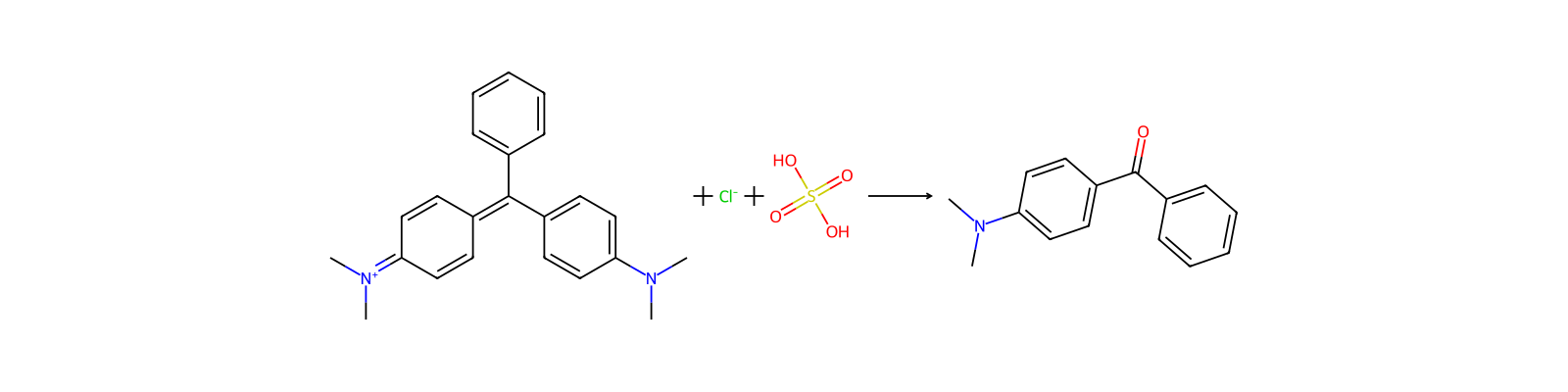
Related reactions
3 records

Linked notes
Loading…