Isoxsuprine hydrochloride
ISOXSUPRINE HCL · Isoxsuprine · Norephedrine, p-hydroxy-N-(1-methyl-2-phenoxyethyl)-, hydrochloride (6CI) · 4-Hydroxy-α-[1-[(1-Methyl-2-phenoxyethyl)aMino]ethyl]benzeneMethanol Hydrochloride · Benzenemethanol, 4-hydroxy-a-[1-[(1-methyl-2-phenoxyethyl)amino]ethyl]-, hydrochloride (9CI) · Navilox · isolait · vasoplex
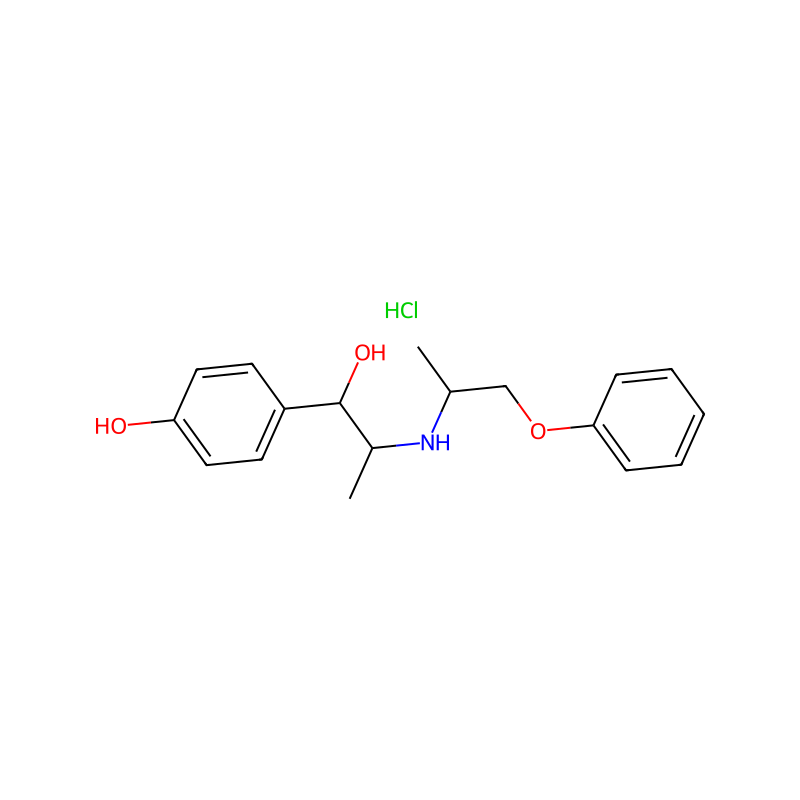
Identifiers & Physical Properties
| CAS No. | 579-56-6 |
|---|---|
| Molecular formula | C18H24ClNO3 |
| Average molar mass | 337.847 g/mol |
| Monoisotopic mass | 337.14447131 g/mol |
| SMILES | CC(COc1ccccc1)NC(C)C(O)c1ccc(O)cc1.Cl |
| InChIKey | QVPSGVSNYPRFAS-UHFFFAOYSA-N |
| PubChem CID | 11368 |
| ChEMBL | CHEMBL559180 |
| ChEBI | CHEBI:31735 |
| EC No. | 209-443-6 |
| DTXSID | DTXSID1045328 |
Chemical & Physical Properties
| Melting point | 203-204° |
|---|---|
| Storage conditions | Inert atmosphere,2-8°C |
| Solubility | Sparingly soluble in water and in ethanol (96 per cent), practically insoluble in methylene chloride. |
| Physical state | Solid |
| pKa (acidity coefficient) | pKa 8.0 (Uncertain)9.8 (Uncertain) |
| Color | White to off-white |
| Major applications | forensics and toxicologypharmaceutical (small molecule)veterinary |
| InChI | 1S/C18H23NO3.ClH/c1-13(12-22-17-6-4-3-5-7-17)19-14(2)18(21)15-8-10-16(20)11-9-15/h3-11,13-14,18-21H,12H2,1-2H3 |
| InChIKey | QVPSGVSNYPRFAS-UHFFFAOYSA-N |
| SMILES | OC(C(NC(COC1=CC=CC=C1)C)C)C2=CC=C(O)C=C2.Cl |
| CAS DataBase Reference | 579-56-6(CAS DataBase Reference) |
| FDA UNII | V74TEQ36CO |
| ATC code | C04AA01 |
| UNSPSC Code | 41116107 |
| NACRES | NA.24 |
| GHS pictogram | GHS07,GHS09 |
| Signal word | Warning |
| GHS hazard statements | H302-H410 |
| GHS precautionary statements | P264-P270-P273-P301+P312-P391-P501 |
| Hazard symbols | Xn,N |
| Risk statements (R) | 22-50/53-63-50 |
| Safety statements (S) | 36-61-60 |
| UN transport number | UN 3077 9 / PGIII |
| Water hazard class (WGK) | 3 |
| RTECS number | DO8225000 |
| Customs code | 2922504500 |
| Storage class | 11 - Combustible Solids |
| Hazard class | Acute Tox. 4 OralAquatic Acute 1Aquatic Chronic 1 |
| Hazardous substances data | 579-56-6(Hazardous Substances Data) |
| Toxicity | LD50 in rats (mg/kg): 1750 orally164 i.p. (Goldenthal) |
Safety & Regulations
| Water hazard class (WGK) | 3 |
|---|---|
| RTECS number | DO8225000 |
| UN transport number | UN 3077 9 / PGIII |
| Customs code | 2922504500 |
| Toxicity | LD50 in rats (mg/kg): 1750 orally164 i.p. (Goldenthal) |
| Risk statements (R) | 22-50/53-63-50 |
| Signal word | Warning |
| GHS pictogram | GHS07,GHS09 |
| Hazard symbols | Xn,N |
| Safety statements (S) | 36-61-60 |
| Storage class | 11 - Combustible Solids |
| GHS hazard statements | H302-H410 |
| Hazard class | Acute Tox. 4 OralAquatic Acute 1Aquatic Chronic 1 |
| GHS precautionary statements | P264-P270-P273-P301+P312-P391-P501 |
| Hazardous substances data | 579-56-6(Hazardous Substances Data) |
Applications & Uses
Description
Isoxsuprine is an adrenergic receptor modulator that has α-adrenergic receptor (α-AR) antagonist and β-AR agonist properties. It induces vasodilation of isolated equine common digital artery strips precontracted with norepinephrine, indicating an α-AR effect, and induces relaxation of isolated fowl cecum, an effect that can be blocked by the β-AR antagonist propranolol (Item Nos. 23349 | 17291). Isoxsuprine has antinociceptive effects in an acetic acid writhing test in mice. It also inhibits oxytocin-induced contractions in isolated rat uterus (IC50 = 9.15 μM). It delays labor onset in rats by 31.63 hours when administered at a dose of 10 mg/kg per day on days 13 to 21 of gestation but increases heart rate with increasing concentration.
Uses
vasodilator
Uses
It is prescribed for the symptomatic relief of cerebrovascular insufficiency and improvement of circulation
Uses
As a vasilodator drug, Isoxsuprine Hydrochloride is used in veterinary medicine for the treatment of navicular syndrome and laminitis in horses. Isoxsuprine Hydrochloride has been shown to be a β-adrenoreceptor antagonist with β-adrenoreceptor agonistic properties, with both characteristics contributing to vasodilation and uterine relaxation. Studies suggest that Isoxsuprine Hydrochloride may be useful as a as a tocolytic agent in the treatment of preterm labour.
Uses
antiepileptic