HomeMCPWorkbenchSkills
HomeWorkbenchNotificationsMe
llms.txt · MCP GuidePrivacy Policy · Terms of Service · Supportv1.8.3
  1. Home
  2. /Compound

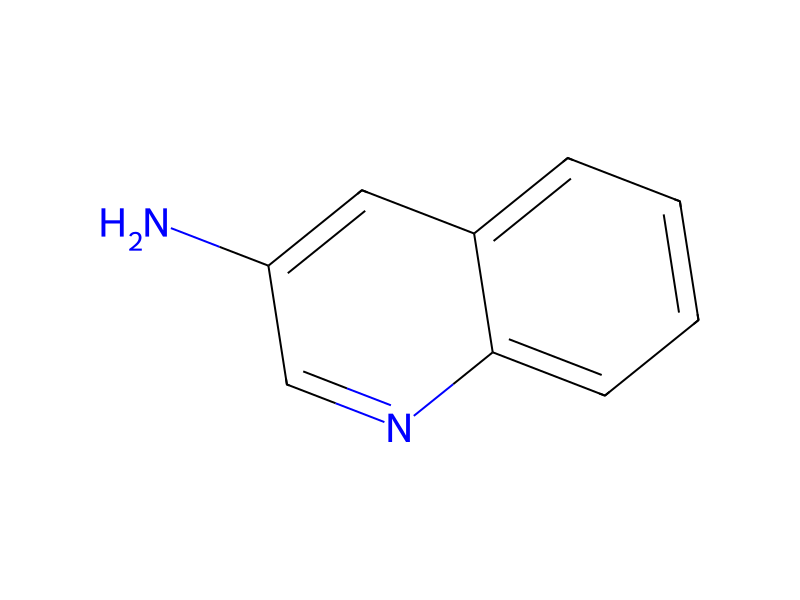
3-Aminoquinoline

HCID 11375
New reaction
Print
Basic informationOverviewNames & identifiersPropertiesSafety & regulationChemistry & industryRelated reactionsCompound notes
Substructure searchFind similar structures

Basic information

CAS
580-17-6
Standard SMILES
Nc1cnc2ccccc2c1
InChIKey
SVNCRRZKBNSMIV-UHFFFAOYSA-N
Molecular formula
C9H8N2
Average molar mass
144.17 g/mol
Monoisotopic mass
144.06874826

Overview

3-Aminoquinoline is an aminoquinoline.

Names & identifiers

Preferred name
3-Aminoquinoline
IUPAC
quinolin-3-amine
English name
3-Aminoquinoline
Molecular formula
C9H8N2
Molecular weight
144.17

Names & synonyms

3-AMINOQUINOLINEquinolin-3-amine3-Quinolinamine3-QuinolylamineQuinoline, 3-amino-3-Quinolineamine(Quinolin-3-yl)amineCCRIS 1678NSC 7934EINECS 209-455-1UNII-98OVL5K3R4BRN 0113317
Show more names
3-AQ3-AminoquinoL3-amino-quinolin6-Amine-quinolineQUINOLIN-3-YLAMINE
98OVL5K3R4NSC-7934AMINOQUINOLINE, 3-DTXSID80603795-22-10-00233 (Beilstein Handbook Reference)RefChem:93006DTXCID5042295InChI=1/C9H8N2/c10-8-5-7-3-1-2-4-9(7)11-6-8/h1-6H,10H

Database identifiers

CAS
580-17-6
PubChem CID
11375
DTXSID
DTXSID8060379
ChEMBL
CHEMBL80298
ChEBI
CHEBI:166512
UNII
98OVL5K3R4
EC Number
209-455-1
Nikkaji
J48.195E

Properties

Computed structural properties

XLogP
1.6
Topological polar surface area
38.9 Ų
Hydrogen bond donors
1
Hydrogen bond acceptors
2
Rotatable bonds
0
Heavy atoms
11
Formal charge
0
Complexity
136

Experimental & physicochemical properties

SpringerMaterials PropertiesChemical shift
LogP1.63

Physicochemical properties

Melting point
91 · 91-92 °C(lit.)
Boiling point
137 °C · 137 °C / 1mmHg
Density
1.1148 · 1.1148 (estimate)
refractive index
1.708 · 1.7080 (estimate)
storage temp.
30 °C · Store below +30°C.
solubility
0.1 g/mL, · methanol: 0.1 g/mL, clear
pka
4.91 · 4.91(at 20℃)
form
Crystalline Powder or Crystals
color
White to beige
Water Solubility
slightly soluble in hot water
Sensitive
Air Sensitive

Safety & regulation

Safety information is for reference only and does not replace the supplier’s Safety Data Sheet (SDS), applicable regulations, or professional assessment.

GHS classification

GHS Classification · 4 items

Warning

H302 (10.9%): Harmful if swallowed [Warning Acute toxicity, oral]

P261, P264, P264+P265, P270, P271, P280, P301+P317, P302+P352, P304+P340, P305+P351+P338, P317, P319, P321, P330, P332+P317, P337+P317, P362+P364, P403+P233, P405, and P501 (click each P-code to see the statement)

Aggregated GHS information provided per 46 reports by companies from 5 notifications to the ECHA C&L Inventory. Each notification may be associated with multiple companies.

Hazard information

Hazard Classes and CategoriesAcute Tox. 4 (10.9%)
CSL Reaction Information · 6 items

CSL00129

3-AMINOQUINOLINE + SODIUM ETHYLXANTHATE

I was attempting to prepare 3-[ethoxy(thiocarbonyl)thio]quinoline by reacting the diazonium salt of 3-aminoquinine with potassium ethyl xanthate when an explosion occurred. Thankfully, the injury I received was minor. I was following the procedure described in the Journal of the Chemical Society, Part III [3, 2384 (1959)] on twice their scale. Jerry March's book "Advanced Organic Chemistry: Reactions, Mechanisms, Structure" (New York: John Wiley & Sons, 1992, 4th edition, page 670) lists the procedure as a customary route for the desired aryl xanthate ester and a convenient method for producing thiophenols. The same procedure is also described in "Organic Syntheses, Collective Volume III" (New York: John Wiley & Sons, page 809), which contains a cautionary note about a reported explosion, although the editors found no unusual reactivity. Since diazo esters were present, the explosion most likely resulted from the diazo ester's tendency to decompose explosively. It is unclear whether the diazo ester is a precursor of the desired product or whether the diazo ester forms through a competitive reaction. The reaction proceeded without event. But unlike the literature preparations, precipitation occurred during product extraction with diethyl ether and was isolated by filtration. A 1H NMR of the wet cake was consistent with the desired structure. The solid was air-dried overnight and weighed 17 g. The detonation occurred when a metal spatula was inserted into the solid. Related work in Tetrahedron Letters [26, 6365 (1985)] successfully demonstrated the safe preparation of diaryl sulfides. However, this was done at 25 ºC (mine at 45 ºC) with care taken to avoid heat, since a reference is cited of an explosion at 60 ºC. Also, the disappearance of the suspected diazo sulfide was monitored by thin layer chromatography, and sluggish reactions were not pushed to conversion. Instead, chromatography was used to remove any intermediates.

Chemistry & industry

Uses & manufacturing

UsesSynthetic Polymer MALDI Matrix Compounds
General Manufacturing Information3-Quinolinamine: INACTIVE
Applications · 1 item

Uses3-Aminoquinoline was used:in liquid matrix for matrix-assisted laser desorption/ionization mass spectrometry (MALDI-MS) for glycopeptides, carbohydrates and phosphopeptidesin liquid matrix during novel glycan-labeling method for quantitative profiling of N-glycan by MALDI-MS analysisas derivatizing reagent for MALDI-MS analysis of oligosachharides

Upstream & downstream products

Upstream raw materials

3-BromoquinolineCopper(II) sulfate pentahydrateAmmonia

Downstream products

(+/-)-3-Amino-1,2,3,4-tetrahydroquinolineBoc-3-amino-1,2,3,4-tetrahydroquinoline3-Amino-4-chloroquinoline3-Chloroquinoline3-Amino-2-bromoquinoline3-Fluoro-8-Quinolinesulfonyl Chloride

Related reactions

143 records
New reaction record
HRID 667 reaction equation
HRID 667As reactant
HRID 84909 reaction equation
HRID 84909As reactant
HRID 84921 reaction equation
HRID 84921As reactant
HRID 84926 reaction equation
HRID 84926As reactant
HRID 90402 reaction equation
HRID 90402As reactant
HRID 107096 reaction equation
HRID 107096As reactant
HRID 139003 reaction equation
HRID 139003As product
HRID 141290 reaction equation
HRID 141290As reactant
PreviousPage 1 of 18

Compound notes

On this pageBasic informationOverviewNames & identifiersPropertiesSafety & regulationChemistry & industryRelated reactionsCompound notes
BRN
113317 · 113317
InChI
1S/C9H8N2/c10-8-5-7-3-1-2-4-9(7)11-6-8/h1-6H,10H2
InChIKey
SVNCRRZKBNSMIV-UHFFFAOYSA-N
SMILES
Nc1cnc2ccccc2c1
CAS DataBase Reference
580 · 580-17-6(CAS DataBase Reference)
EWG's Food Scores
1 · 1
FDA UNII
98 OVL5K3R4 · 98OVL5K3R4
NIST Chemistry Reference
3 · 3-Quinolinamine(580-17-6)
EPA Substance Registry System
3 · 3-Quinolinamine (580-17-6)
UNSPSC Code
12352100 · 12352100
NACRES
22 · NA.22
Symbol(GHS)
7 · GHS07
Signal word
Warning
Hazard statements
315 · H315-H319
Precautionary statements
264 · P264-P280-P302+P352-P337+P313-P305+P351+P338-P362+P364-P332+P313
target organs
Respiratory system
PPE
95 · dust mask type N95 (US), Eyeshields, Gloves
Hazard Codes
Xi,Xn
Risk Statements
36 · 36/38-68-36/37/38-20/21/22
Safety Statements
26 · 26-36-36/37/39-22
RIDADR
2811 · 2811
WGK Germany
3 · 3
RTECS
9622000 · VA9622000
F
2 · 2-10
TSCA
TSCA listed
HazardClass
IRRITANT
HS Code
2933490090 · 2933490090
Storage Class
11 · 11 - Combustible Solids
Hazard Classifications
2 Skin · Eye Irrit. 2Skin Irrit. 2STOT SE 3
Toxicity
5 mmol/plate · mma-sat 5 mmol/plate MUREAV 187,191,87

Explosive

M (up to 100g)

http://pubs.acs.org/cen/safety/20010709.html

Safety data

F
2-10
PPE
dust mask type N95 (US), Eyeshields, Gloves
wgk
3
tsca
TSCA listed
rtecs
VA9622000
ridadr
2811
hs_code
2933490090
Toxicity
mma-sat 5 mmol/plate MUREAV 187,191,87
risk_code
36/38-68-36/37/38-20/21/22
Signal word
Warning
Symbol(GHS)
GHS07
hazard_code
Xi,Xn
safety_code
26-36-36/37/39-22
hazard_class
IRRITANT
Storage Class
11 - Combustible Solids
target organs
Respiratory system
Hazard statements
H315-H319
Hazard Classifications
Eye Irrit. 2Skin Irrit. 2STOT SE 3
Precautionary statements
P264-P280-P302+P352-P337+P313-P305+P351+P338-P362+P364-P332+P313

Additional notes

DefinitionChEBI: 3-Aminoquinoline is an aminoquinoline.