4-Bromobenzoic acid
P-BROMOBENZOIC ACID · Benzoic acid, p-bromo- · 4-bromo-benzoicaci · 4-Bromobenzoic aicd · Benzoicacid,4-bromo- · 'LGC' (4008) · Homarine HCL · 4-Brombenzoesure
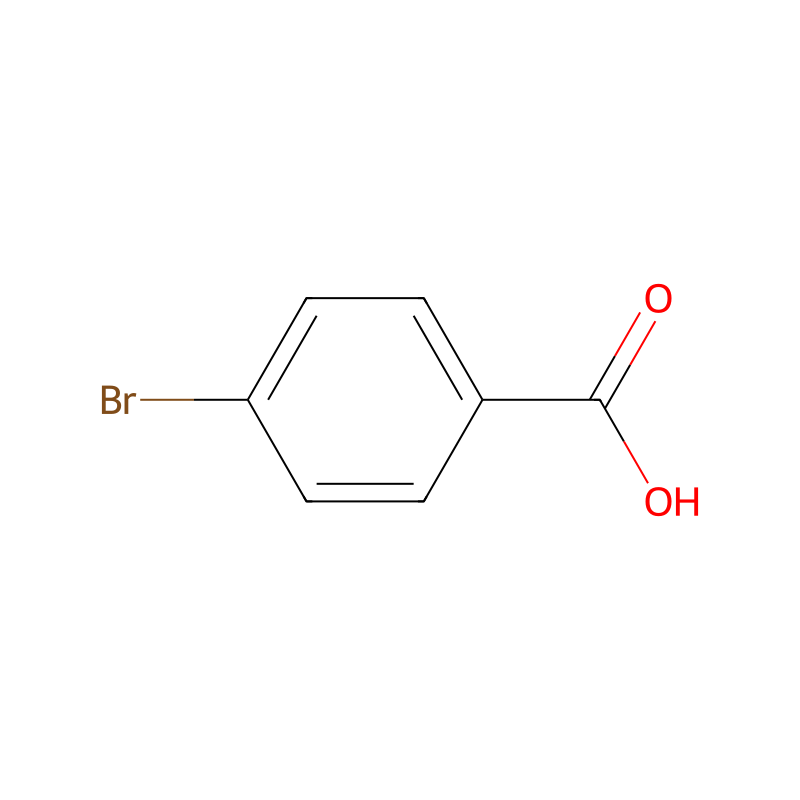
Identifiers & Physical Properties
| CAS No. | 586-76-5 |
|---|---|
| Molecular formula | C7H5BrO2 |
| Average molar mass | 201.02 g/mol |
| Monoisotopic mass | 199.9472915 g/mol |
| SMILES | O=C(O)c1ccc(Br)cc1 |
| InChIKey | TUXYZHVUPGXXQG-UHFFFAOYSA-N |
| PubChem CID | 11464 |
| ChEMBL | CHEMBL22051 |
| ChEBI | CHEBI:60698 |
| EC No. | 209-581-7 |
| DTXSID | DTXSID7060413 |
Chemical & Physical Properties
| XLogP | 2.9 |
|---|---|
| Topological polar surface area | 37.3 |
| Hydrogen bond donors | 1 |
| Hydrogen bond acceptors | 2 |
| Rotatable bonds | 1 |
| Heavy atoms | 10 |
| Formal charge | 0 |
| Complexity | 128 |
| Chemical classes | Other Classes -> Benzoic Acid Derivatives |
| SpringerMaterials Properties | Crystal structure |
| LogP (partition coefficient) | 2.86 |
| Melting point | 473.9 °F (NTP, 1992)252-254 °C (lit.) |
| Physical Description | 4-bromobenzoic acid appears as colorless to red crystals. (NTP, 1992)Solid[Merck Index] Colorless to red solid[CAMEO] Beige powder[Aldrich MSDS] |
| Boiling point | 116 °C(Press: 15-16 Torr) |
| Density | 1,894 g/cm3 |
| Refractive index | 1.6080 (estimate) |
| Storage conditions | Sealed in dry,Room Temperature |
| Solubility | ethanol: soluble5%SOLUBLE IN HOT WATER |
| Physical state | Crystals or Powder |
| pKa (acidity coefficient) | 3.96(at 25℃) |
| Color | White to beige to pink-brownish |
| Merck | 14,1408 |
| BRN | 1906923 |
| Stability | Stable. Incompatible with strong oxidizing agents. |
| Cosmetics Ingredients Functions | SKIN CONDITIONING |
| InChI | 1S/C7H5BrO2/c8-6-3-1-5(2-4-6)7(9)10/h1-4H,(H,9,10) |
| InChIKey | TUXYZHVUPGXXQG-UHFFFAOYSA-N |
| SMILES | OC(=O)c1ccc(Br)cc1 |
| CAS DataBase Reference | 586-76-5(CAS DataBase Reference) |
| EWG's Food Scores | 1 |
| FDA UNII | 6992P6102O |
| NIST Chemistry Reference | Benzoic acid, 4-bromo-(586-76-5) |
| EPA Substance Registry System | 4-Bromobenzoic acid (586-76-5) |
| UNSPSC Code | 12352100 |
| NACRES | NA.22 |
| GHS pictogram | GHS07 |
| Signal word | Warning |
| GHS hazard statements | H302 |
| GHS precautionary statements | P264-P270-P301+P312-P501 |
| Hazard symbols | Xn,Xi |
| Risk statements (R) | 22-36/37/38-36-37/38 |
| Safety statements (S) | 26-36-24/25-22-37/39 |
| Water hazard class (WGK) | 3 |
| RTECS number | DG4448050 |
| Hazard Note | Irritant |
| TSCA inventory status | TSCA listed |
| Customs code | 29163900 |
| Storage class | 11 - Combustible Solids |
| Hazard class | Acute Tox. 4 Oral |
Safety & Regulations
| GHS classification | DangerH302 (95.2%): Harmful if swallowed [Warning Acute toxicity, oral]P261, P262, P264, P264+P265, P270, P271, P273, P280, P301+P317, P302+P352, P304+P340, P305+P351+P338, P316, P317, P319, P321, P330, P332+P317, P337+P317, P361+P364, P362+P364, P391, P403+P233, P405, and P501 (click each P-code to see the statement)Aggregated GHS information provided per 63 reports by companies from 13 notifications to the ECHA C&L Inventory. Each notification may be associated with multiple companies. |
|---|---|
| Regulatory information | Chemical: Benzoic acid, 4-bromo-Benzoic acid, 4-bromo-: Does not have an individual approval but may be used under an appropriate group standard |
| Health hazards | ACUTE/CHRONIC HAZARDS: Explodes above its melting point. (NTP, 1992) |
| Hazards summary | An irritantHarmful by ingestion[Aldrich MSDS] |
| Reactive group | Acids, Carboxylic |
| Reactivity Profile | Carboxylic acids donate hydrogen ions if a base is present to accept them. They react in this way with all bases, both organic (for example, the amines) and inorganic. Their reactions with bases, called "neutralizations", are accompanied by the evolution of substantial amounts of heat. Neutralization between an acid and a base produces water plus a salt. Carboxylic acids with six or fewer carbon atoms are freely or moderately soluble in waterthose with more than six carbons are slightly soluble in water. Soluble carboxylic acid dissociate to an extent in water to yield hydrogen ions. The pH of solutions of carboxylic acids is therefore less than 7.0. Many insoluble carboxylic acids react rapidly with aqueous solutions containing a chemical base and dissolve as the neutralization generates a soluble salt. Carboxylic acids in aqueous solution and liquid or molten carboxylic acids can react with active metals to form gaseous hydrogen and a metal salt. Such reactions occur in principle for solid carboxylic acids as well, but are slow if the solid acid remains dry. Even "insoluble" carboxylic acids may absorb enough water from the air and dissolve sufficiently in it to corrode or dissolve iron, steel, and aluminum parts and containers. Carboxylic acids, like other acids, react with cyanide salts to generate gaseous hydrogen cyanide. The reaction is slower for dry, solid carboxylic acids. Insoluble carboxylic acids react with solutions of cyanides to cause the release of gaseous hydrogen cyanide. Flammable and/or toxic gases and heat are generated by the reaction of carboxylic acids with diazo compounds, dithiocarbamates, isocyanates, mercaptans, nitrides, and sulfides. Carboxylic acids, especially in aqueous solution, also react with sulfites, nitrites, thiosulfates (to give H2S and SO3), dithionites (SO2), to generate flammable and/or toxic gases and heat. Their reaction with carbonates and bicarbonates generates a harmless gas (carbon dioxide) but still heat. Like other organic compounds, carboxylic acids can be oxidized by strong oxidizing agents and reduced by strong reducing agents. These reactions generate heat. A wide variety of products is possible. Like other acids, carboxylic acids may initiate polymerization reactionslike other acids, they often catalyze (increase the rate of) chemical reactions. |
| Air and Water Reactions | No rapid reaction with air. No rapid reaction with water. |
| Hazard Classes and Categories | Acute Tox. 4 (95.2%) |
| Fire fighting | A fire in your laboratory involving this chemical should be extinguished with a dry chemical, carbon dioxide or halon extinguisher. (NTP, 1992) |
| First aid | EYES: First check the victim for contact lenses and remove if present. Flush victim's eyes with water or normal saline solution for 20 to 30 minutes while simultaneously calling a hospital or poison control center. Do not put any ointments, oils, or medication in the victim's eyes without specific instructions from a physician. IMMEDIATELY transport the victim after flushing eyes to a hospital even if no symptoms (such as redness or irritation) develop. |
| Personal Protective Equipment (PPE) | RECOMMENDED RESPIRATOR: Where the neat test chemical is weighed and diluted, wear a NIOSH-approved half face respirator equipped with an organic vapor/acid gas cartridge (specific for organic vapors, HCl, acid gas and SO2) with a dust/mist filter. |
| Water hazard class (WGK) | 3 |
| TSCA inventory status | TSCA listed |
| RTECS number | DG4448050 |
| Customs code | 29163900 |
| Risk statements (R) | 22-36/37/38-36-37/38 |
| Signal word | Warning |
| GHS pictogram | GHS07 |
| Hazard symbols | Xn,Xi |
| hazard_note | Irritant |
| Safety statements (S) | 26-36-24/25-22-37/39 |
| Storage class | 11 - Combustible Solids |
| GHS hazard statements | H302 |
| Hazard class | Acute Tox. 4 Oral |
| GHS precautionary statements | P264-P270-P301+P312-P501 |
Applications & Uses
Uses
4-Bromobenzoic acid was used to study the metabolic fate of 2-,3-and 4-bromo benzoic acids in rat hepatocytes incubation using high temperature liquid chromatography. It was used in bromine-specific detection of the metabolites of 2-,3-and 4-bromobenzoic acid in the urine and bile of rats by inductively coupled plasma mass spectrometry. It is also used as an intermediate for the synthesis of agrochemicals, pharmaceutical, chemical intermediates and liquid crystals.
General Description
Colorless to red crystals.
Preparation & Synthesis
Preparation
4-Bromobenzoic acid is obtained by the reaction of p-bromotoluene with glacial acetic acid as the molten agent and oxygen as the oxidant, utilising a liquid-phase oxidation catalytic method under the action of a catalyst. The catalyst is a combination of acetic acid cobalt, manganese acetate, and bromide compounds.