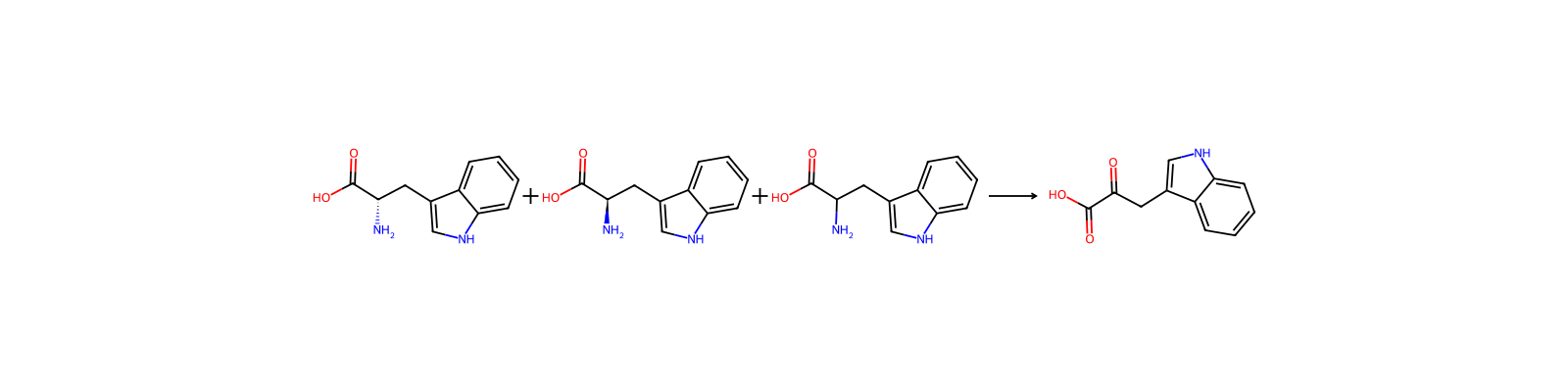
Dl-Tryptophan
Completing data — refresh the page later to see the latest

Basic information
- CAS
27813-82-7- Standard SMILES
NC(Cc1c[nH]c2ccccc12)C(=O)O- InChIKey
QIVBCDIJIAJPQS-UHFFFAOYSA-N- Molecular formula
- C11H12N2O2
- Average molar mass
- 204.22 g/mol
- Monoisotopic mass
- 204.08987762
Overview
Tryptophan is an alpha-amino acid that is alanine bearing an indol-3-yl substituent at position 3. It has a role as a Daphnia magna metabolite. It is a polar amino acid, an alpha-amino acid, an aromatic amino acid and an aminoalkylindole. It contains a 1H-indol-3-ylmethyl group. It is a conjugate base of a tryptophanium. It is a conjugate acid of a tryptophanate. It is a tautomer of a tryptophan zwitterion.
Names & identifiers
- Preferred name
- Dl-Tryptophan
- IUPAC
- 2-amino-3-(1H-indol-3-yl)propanoic acid
- English name
- POLY-L-TRYPTOPHAN
- Molecular formula
- C11H12N2O2
- Molecular weight
- 204.22518
Names & synonyms
DL-Tryptophan2-amino-3-(1H-indol-3-yl)propanoic acid(+-)-TryptophanTryptophan, DLTRYPTOPHAN, DL-CCRIS 719NSC 13118DTXSID0021418EINECS 200-194-9AI3-24395X9U7434L7ANSC-13118
Show more names
Poly(Try)POLY-L-TRYPTOPHANpoly-l-TryptophanMW1000-5000poly-L-tryptophan mol wt 15000-50000poly-L-tryptophan mol. wt. 1,000-5,000
DL-TRYPTOPHAN [FCC]DTXCID401418DLTrytophaneDL3betaIndolylalanineRefChem:589984DLalphaAmino3indolepropionic acid200-194-954-12-6
Database identifiers
- CAS
27813-82-7、54-12-6、73-22-3- PubChem CID
- 1148
- DTXSID
DTXSID0021418- ChEMBL
CHEMBL484901- ChEBI
CHEBI:27897- UNII
- X9U7434L7A
Properties
Computed structural propertiesFilling in
- XLogP
- -1.1
- Topological polar surface area
- 79.1 Ų
- Hydrogen bond donors
- 3
- Hydrogen bond acceptors
- 3
- Rotatable bonds
- 3
- Heavy atoms
- 15
- Formal charge
- 0
- Complexity
- 245
Experimental & physicochemical properties
Chemical ClassesBiological Agents -> Amino Acids and Derivatives
LogP-1.05
Boiling Point289.00 to 291.00 °C. @ 760.00 mm Hg
Melting Point293 °C
Physical Description
Beige powder; [Sigma-Aldrich MSDS]
Solid
Dissociation Constants
2.3
9.3
Physicochemical properties
- storage temp.
- 20 °C · −20°C
- WGK Germany
- 3 · 3
Safety & regulation
Safety information is for reference only and does not replace the supplier’s Safety Data Sheet (SDS), applicable regulations, or professional assessment.
GHS classification
GHS Classification
This chemical does not meet GHS hazard criteria for 77.8% (7 of 9) of all reports.
Warning
H315 (22.2%): Causes skin irritation [Warning Skin corrosion/irritation]
P261, P264, P264+P265, P271, P280, P302+P352, P304+P340, P305+P351+P338, P319, P321, P332+P317, P337+P317, P362+P364, P403+P233, P405, and P501 (click each P-code to see the statement)
Aggregated GHS information provided per 9 reports by companies from 3 notifications to the ECHA C&L Inventory. Each notification may be associated with multiple companies.
Hazard information
Hazards SummaryIntraperitoneal LD50 (mouse) > 1,000 mg/kg; [RTECS] May cause irritation; [Sigma-Aldrich MSDS]
Hazard Classes and CategoriesSkin Irrit. 2 (22.2%)
Safety data
- wgk
- 3
Chemistry & industry
Pharmacology
Cellular LocationsCytoplasm
Uses & manufacturing
UsesTryptophan is an essential amino acid; [Merck Index]
Additional notes
DefinitionChEBI: Tryptophan is an alpha-amino acid that is alanine bearing an indol-3-yl substituent at position 3. It has a role as a Daphnia magna metabolite. It is an alpha-amino acid, an aminoalkylindole, a polar amino acid and an aromatic amino acid. It contains a 1H-indol-3-ylmethyl group. It is a conjugate base of a tryptophanium. It is a conjugate acid of a tryptophanate. It is a tautomer of a tryptophan zwitterion.
Related reactions
34 records


Compound notes
Loading…