
Tryptamine
Completing data — refresh the page later to see the latest
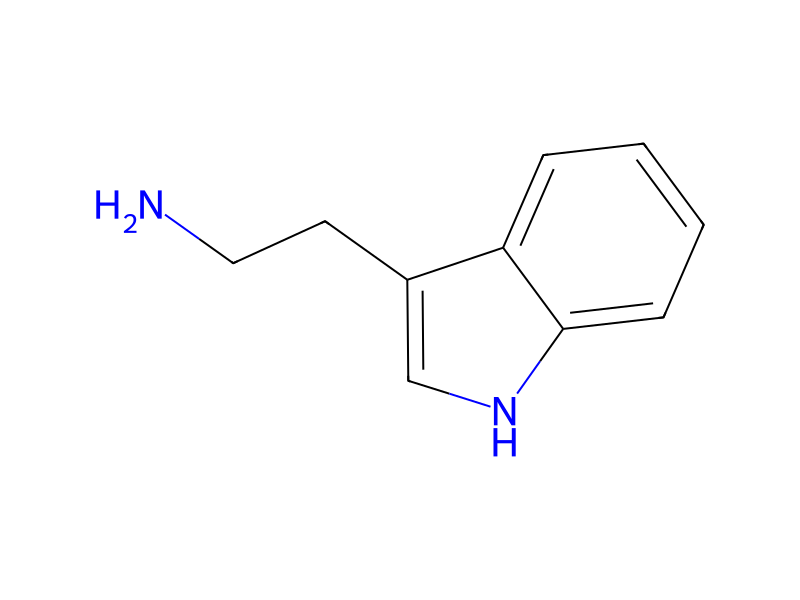
Basic information
- CAS
61-54-1- Standard SMILES
NCCc1c[nH]c2ccccc12- InChIKey
APJYDQYYACXCRM-UHFFFAOYSA-N- Molecular formula
- C10H12N2
- Average molar mass
- 160.22 g/mol
- Monoisotopic mass
- 160.10004839
Overview
Tryptamine is an aminoalkylindole consisting of indole having a 2-aminoethyl group at the 3-position. It has a role as a mouse metabolite, a plant metabolite and a human metabolite. It is a member of tryptamines, an aminoalkylindole, an indole alkaloid and an aralkylamino compound. It is a conjugate base of a tryptaminium.
Names & identifiers
- Preferred name
- Tryptamine
- IUPAC
- 2-(1H-indol-3-yl)ethanamine
- English name
- Tryptamine
- Molecular formula
- C10H12N2
- Molecular weight
- 160.22
Names & synonyms
tryptamine61-54-12-(1H-Indol-3-yl)ethanamine3-(2-aminoethyl)indole1H-Indole-3-ethanamine2-(3-Indolyl)ethylamine2-(1H-Indol-3-Yl)Ethan-1-AmineIndole, 3-(2-aminoethyl)-beta-(3-Indolyl)ethylamine422ZU9N5TVCHEBI:16765DTXSID2075340
Show more names
L-TRYPTAMINETRIPTAMINETRYPTAMINE CAS 61-54-12-(1H-indol-3-yl)ethan-1-aMine hydrochlorideb mk-2ryptamine
NSC-1652123-[2-Aminoethyl]indoleRefChem:900684DTXCID3042922200-510-5TryptaminIndol-3-ethylamine2-(Indol-3-yl)ethylamine
Database identifiers
- CAS
61-54-1- PubChem CID
- 1150
- DTXSID
DTXSID2075340- ChEMBL
CHEMBL6640- ChEBI
CHEBI:16765- UNII
- 422ZU9N5TV
- EC Number
- 200-510-5
Properties
Computed structural propertiesFilling in
- XLogP
- 1.6
- Topological polar surface area
- 41.8 Ų
- Hydrogen bond donors
- 2
- Hydrogen bond acceptors
- 1
- Rotatable bonds
- 2
- Heavy atoms
- 12
- Formal charge
- 0
- Complexity
- 147
Experimental & physicochemical properties
Drugs
DEA NFLIS-Drug Category -> Tryptamines
Pharmaceuticals -> Listed in ZINC15
SpringerMaterials PropertiesAngular frequency
LogP
1.55
1.35
Melting Point114 - 119 °C
Physical DescriptionSolid
Collision Cross Section
128.42 Ų [M+H]+ [CCS Type: DT; Method: stepped-field]
125.1 Ų [M+H-H2O]+ [CCS Type: DT; Method: single field calibrated with Agilent tune mix (Agilent)]
131.25 Ų [M+H]+ [CCS Type: TW; Method: calibrated with polyalanine and drug standards]
124.4 Ų [M+H-H2O]+ [CCS Type: TW; Method: calibrated with polyalanine and drug standards]
127.6 Ų [M+H]+
Physicochemical properties
- Melting point
- 113 · 113-116 °C (lit.)
Safety & regulation
Safety information is for reference only and does not replace the supplier’s Safety Data Sheet (SDS), applicable regulations, or professional assessment.
GHS classification
GHS Classification
This chemical does not meet GHS hazard criteria for 1.9% (1 of 52) of reports.
Warning
H315 (96.2%): Causes skin irritation [Warning Skin corrosion/irritation]
P261, P264, P264+P265, P271, P280, P302+P352, P304+P340, P305+P351+P338, P319, P321, P332+P317, P337+P317, P362+P364, P403+P233, P405, and P501 (click each P-code to see the statement)
Aggregated GHS information provided per 52 reports by companies from 9 notifications to the ECHA C&L Inventory. Each notification may be associated with multiple companies.
Hazard information
Regulatory Information
REACH registered substance: 2-(indol-3-yl)ethylamine (EC: 200-510-5)
1H-Indole-3-ethanamine: Does not have an individual approval but may be used under an appropriate group standard
Hazard Classes and CategoriesSkin Irrit. 2 (96.2%)
Safety data
- F
- 8-23
- wgk
- 3
- rtecs
- NL4020000
- hs_code
- 29339990
- risk_code
- 20/21/22-36/37/38-41-37/38-22
- Signal word
- Danger
- Symbol(GHS)
- GHS05,GHS07
- hazard_code
- Xi
- safety_code
- 24/25-36/37/39-36-26
- hazard_class
- IRRITANT
- Storage Class
- 11 - Combustible Solids
Chemistry & industry
Pharmacology
Tissue LocationsBrain
Cellular LocationsCytoplasm
Metabolite PathwaysTryptophan metabolism
Applications
DescriptionTryptamine is a monoamine alkaloid that can be synthesized by decarboxylation of the amino acid tryptophan. Notably, tryptamine can be found in fungi, plants, Amphibia, animals, and microbes. Tryptamine has an indole ring structure and a fused double ring that is composed of a benzene ring and a pyrrole ring, linked to an amino group by 2-carbon side chain. The indole ring is the vital nucleus of many complex natural products that have significance in drug discovery as well as some synthetic and non-synthetic drugs that are based on tryptamine skeleton. The chemical’s distinct structure is an approximation to the neurotransmitter serotonin as well-known drugs and hallucinogens. Tryptamine’s significance as psychedelic drugs, neuromodulator, and neurotransmitter is well understood due to its presence in mammalian brain in small amounts.
DescriptionTryptamine is an indole alkaloid and intermediate in the biosynthesis of serotonin and the phytohormone melatonin in plants. It increases the levels of the terpenoid indole alkaloids ajmalicine, strictosidine, and catharanthine in cultures of C. roseus. Tryptamine is also a product of tryptophan metabolism in mammals. Tryptamine derivatives have been synthetically produced as hallucinogenic drugs of abuse that act on the serotonergic system.
UsesTryptamine is a monoamine alkaloid found in plants. Tryptamine is commonly used in the preparation of biologically active compounds such as neurotransmitters and psychedelics.
General DescriptionTryptamines which are usually found in plants, fungi, animals, etc. are categorized under the monoamine alkaloids class of compounds.
Preparation methods
Related reactions
319 records


Compound notes
Loading…