
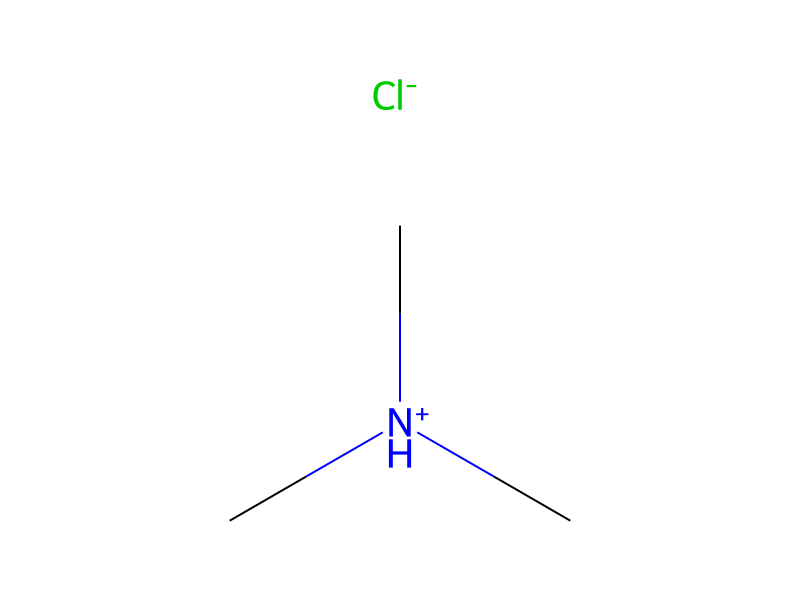
Basic information
- CAS
593-81-7- Standard SMILES
C[NH+](C)C.[Cl-]- InChIKey
SZYJELPVAFJOGJ-UHFFFAOYSA-N- Molecular formula
- C3H10ClN
- Average molar mass
- 95.57 g/mol
Overview
See also: Trimethylamine Hydrochloride (preferred).
Names & identifiers
- Preferred name
- Trimethylazanium;chloride
- IUPAC
- trimethylazanium chloride
- English name
- Trimethylamine hydrochloride
- Molecular formula
- C3H10ClN
- Molecular weight
- 95.57
Names & synonyms
trimethylazanium;chlorideUW38SRM77KNS00077221TRIMETHYLAMMONIUM CHLORIDETRIMETHYLAMINE HCLFEMA 3241Trimthylamine bydrochlorideN, N-DIMETHYLMETHYLAMINE HCLTrimethylamine monohydrochlorideTrimethylammonium monohydrochlorideMethanamine,N,N-dimethyl-,hydrochlorideHJ 1042-2019)
Show more names
TrimethylamineHcl99%
Database identifiers
- CAS
593-81-7- PubChem CID
- 11649
Properties
Computed structural properties
- Topological polar surface area
- 4.4 Ų
- Hydrogen bond donors
- 1
- Hydrogen bond acceptors
- 1
- Rotatable bonds
- 0
- Heavy atoms
- 5
- Formal charge
- 0
- Complexity
- 8
Physicochemical properties
- Melting point
- 283 · 283-284 °C (dec.)(lit.)
- Boiling point
- 132.32 °C · 132.32°C (rough estimate)
- Density
- 0.9337 · 0.9337 (rough estimate)
- vapor pressure
- 0 Pa · 0Pa at 25℃
- refractive index
- 1.4413 · 1.4413 (estimate)
- storage temp.
- 30 °C · Store below +30°C.
- solubility
- SOLUBLE
- form
- Crystalline Powder
- color
- White to slightly cream
- PH
- 5 · 5 (100g/l, H2O, 20℃)
- Water Solubility
- SOLUBLE
- Sensitive
- Hygroscopic
- Merck
- 14 · 14,9710
- BRN
- 3905063 · 3905063
- Stability
- Hygroscopic
- InChI
- 1S/C3H9N.ClH/c1-4(2)3;/h1-3H3;1H
- InChIKey
- SZYJELPVAFJOGJ-UHFFFAOYSA-N
- SMILES
- Cl[H].CN(C)C
- LogP
- -2.25 at · -2.25 at 25℃
- CAS DataBase Reference
- 593 · 593-81-7(CAS DataBase Reference)
- FDA UNII
- 38 SRM77K · UW38SRM77K
- NIST Chemistry Reference
- Methanamine,n,n-dimethyl-,hydrochloride(593-81-7)
- EPA Substance Registry System
- Trimethylamine hydrochloride (593-81-7)
- UNSPSC Code
- 85151701 · 85151701
- NACRES
- 24 · NA.24
- Symbol(GHS)
- 7 · GHS07
- Signal word
- Warning
- Hazard statements
- 315 · H315-H319
- Precautionary statements
- 264 · P264-P280-P302+P352-P305+P351+P338-P332+P313-P337+P313
- PPE
- 95 · dust mask type N95 (US), Eyeshields, Gloves
- Hazard Codes
- Xi
- Risk Statements
- 36 · 36/37/38-38-36
- Safety Statements
- 26 · 26-36-37/39
- WGK Germany
- 1 · 1
- RTECS
- 2700000 · YH2700000
- F
- 3 · 3-10
- TSCA
- TSCA listed
- HS Code
- 29211190 · 29211190
- Storage Class
- 11 · 11 - Combustible Solids
- Hazard Classifications
- 2 Skin · Eye Irrit. 2Skin Irrit. 2
- Hazardous Substances Data
- 593 · 593-81-7(Hazardous Substances Data)
- Toxicity
- 50 orally · LD50 orally in Rabbit: 3090 mg/kg
- REACH Registrations
- Active
Safety & regulation
Safety data
- F
- 3-10
- PPE
- dust mask type N95 (US), Eyeshields, Gloves
- wgk
- 1
- tsca
- TSCA listed
- rtecs
- YH2700000
- hs_code
- 29211190
- Toxicity
- LD50 orally in Rabbit: 3090 mg/kg
- risk_code
- 36/37/38-38-36
- Signal word
- Warning
- Symbol(GHS)
- GHS07
- hazard_code
- Xi
- safety_code
- 26-36-37/39
- Storage Class
- 11 - Combustible Solids
- Hazard statements
- H315-H319
- REACH Registrations
- Active
- Hazard Classifications
- Eye Irrit. 2Skin Irrit. 2
- Precautionary statements
- P264-P280-P302+P352-P305+P351+P338-P332+P313-P337+P313
- Hazardous Substances Data
- 593-81-7(Hazardous Substances Data)
Chemistry & industry
Applications
UsesTrimethylamine hydrochloride is used in the manufacture of quaternary ammonium compounds, as insect attractant. It is also used as a raw material for the synthesis of choline chloride and ion exchange resins. Additionally, It acts as a cationic starch reagent, phase transfer catalyst, oil field chemicals, warning agent for natural gas and flotation agent.
Preparation methods
PreparationTrimethylamine hydrochloride can be synthesized through the reaction of trimethylamine (TMA) and hydrochloric acid (HCl). The synthesis reaction can be written as follows:C3H9N+ HCl → C3H10ClNThe following steps are involved in obtaining trimethylamine hydrochloride:Step 1: Evaporation of hydrochloric acid solution The hydrochloric acid solution is evaporated, first over a free flame, and later on a steam bath. This process results in concentration of the solution, which aids in the formation of trimethylamine hydrochloride crystals.Step 2: Crystal formation and filtration As the solution becomes more and more concentrated, the trimethylamine hydrochloride crystals begin to form. The crystals are filtered periodically to remove them from the solution.Step 3: Drying The filtered crystals are dried in an air bath for a few minutes, with a temperature range of 100-110°.Step 4: Storage The air-dried crystals are then stored in a tightly closed bottle.Step 5: Centrifugation (optional) If the trimethylamine hydrochloride crystals are centrifuged, the product is obtained pure and dry.Overall, four runs yield an average of 710 g of pure trimethylamine hydrochloride and 82 g of slightly yellow-tinted product. This yield is equivalent to 89% of the theoretical amount based on ammonium chloride. The slight yellow coloration results from the evaporation of the last traces of solution.DOI: 10.15227/orgsyn.001.0079
Upstream & downstream products
Upstream raw materials
Downstream products
Suppliers100 total
国药集团化学试剂有限公司86-21-63210123 · [email protected]
梯希爱(上海)化成工业发展有限公司021-67121386 · [email protected]
衢州润东化工有限公司0570-8789886 18892685668 · [email protected]
上海阿拉丁生化科技股份有限公司400-6206333 13167063860 · [email protected]
爱斯特(成都)生物制药股份有限公司+86-28-85122536 85324413 · [email protected]
上海将来实业股份有限公司400-0066400 13621662912 · [email protected]
Syntechem Co.,Ltd[email protected]
上海迈瑞尔生化科技有限公司4006356688 18621169109 · [email protected]
大连美仑生物技术有限公司0411-62910999 13889544652 · [email protected]
阿法埃莎(中国)化学有限公司400-6106006 · [email protected]
太原市瑞和丰科贸有限公司+86 351 7031519 · [email protected]
安耐吉化学&3A(安徽泽升科技股份有限公司)400-0056266 · [email protected]
北京绿百草科技发展有限公司010-61136123 · [email protected]
上海瀚鸿科技股份有限公司021-54306202 13764082696 · [email protected]
上海柯维化学技术有限公司021-64609169 18901607656 · [email protected]
嘉兴市艾森化工有限公司0573-85285100 18627885956 · [email protected]
上海隆盛化工有限公司58099637 13585536065 · [email protected]
合肥天健化工有限公司551-65418679 15856988503;15837135945 · [email protected]
山东西亚化学有限公司13355009207 13355009207 · [email protected]
唐山默内德贸易有限公司0315-8309571 15633399667 · [email protected]
玛雅试剂+86 (573) 82222445 (0)18006601000 452520369 · [email protected]
四川库利南科技有限公司400-1166-196 18981987031 · [email protected]
湖南汇百侍生物科技有限公司0731-85526065 13308475853 · [email protected]
河南多贝化工有限公司0370-2785118 17550508557 · [email protected]
斯百全化学(上海)有限公司021-021-021-67601398-809-809-809 15221380277 · [email protected]
上海源叶生物科技有限公司13636370518 · [email protected]
艾科试剂4008-755-333 18080918076 · [email protected]
上海思域化工科技有限公司86-21-34053660 · [email protected]
赛默飞世尔科技(中国)有限公司800-810-5118 · [email protected]
北京伊诺凯科技有限公司400-810-7969 010-59572699 · [email protected]
上海健超生物科技有限公司150-2103-5486 18017383231 · [email protected]
TOKYO CHEMICAL INDUSTRY CO., LTD.03-36680489 · [email protected]
深圳康特腾科技有限公司86-0755-86635001 · [email protected]
上海将来实业股份有限公司400-0066400 13621662912 · [email protected]
上海将来实业股份有限公司021-61552785 · [email protected]
HBCChem, Inc.+1-510-219-6317 · [email protected]
日照力德士化工有限公司010-51268198 · [email protected]
郑州阿尔法化工有限公司0371-53732842 15981811963 · [email protected]
美岚实业(上海)有限公司021-58958189 · [email protected]
上海爱蝶实业有限公司021-58957966 18930537195 · [email protected]
四川省维克奇生物科技有限公司028-81700200 18116577057 · [email protected]
成都零六生物科技有限公司400-1166-196 13458535857 · [email protected]
广拓化学(上海)有限公司021-60899189-8001 18918189673 · [email protected]
上海德榜化工有限公司021-61531158 · [email protected]
杭州海尔希畜牧科技有限公司13336065779 · [email protected]
上海麦克林生化科技股份有限公司15221275939 15221275939 · [email protected]
杭州杰恒化工有限公司0571-87396432 · [email protected]
上海嵩爰化工科技有限公司010-1234567 18521000990 · [email protected]
上海有朋化工有限公司021-69005955 13701776567 · [email protected]
北京海力扬化学科技有限公司13718199399 · [email protected]
Additional notes
DefinitionChEBI: Trimethylamine hydrochloride is a hydrochloride salt formed by reaction of equimolar amounts of trimethylamine and hydrogen chloride. It contains a trimethylammonium.
Related reactions
5 records


Compound notes
Loading…