
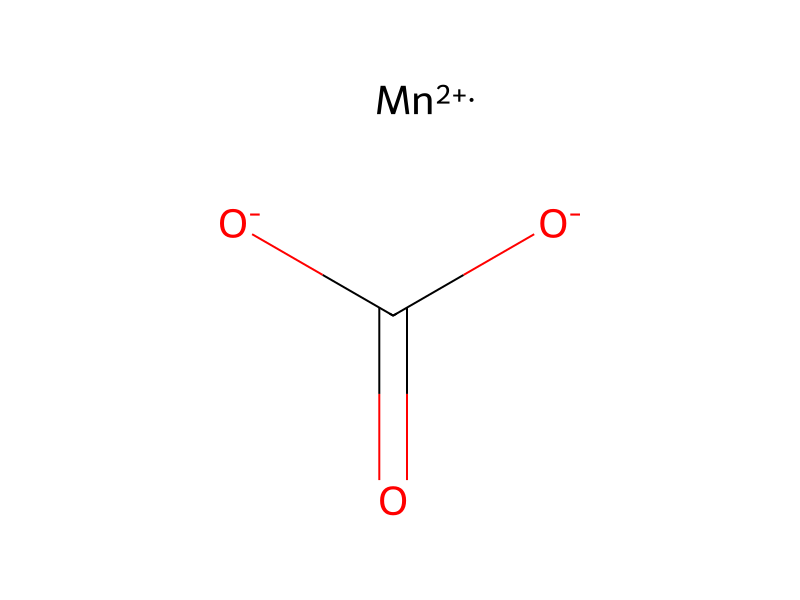
Basic information
- Standard SMILES
O=C([O-])[O-].[Mn+2]- InChIKey
XMWCXZJXESXBBY-UHFFFAOYSA-L- Molecular formula
- CMnO3
- Average molar mass
- 114.947 g/mol
- Monoisotopic mass
- 114.92278896
Overview
Manganese carbonate is a chemical compound of manganese that occurs naturally as the mineral rhodochrosite. It is widely used as an additive to plant fertilizers to cure manganese deficient crops, in health foods, in ceramics as a glaze colorant and flux, and in concrete stains. Manganese is a naturally occurring metal with the symbol Mn and the atomic number 25. It does not occur naturally in its pure form, but is found in many types of rocks in combination with other substances such as oxygen, sulfur, or chlorine. Manganese occurs naturally in most foods and small amounts are needed to stay healthy, as manganese ions act as cofactors for a number of enzymes. (L228, L229, L233)
Names & identifiers
- Preferred name
- Manganese carbonate
- IUPAC
- manganese(2+) carbonate
Names & synonyms
MANGANESE CARBONATE598-62-9Manganese(II) carbonateManganous carbonateManganese(2+) carbonateNatural rhodochrositeManganese carbonate (1:1)Manganese carbonate (MnCO3)Manganese(2+) carbonate (1:1)9ZV57512ZMCarbonic acid, manganese(2+) salt (1:1)MANGANUM CARBONICUM
Show more names
DTXSID1042108NSC-83512carbonic acid manganeseRefChem:55543DTXCID9022108209-942-9Carbonic acid, manganese saltCCRIS 3660
Database identifiers
- CAS
17375-37-0、598-62-9- PubChem CID
- 11726
- DTXSID
DTXSID1042108- UNII
- 9ZV57512ZM
- EC Number
- 209-942-9、241-414-3
- Nikkaji
- J476F
Properties
Computed structural properties
- Topological polar surface area
- 63.2 Ų
- Hydrogen bond donors
- 0
- Hydrogen bond acceptors
- 3
- Rotatable bonds
- 0
- Heavy atoms
- 5
- Formal charge
- 0
- Complexity
- 18.8
Experimental & physicochemical properties
Chemical ClassesMetals -> Manganese Compounds, Inorganic
Density
3.7
3.7 @25 °C
Color/Form
Pink to almost white powder when freshly precipitated; rhombohedral, calcite structure
Rose-colored crystals, almost white when precipitated.
Pink solid trigonal
Solubility
Solubility product in water: 8.8X10⁻¹¹
Sol in dil acid; insol in water or alcohol
SOL IN AQ CARBON DIOXIDE; INSOL IN AMMONIA
Soluble in dilute inorganic acids; almost insoluble in common organic acids, both concentrated and dilute.
Animal DrugsActive Ingredients (Manganese carbonate) -> FDA Greenbook
Melting PointDecomposes >200 °C
Physical Description
Other Solid; Dry Powder; CBI; Large Crystals; Liquid; Other Solid
Rose-colored crystals; [HSDB] Tarnishes to light brown; [Merck Index] Hygroscopic solid; Practically insoluble in water: 0.065 g/L @ 25 deg C; [MSDSonline]
Stability/Shelf LifeGRADUALLY BECOMES LIGHT BROWN IN AIR
Other Experimental PropertiesHeating above 200 °C causes decomposition to manganese oxide and carbon dioxide.
Safety & regulation
GHS classification
GHS Classification
This chemical does not meet GHS hazard criteria for 54% (147 of 272) of all reports.
Danger
H372 (40.1%): Causes damage to organs through prolonged or repeated exposure [Danger Specific target organ toxicity, repeated exposure]
P260, P264, P270, P319, and P501 (click each P-code to see the statement)
Aggregated GHS information provided per 272 reports by companies from 7 notifications to the ECHA C&L Inventory.
Danger
Hazard information
Regulatory Information
Chemical: Carbonic acid, manganese(2+) salt (1:1)
Carbonic acid, manganese(2+) salt (1:1) is listed on the EPA's Chemical Data Reporting (CDR) system. Manufacturers and importers of Carbonic acid, manganese(2+) salt (1:1) are required to report information about their production and use of this chemical to the EPA under the Toxic Substances Control Act (TSCA). (40 eCFR Part 711)
Status: Active Update: 03-08-2022 https://echa.europa.eu/registration-dossier/-/registered-dossier/14838
Manganese carbonate: Does not have an individual approval but may be used under an appropriate group standard
Hazards SummaryAn irritant; Toxic if absorbed; [MSDSonline] See Manganese and linked occupational diseases.
FDA Requirements
Trace minerals added to animal feeds. These substances added to animal feeds as nutritional dietary supplements are generally recognized as safe when added at levels consistent with good feeding practice. Element: Manganese; Source compound: manganese carbonate. (All substances listed may be in anhydrous or hydrated form.)
FIFRA RequirementsResidues of manganese carbonate are exempted from the requirement of a tolerance when used in accordance with good agricultural practice as inert (or occasionally active) ingredients in pesticide formulations applied to growing crops only.
OSHA StandardsPermissible Exposure Limit: Table Z-1 Ceiling value: 5 mg/cu m. /Manganese cmpd (as Mn)/
Atmospheric Standards
Listed as a hazardous air pollutant (HAP) generally known or suspected to cause serious health problems. The Clean Air Act, as amended in 1990, directs EPA to set standards requiring major sources to sharply reduce routine emissions of toxic pollutants. EPA is required to establish and phase in specific performance based standards for all air emission sources that emit one or more of the listed pollutants. Manganese carbonate is included on this list.
... Substances for which a Federal Register notice has been published that included consideration of the serious health effects, including cancer, form ambient air exposure to the substance. Manganese (50 FR 32627; Aug. 13, 1985) is included on this list. /Manganese/
NIOSH Recommendations
Recommended Exposure Limit: 10 Hr Time-Weighted Avg: 1 mg/cu m. /Manganese compounds and fume (as Mn)/
Recommended Exposure Limit: 15 Min Short-Term Exposure Limit: 3 mg/cu m. /Manganese compounds and fume (as Mn)/
Hazard Classes and Categories
STOT RE 1 (40.1%)
Specific target organ toxicity - Single exposure - Category 1 (respiratory system)
Reproductive toxicity - Category 1B
State Drinking Water Standards(NY) NEW YORK 300 ug/l /Manganese/
State Drinking Water Guidelines
(CA) CALIFORNIA 500 ug/l /Manganese/
(CT) CONNECTICUT 500 ug/l /Manganese/
(MD) MARYLAND 50 ug/l /Manganese/
(ME) MAINE 500 ug/l /Manganese/
For more State Drinking Water Guidelines (Complete) data for MANGANESE CARBONATE (6 total), please visit the HSDB record page.
Federal Drinking Water GuidelinesEPA 50 ug/l /Manganese/
Safety & protection
Exposure Control and Personal Protection0.2 [mg/m3], as Mn (inhalable fraction), 0.02 mg/m3, as Mn (respirable fraction)[German Research Foundation (DFG)]
Storage ConditionsKEEP WELL CLOSED
Disposal Methods
SRP: At the time of review, criteria for land treatment or burial (sanitary landfill) disposal practices are subject to significant revision. Prior to implementing land disposal of waste residue (including waste sludge), consult with environmental regulatory agencies for guidance on acceptable disposal practices.
Preventive Measures
SRP: Local exhaust ventilation should be applied wherever there is an incidence of point source emissions or dispersion of regulated contaminants in the work area. Ventilation control of the contaminant as close to its point of generation is both the most economical and safest method to minimize personnel exposure to airborne contaminants.
Minimum Risk LevelChronic Inhalation: 0.0003 mg/m3 (L134)
Allowable Tolerances
Manganese carbonate is exempted from the requirement of a tolerance when used as a plant nutrient in accordance with good agricultural practice as inert (or occasionally active) ingredients in pesticide formulations applied to growing crops only.
Threshold Limit Values (TLV)0.02 [mg/m3], as Mn (respirable fraction), 0.1 mg/m3, as Mn (inhalable fraction)
Protective Action Criteria (PAC)
6.3 [mg/m3]
10 [mg/m3]
1000 [mg/m3]
Immediately Dangerous to Life or Health (IDLH)500 mg/cu m /Manganese compounds and fume (as Mn)/
Toxicology
Health Effects
Manganese mainly affects the nervous system and may cause behavioral changes and other nervous system effects, which include movements that may become slow and clumsy. This combination of symptoms when sufficiently severe is referred to as “manganism”. (L228)
Adverse EffectsNeurotoxin - Parkinsonism
Exposure RoutesOral (L228) ; inhalation (L228)
Toxicity Summary
Manganese is a cellular toxicant that can impair transport systems, enzyme activities, and receptor functions. It primarily targets the central nervous system, particularily the globus pallidus of the basal ganglia. It is believed that the manganese ion, Mn(II), enhances the autoxidation or turnover of various intracellular catecholamines, leading to increased production of free radicals, reactive oxygen species, and other cytotoxic metabolites, along with a depletion of cellular antioxidant defense mechanisms, leading to oxidative damage and selective destruction of dopaminergic neurons. In addition to dopamine, manganese is thought to perturbations other neurotransmitters, such as GABA and glutamate. In order to produce oxidative damage, manganese must first overwhelm the antioxidant enzyme manganese superoxide dismutase. The neurotoxicity of Mn(II) has also been linked to its ability to substitute for Ca(II) under physiological conditions. It can enter mitochondria via the calcium uniporter and inhibit mitochondrial oxidative phosphorylation. It may also inhibit the efflux of Ca(II), which can result in a loss of mitochondrial membrane integrity. Mn(II) has been shown to inhibit mitochondrial aconitase activity to a significant level, altering amino acid metabolism and cellular iron homeostasis. (L228)
Signs and Symptoms
Manganese mainly affects the nervous system and may cause behavioral changes and other nervous system effects, which include movements that may become slow and clumsy. This combination of symptoms when sufficiently severe is referred to as “manganism”. (L228)
Natural Pollution SourcesOccurs in nature as the mineral rhodochrosite.
Carcinogen ClassificationNo indication of carcinogenicity to humans (not listed by IARC).
Non-Human Toxicity Excerpts
Twenty-four crossbred Florida native wether lambs, 28 kg initially, were assigned randomly to a basal diet (31 ppm Mn dry matter basis) supplemented with either 0, 500, 1,000, 2,000 or 4,000 ppm Mn from feed grade MnO or 2,000, 4,000 or 8,000 ppm Mn from reagent grade MnCO3. There were three sheep/treatment, with ad libitum access to feed & tap water. After 84 d, all animals were slaughtered & tissues removed for analysis. Dietary Mn at the highest levels from either source reduced (P<0.05) average daily feed intake & average daily gain. Hemoglobin & hematocrit were not affected by dietary Mn. Manganese concn in kidney, spleen, heart, skeletal muscle, bone, serum (P<0.01) & liver (P<0.05) increased as dietary Mn increased. Kidney P was reduced (P<0.05) as dietary Mn increased; however, no other tissue minerals were affected. At comparable levels of supplementation, sheep fed feed-grade MnO exhibited numerically greater tissue Mn concentration than did those fed reagent-grade MnCO3 & regression analysis indicated higher rates of tissue uptake in MnO-supplemented sheep. Reduced feed intake & gain & apparent Mn homeostatic failure in liver were the only observed effects that may have been related to Mn toxicosis.
Antidote and Emergency Treatment
Basic treatment: Establish a patent airway. Suction if necessary. Watch for signs of respiratory insufficiency and assist ventilations if necessary. Administer oxygen by nonrebreather mask at 10 to 15 L/min. Monitor for pulmonary edema and treat if necessary ... . Monitor for shock and treat if necessary ... . For eye contamination, flush eyes immediately with water. Irrigate each eye continuously with normal saline during transport ... . Do not use emetics. For ingestion, rinse mouth and administer 5 ml/kg up to 200 ml of water for dilution if the patient can swallow, has a strong gag reflex, and does not drool ... . /Manganese and related compounds/
Advanced treatment: Consider orotracheal or nasotracheal intubation for airway control in the patient who is unconscious or in severe respiratory distress. Monitor cardiac rhythm and treat arrhythmias if necessary ... . Start an IV with D5W /SRP: "To keep open", minimal flow rate/. Use lactated Ringer's if signs of hypovolemia are present. Consider drug therapy for pulmonary edema ... . For hypotension with signs of hypovolemia, administer fluid cautiously. Consider vasopressors for hypotension with a normal fluid volume. Watch for signs of fluid overload ... . Use proparacaine hydrochloride to assist eye irrigation ... . /Manganese and related compounds/
Regulatory information
FDA Requirements
Trace minerals added to animal feeds. These substances added to animal feeds as nutritional dietary supplements are generally recognized as safe when added at levels consistent with good feeding practice. Element: Manganese; Source compound: manganese carbonate. (All substances listed may be in anhydrous or hydrated form.)
FIFRA RequirementsResidues of manganese carbonate are exempted from the requirement of a tolerance when used in accordance with good agricultural practice as inert (or occasionally active) ingredients in pesticide formulations applied to growing crops only.
Atmospheric Standards
Listed as a hazardous air pollutant (HAP) generally known or suspected to cause serious health problems. The Clean Air Act, as amended in 1990, directs EPA to set standards requiring major sources to sharply reduce routine emissions of toxic pollutants. EPA is required to establish and phase in specific performance based standards for all air emission sources that emit one or more of the listed pollutants. Manganese carbonate is included on this list.
... Substances for which a Federal Register notice has been published that included consideration of the serious health effects, including cancer, form ambient air exposure to the substance. Manganese (50 FR 32627; Aug. 13, 1985) is included on this list. /Manganese/
State Drinking Water Standards(NY) NEW YORK 300 ug/l /Manganese/
State Drinking Water Guidelines
(CA) CALIFORNIA 500 ug/l /Manganese/
(CT) CONNECTICUT 500 ug/l /Manganese/
(MD) MARYLAND 50 ug/l /Manganese/
(ME) MAINE 500 ug/l /Manganese/
For more State Drinking Water Guidelines (Complete) data for MANGANESE CARBONATE (6 total), please visit the HSDB record page.
Federal Drinking Water GuidelinesEPA 50 ug/l /Manganese/
Chemistry & industry
Pharmacology
Metabolism/Metabolites
Manganese is absorbed mainly via ingestion, but can also be inhaled. It binds to alpha-2-macroglobulin, albumin, or transferrin in the plasma and is distributed to the brain and all other mammalian tissues, though it tends to accumulate more in the liver, pancreas, and kidney. Manganese is capable of existing in a number of oxidation states and is believed to undergo changes in oxidation state within the body. Manganese oxidation state can influence tissue toxicokinetic behavior, and possibly toxicity. Manganese is excreted primarily in the faeces. (L228)
FDA Pharmacological Classification
MANGANUM CARBONICUM
Paramagnetic Contrast Agent [EPC]; Magnetic Resonance Contrast Activity [MoA]
Absorption, Distribution and Excretion
The subcellular distribution of manganese (Mn) in brains of mice chronically admin Mn in different chemical forms with food was examined using gel chromatography. Male ddY-mice were divided into five groups of six animals each, & Groups 1 to 4 were given 2 grams/kilogram Mn of standard laboratory mouse chow) in the form of manganese chloride (MnCl2), manganese acetate (MnAc), manganese carbonate (MnCO3), or manganese oxide (MnO2), in the diets for 12 months, while Group 5 served as control. 24 hr after the last feed, animals were decapitated & brains were rapidly removed for study of the different regions (corpus striatum (CS), hypothalamus, midbrain, cerebral cortex (CC), hippocampus, cerebellum, & medulla oblongata). Subcellular fractions (mitochondrial, microsomal & cytosolic) & gel chromatography fractions were analyzed for Mn contents using flame atomizer absorption spectrophotometry. Results showed that CC levels of Mn in mice exposed to the nearly insoluble MnCO3 & MnO2 were higher than in controls, while Mn concns in the CS were similar to those in controls. Microsomal Mn in treated mice was also higher than in controls. The gel chromatographic profile of CS showed that 20% Mn was in the high molecular weight (MW) fractions, 45% was in the middle MW fractions, while 32% was in the low MW fractions. The % Mn in high MW fractions was higher (29% to 49%) in the Mn treated groups, than in controls. The % of Mn in low MW fractions of the MnO2 exposed group (9%) was lower than in the MnCl2, MnAc, & MnCO3 exposed groups (42%, 36%, & 38%, respectively). The authors conclude that the brain regional distribution of Mn from the virtually insoluble cmpds is different from that of soluble Mn cmpds, & that striatal subcellular & gel chromatographic profiles are similar for the divalent Mn cmpds. They add that there is more Mn associated with fast migrating ligands in the striatal cytosol of the Mn treated groups than in the controls, & that these binding characteristics are different from those of other organs.
Uses & manufacturing
Uses
Used as a pigment (manganese white), drier for varnishes, animal feed additive, welding rod ingredient, and to make other manganese salts and pharmaceuticals; [HSDB]
Welding [Category: Weld]
As pigment ("Manganese White"); drier for varnishes; in feeds
USED IN MANUFACTURING OF MANGANESE SALTS & PHARMACEUTICALS.
Used as a plant nutrient.
Used in the synthesis of other manganese(II) salts (by reaction with corresponding acids) and also in the production of battery-active chemical manganese dioxide; important in the preparation of high-quality zinc-ferritess for the television and computer industries.
ImpuritiesIMPURITIES MAY BE CALCIUM OXIDE AND SODIUM OXIDE.
U.S. Production2023: 550,000 - <700,000 lb
Consumer UsesPlating agent
Industry UsesProcessing aids not otherwise specified
Methods of Manufacturing
(1) A precipitate from the addition of sodium carbonate to a soln of manganese salt. (2) Hydrometallurgical treatment of manganiferous iron ore.
Produced commercially from manganese sulfate by precipitation with alkali-metal carbonates or hydrogen carbonates. If the presence of alkali-metal ions must be avoided in the product (as in the manufacture of ferrites), ammonium hydrogen carbonate may be used as the precipitating agent; precipitated manganese carbonate is filtered, washed, and dried at 110-120 °C.
Formulations/Preparations
Grades: chemical (46% manganese)
44% manganese; acid soluble.
Use ClassificationAnimal Drugs -> FDA Approved Animal Drug Products (Green Book) -> Active Ingredients
General Manufacturing Information
All Other Chemical Product and Preparation Manufacturing
Carbonic acid, manganese(2+) salt (1:1): ACTIVE
... /EXTRACTED FROM MINES/ WHERE MANGANESE CARBONATE /OCCURS/ IN QUARTZ & GRANITE ... /AS IN THE MINES AT BUTTE, MONTANA/. LARGE DEPOSITS CONTRIBUTING TO WORLD SUPPLY REQUIRE SIMPLE CONCENTRATING PROCESSES, SUCH AS WASHING TO REMOVE CLAY & PRIMARY CRUSHING. LOW GRADE ORES ARE BENEFICIATED BY SULFURIC ACID, SULFUR DIOXIDE LEACH, OR BY NITRIC OXIDE, NITRIC ACID LEACH.
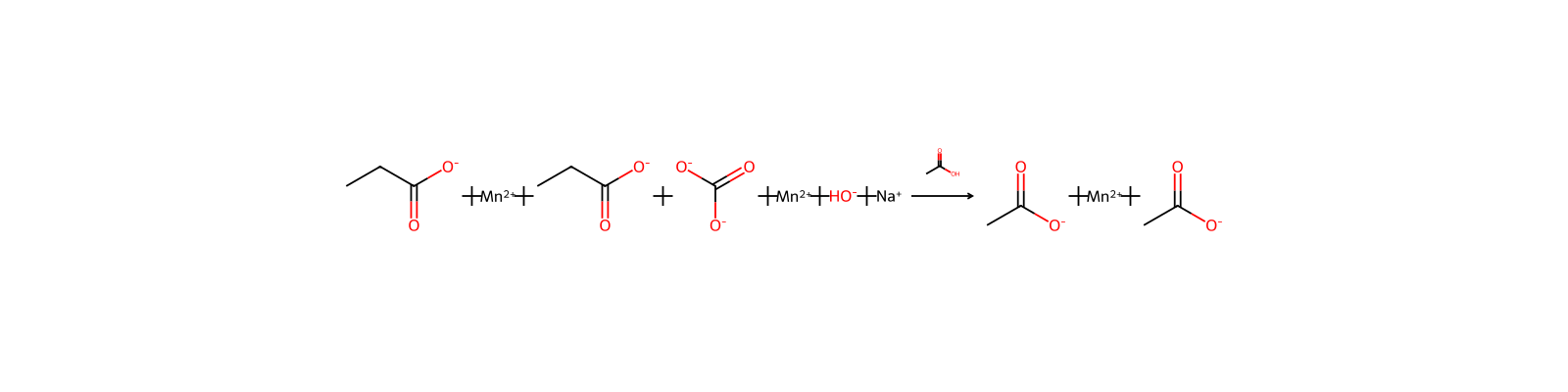
Related reactions
12 records



Linked notes
Loading…