HomeMCPWorkbenchSkills
HomeWorkbenchNotificationsMe
llms.txt · MCP GuidePrivacy Policy · Terms of Service · Supportv1.8.3
  1. Home
  2. /Compound

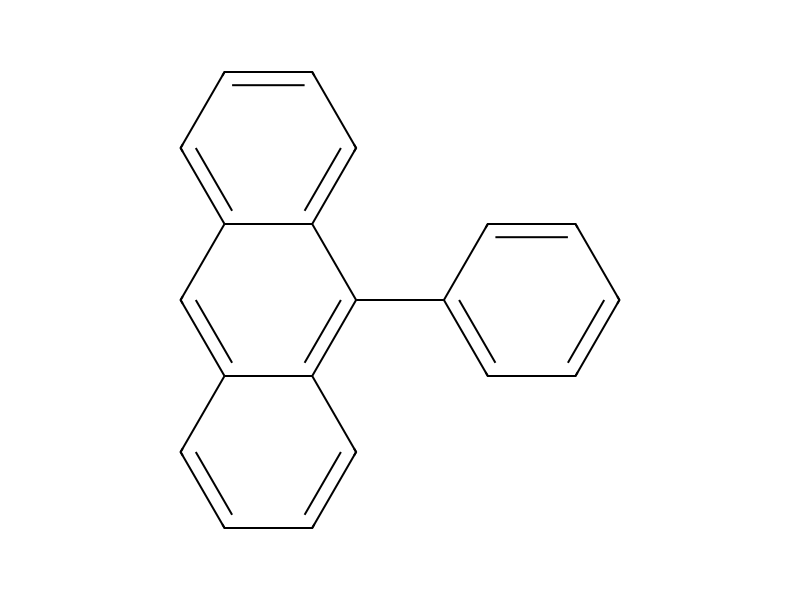
9-Phenylanthracene

HCID 11766
New reaction
Print
Basic informationNames & identifiersPropertiesSafety & regulationChemistry & industryRelated reactionsCompound notes
Substructure searchFind similar structures

Basic information

CAS
602-55-1
Standard SMILES
c1ccc(-c2c3ccccc3cc3ccccc23)cc1
InChIKey
LUBXLGUQZVKOFP-UHFFFAOYSA-N
Molecular formula
C20H14
Average molar mass
254.3 g/mol
Monoisotopic mass
254.10955045

Names & identifiers

Preferred name
9-Phenylanthracene
IUPAC
9-phenylanthracene
English name
9-phenylanthracene
Molecular formula
C20H14
Molecular weight
254.33

Names & synonyms

9-PHENYLANTHRACENEAnthracene, 9-phenyl-EINECS 210-019-8DC63Z5S1UPNSC 90796NSC-90796DTXSID3075254UNII-DC63Z5S1UPAnthracene, 9phenylRefChem:108184Anthracene, 9-phenyl-(8CI)DTXCID2042771
Show more names
9-phenylantracenePhenylanthracene,98%anthracene,9-phenyl-9-Phenylanthracene97%9-Phenylanthracene>9-phenylanthracene-D99-Phenylanthracene,98%9-Phenylanthracene 97%
Anthracene, 9-phenyl-(8CI)(9CI)210-019-8LUBXLGUQZVKOFP-UHFFFAOYSA-N602-55-1MFCD000012529-phenyl-anthraceneNSC907969-Phenylanthracene, 98%

Database identifiers

CAS
602-55-1
PubChem CID
11766
DTXSID
DTXSID3075254
UNII
DC63Z5S1UP
EC Number
210-019-8
Nikkaji
J79.700F

Properties

Computed structural properties

XLogP
6
Topological polar surface area
0 Ų
Hydrogen bond donors
0
Hydrogen bond acceptors
0
Rotatable bonds
1
Heavy atoms
20
Formal charge
0
Complexity
292

Experimental & physicochemical properties

PolymersOther Classes -> Polycyclic Aromatic Hydrocarbons
SpringerMaterials PropertiesAngular frequency
LogP6.01
Vapor Pressure0.00000009 [mmHg]
Physical DescriptionSolid; [Aldrich MSDS]

Physicochemical properties

Melting point
153 · 153-155 °C (lit.)
Boiling point
417 °C · 417 °C (lit.)
Density
1.118 · 1.1180 (estimate)
refractive index
1.704 · 1.7040 (estimate)
storage temp.
Sealed in dry,Room Temperature
solubility
Chloroform (Slightly), Ethyl Acetate (Slightly)
form
Solid

Safety & regulation

Safety information is for reference only and does not replace the supplier’s Safety Data Sheet (SDS), applicable regulations, or professional assessment.

GHS classification

GHS Classification · 4 items

Warning

H400 (100%): Very toxic to aquatic life [Warning Hazardous to the aquatic environment, acute hazard]

P273, P391, and P501 (click each P-code to see the statement)

Aggregated GHS information provided per 39 reports by companies from 2 notifications to the ECHA C&L Inventory. Each notification may be associated with multiple companies.

Hazard information

Hazards SummaryMay cause irritation; [Aldrich MSDS] See POLYCYCLIC AROMATIC HYDROCARBONS.
Hazard Classes and CategoriesAquatic Acute 1 (100%)

Safety data

PPE
Eyeshields, Gloves
wgk
3
ridadr
UN 3077 9/PG 3
hs_code
2902909000
risk_code
50/53
Signal word
Warning
Symbol(GHS)
GHS09
hazard_code
N
safety_code
60-61
hazard_class
9
Storage Class
11 - Combustible Solids
Hazard statements
H410
Hazard Classifications
Aquatic Acute 1Aquatic Chronic 1
Precautionary statements

Chemistry & industry

Applications

Uses9-Phenylanthracene is used to synthesize organic light-emitting material intermediates.

Preparation methods · 1 item

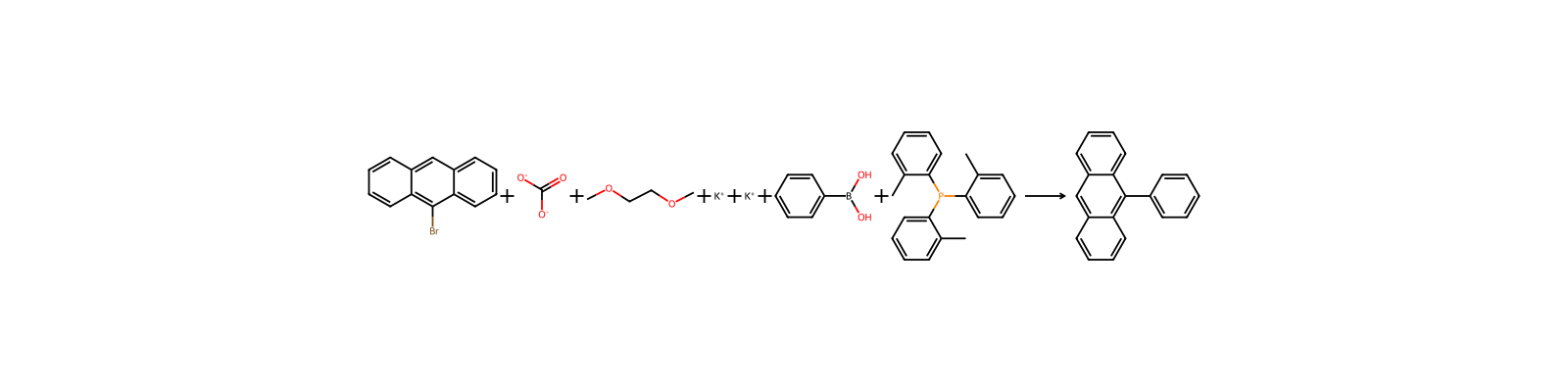
PreparationThe synthesis of 9-phenylanthracene involved mixing phenylboronic acid (2.13 g, 17.49 mmol), 9-bromoanthracene (3 g, 11.66 mmol), Pd(PPh3)4 (140 mg, 0.12 mmol), K2CO3 (16 mL, 2 M), and ethanol (8 mL) in a 100 mL flask with anhydrous toluene (32 mL). The mixture was refluxed for 48 h under nitrogen. After cooled to room temperature, the reaction mixture was quenched with dilute hydrochloric acid solution and extracted with CH2Cl2. The organic extracts were dried over anhydrous MgSO4 and concentrated by rotary evaporation. The crude product was further purified by silica gel column chromatography (CH2Cl2/petroleum ether (1:4,v/v)) to get a white powder (2.43 g, 81.9 %). 1H NMR (500 MHz, CDCl3) δ 8.53 (s, 1H), 8.08 (d, J = 8.5 Hz, 2H), 7.70 – 7.67 (m, 2H), 7.63 – 7.54 (m, 3H), 7.50 – 7.45 (m, 4H), 7.37 (ddd, J = 8.7, 6.5, 1.2 Hz, 2H). EI-MS (m/z): Calculated for C20H14: 254.33. Found [M+]: 253.02.Synthesis of 9-phenylanthracene

Upstream & downstream products

Upstream raw materials

AnthroneBromobenzeneMagnesiumPhenylboronic acid9-BromoanthraceneTetrakis(triphenylphosphine)palladiumPotassium carbonateEthanol

Related reactions

39,452 records
New reaction record
HRID 80288 reaction equation
HRID 80288As product
HRID 125270 reaction equation
HRID 125270As product
HRID 192064 reaction equation
HRID 192064As product
HRID 411955 reaction equation
HRID 411955As reactant
HRID 444662 reaction equation
HRID 444662As product
HRID 535234 reaction equation
HRID 535234As product
HRID 535235 reaction equation
HRID 535235As reactant
HRID 537591 reaction equation
HRID 537591As product
PreviousPage 1 of 4932

Compound notes

On this pageBasic informationNames & identifiersPropertiesSafety & regulationChemistry & industryRelated reactionsCompound notes
color
Off-white to pale brown
Sensitive
Light Sensitive
BRN
1910570 · 1910570
InChI
InChI=1S/C20H14/c1-2-8-15(9-3-1)20-18-12-6-4-10-16(18)14-17-11-5-7-13-19(17)20/h1-14H
InChIKey
LUBXLGUQZVKOFP-UHFFFAOYSA-N
SMILES
C1=C2C(C=C3C(=C2C2=CC=CC=C2)C=CC=C3)=CC=C1
CAS DataBase Reference
602 · 602-55-1(CAS DataBase Reference)
FDA UNII
63 Z5S1UP · DC63Z5S1UP
EPA Substance Registry System
9 · Anthracene, 9-phenyl- (602-55-1)
UNSPSC Code
12352100 · 12352100
NACRES
22 · NA.22
Symbol(GHS)
9 · GHS09
Signal word
Warning
Hazard statements
410 · H410
Precautionary statements
273 · P273-P501
PPE
Eyeshields, Gloves
Hazard Codes
N
Risk Statements
50 · 50/53
Safety Statements
60 · 60-61
RIDADR
3077 · UN 3077 9/PG 3
WGK Germany
3 · 3
HazardClass
9 · 9
HS Code
2902909000 · 2902909000
Storage Class
11 · 11 - Combustible Solids
Hazard Classifications
1 Aquatic · Aquatic Acute 1Aquatic Chronic 1
P273-P501