HomeMCPWorkbenchSkills
HomeWorkbenchNotificationsMe
llms.txt · MCP GuidePrivacy Policy · Terms of Service · Supportv1.8.3
  1. Home
  2. /Compound

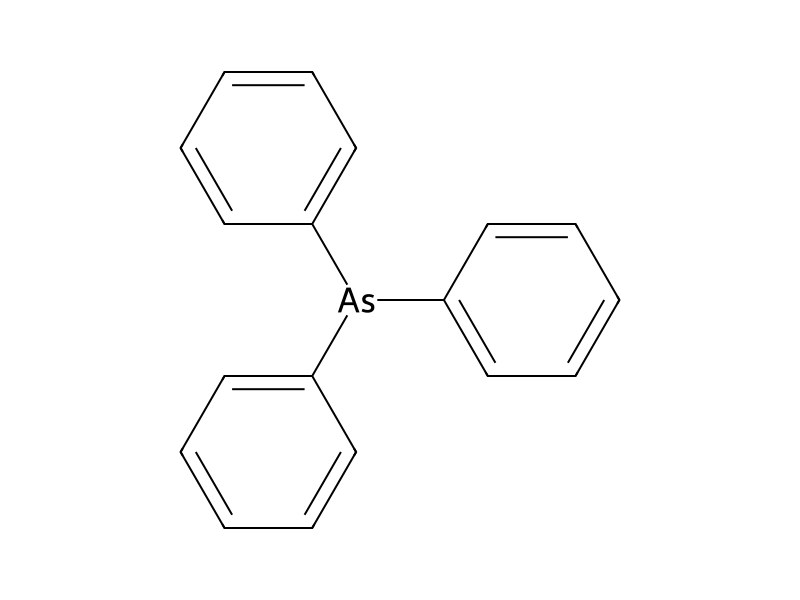
Triphenylarsine

HCID 11773
New reaction
Print
Basic informationOverviewNames & identifiersPropertiesSafety & regulationChemistry & industryRelated reactionsCompound notes
Substructure searchFind similar structures

Basic information

CAS
603-32-7
Standard SMILES
c1ccc([As](c2ccccc2)c2ccccc2)cc1
InChIKey
BPLUKJNHPBNVQL-UHFFFAOYSA-N
Molecular formula
C18H15As
Average molar mass
306.2 g/mol
Monoisotopic mass
306.03897

Overview

Triphenylarsine is an organoarsenic compound. It is used as a ligand and a reagent in coordination chemistry and organic synthesis. Arsenic is a chemical element that has the symbol As and atomic number 33. It is a poisonous metalloid that has many allotropic forms: yellow (molecular non-metallic) and several black and grey forms (metalloids) are a few that are seen. Three metalloidal forms of arsenic with different crystal structures are found free in nature (the minerals arsenopyrite and the much rarer arsenolamprite and pararsenolamprite), but it is more commonly found as a compound with other elements. (T3, L398)

Names & identifiers

Preferred name
Triphenylarsine
IUPAC
triphenylarsane
English name
Triphenylarsine
Molecular formula
C18H15As
Molecular weight
306.23

Names & synonyms

TRIPHENYLARSINE603-32-7TriphenylarsaneArsine, triphenyl-TriphenylarseneTriphenyl arsenicMN8EZ3FL74NSC-478DTXSID4060529RefChem:191898DTXCID6042787210-032-9
Show more names
Triphenyl-arsaneNSC 478triphenyl-arsinTriphenylarsine,97%Triphenylarsine,98%
ArsinetriphenylMFCD00002994TriphenylarsenicArsenic triphenylC18H15Astriphenyl arsinetriphenyl-arsineNSC478

Database identifiers

CAS
603-32-7
PubChem CID
11773
DTXSID
DTXSID4060529
UNII
MN8EZ3FL74
EC Number
210-032-9
Nikkaji
J44.111B

Properties

Computed structural properties

Topological polar surface area
0 Ų
Hydrogen bond donors
0
Hydrogen bond acceptors
0
Rotatable bonds
3
Heavy atoms
19
Formal charge
0
Complexity
202

Experimental & physicochemical properties

Chemical ClassesMetals -> Arsenic Compounds, Organic
Vapor Pressure0.0000496 [mmHg]
Physical DescriptionWhite powder; [Alfa Aesar MSDS] Fine colorless crystals; [Aldrich MSDS]

Physicochemical properties

Melting point
58 · 58-61 °C (lit.)
Boiling point
360 °C · 360 °C
Density
1 · 1,225 g/cm3
refractive index
1.6888 · 1.6888
Flash point
265 °C · 265 °C
storage temp.
30 °C · Store below +30°C.
form
Powder
color
white
Specific Gravity
1.2225 · 1.2225
Water Solubility
Soluble in methanol. Insoluble in water.
Hydrolytic Sensitivity

Safety & regulation

Safety information is for reference only and does not replace the supplier’s Safety Data Sheet (SDS), applicable regulations, or professional assessment.

GHS classification

GHS Classification · 4 items

Danger

H301 (100%): Toxic if swallowed [Danger Acute toxicity, oral]

P261, P264, P270, P271, P273, P301+P316, P304+P340, P316, P321, P330, P391, P403+P233, P405, and P501 (click each P-code to see the statement)

Aggregated GHS information provided per 44 reports by companies from 4 notifications to the ECHA C&L Inventory. Each notification may be associated with multiple companies.

Hazard information

Regulatory Information · 2 items

Restricted substance: Triphenylarsine

Triphenylarsine: Does not have an individual approval but may be used under an appropriate group standard

Hazards Summary · 1 item

An irritant; Toxic by ingestion and inhalation; [Alfa Aesar MSDS] Almost nothing is known regarding health effects of organic arsenic compounds in humans. Studies in animals show that some simple organic arsenic compounds are less toxic than inorganic forms. Ingestion of methyl and dimethyl compounds can cause diarrhea and damage to the kidneys. [ATSDR ToxProfiles] See Dimethylarsenic acid.

Hazard Classes and CategoriesAcute Tox. 3 (100%)

Safety & protection

Minimum Risk LevelAcute Oral: 0.005 mg/kg/day (L134) Chronic Oral: 0.0003 mg/kg/day (L134) Chronic Inhalation: 0.01 mg/m3 (L134)
Permissible Exposure Limit (PEL)0.5 [mg/m3], as As

Toxicology

Chemistry & industry

Pharmacology

Metabolism/Metabolites · 1 item

Arsenic is absorbed mainly by inhalation or ingestion, as to a lesser extent, dermal exposure. It is then distributed throughout the body, where it is reduced into arsenite if necessary, then methylated into monomethylarsenic (MMA) and dimethylarsenic acid (DMA) by arsenite methyltransferase. Arsenic and its metabolites are primarily excreted in the urine. Arsenic is known to induce the metal-binding protein metallothionein, which decreases the toxic effects of arsenic and other metals by binding them and making them biologically inactive, as well as acting as an antioxidant. (L20)

Uses & manufacturing

UsesTriphenylarsine is used as a ligand and a reagent in coordination chemistry and organic synthesis. (L398)
General Manufacturing InformationArsine, triphenyl-: ACTIVE

Applications

UsesTriphenylarsine is used in certain metal-catalyzed coupling reactions. It is a precursor to tetraphenylarsonium chloride a popular precipitating agent.

Upstream & downstream products

Downstream products

Tungsten,pentacarbonyl(triphenylarsine)-(OC-6-22)-

Related reactions

190 records
New reaction record
HRID 14608 reaction equation
HRID 14608As reactant
HRID 33001 reaction equation
HRID 33001As reactant
HRID 33662 reaction equation
HRID 33662As reactant
HRID 53280 reaction equation
HRID 53280As catalyst
HRID 70769 reaction equation
HRID 70769As reactant
HRID 72786 reaction equation
HRID 72786As reactant
HRID 86008 reaction equation
HRID 86008As reactant
HRID 91724 reaction equation
HRID 91724As reactant
PreviousPage 1 of 24

Compound notes

On this pageBasic informationOverviewNames & identifiersPropertiesSafety & regulationChemistry & industryRelated reactionsCompound notes
4 · 4: no reaction with water under neutral conditions
BRN
1842037 · 1842037
InChI
1S/C18H15As/c1-4-10-16(11-5-1)19(17-12-6-2-7-13-17)18-14-8-3-9-15-18/h1-15H
InChIKey
BPLUKJNHPBNVQL-UHFFFAOYSA-N
SMILES
c1ccc(cc1)[As](c2ccccc2)c3ccccc3
CAS DataBase Reference
603 · 603-32-7(CAS DataBase Reference)
REACH Annex XVII Substances List
Triphenylarsine (603-32-7)
FDA UNII
8 EZ3FL74 · MN8EZ3FL74
EPA Substance Registry System
Arsine, triphenyl- (603-32-7)
UNSPSC Code
12352103 · 12352103
NACRES
23 · NA.23
Symbol(GHS)
6 · GHS06,GHS09
Signal word
Danger
Hazard statements
301 · H301+H331-H410
Precautionary statements
273 · P273-P301+P310+P330-P304+P340+P311
Hazard Codes
T,N
Risk Statements
23 · 23/25-50/53
Safety Statements
20 · 20/21-28-45-60-61
RIDADR
3465 · UN 3465 6.1/PG 2
WGK Germany
3 · 3
RTECS
8942500 · CH8942500
TSCA
TSCA listed
HS Code
2931 · 2931 90 00
HazardClass
6.1 · 6.1
PackingGroup
II
Storage Class
6.1 A · 6.1A - Combustible acute toxic Cat. 1 and 2very toxic hazardous materials
Hazard Classifications
3 InhalationAcute · Acute Tox. 3 InhalationAcute Tox. 3 OralAquatic Acute 1Aquatic Chronic 1
Limited Quantities
0.5 Kg · 0.5 Kg (solid)
Excepted Quantities
Max Inner Pack (1g or 1ml) and Max Outer Pack (500g or 500ml)
Treatment · 1 item

Arsenic poisoning can be treated by chelation therapy, using chelating agents such as dimercaprol, EDTA or DMSA. Charcoal tablets may also be used for less severe cases. In addition, maintaining a diet high in sulfur helps eliminate arsenic from the body. (L20)

Health EffectsArsenic poisoning can lead to death from multi-system organ failure, probably from necrotic cell death, not apoptosis. Arsenic is also a known carcinogen, esepcially in skin, liver, bladder and lung cancers. (T1, L20)
Exposure RoutesOral (L2) ; inhalation (L2) ; dermal (L2)
Toxicity Summary · 1 item

Arsenic and its metabolites disrupt ATP production through several mechanisms. At the level of the citric acid cycle, arsenic inhibits pyruvate dehydrogenase and by competing with phosphate it uncouples oxidative phosphorylation, thus inhibiting energy-linked reduction of NAD+, mitochondrial respiration, and ATP synthesis. Hydrogen peroxide production is also increased, which might form reactive oxygen species and oxidative stress. Arsenic's carginogenicity is influenced by the arsenical binding of tubulin, which results in aneuploidy, polyploidy and mitotic arrests. The binding of other arsenic protein targets may also cause altered DNA repair enzyme activity, altered DNA methylation patterns and cell proliferation. (T1, A17)

Signs and SymptomsExposure to lower levels of arsenic can cause nausea and vomiting, decreased production of red and white blood cells, abnormal heart rhythm, damage to blood vessels, and a sensation of
Carcinogen Classification3, not classifiable as to its carcinogenicity to humans. (L135)

Safety data

wgk
3
tsca
TSCA listed
rtecs
CH8942500
ridadr
UN 3465 6.1/PG 2
hs_code
2931 90 00
risk_code
23/25-50/53
Signal word
Danger
Symbol(GHS)
GHS06,GHS09
hazard_code
T,N
safety_code
20/21-28-45-60-61
hazard_class
6.1
Storage Class
6.1A - Combustible acute toxic Cat. 1 and 2very toxic hazardous materials
packing_group
II
Hazard statements
H301+H331-H410
Limited Quantities
0.5 Kg (solid)
Excepted Quantities
Max Inner Pack (1g or 1ml) and Max Outer Pack (500g or 500ml)
Hazard Classifications
Acute Tox. 3 InhalationAcute Tox. 3 OralAquatic Acute 1Aquatic Chronic 1
Precautionary statements
P273-P301+P310+P330-P304+P340+P311