HomeMCPWorkbenchSkills
HomeWorkbenchNotificationsMe
llms.txt · MCP GuidePrivacy Policy · Terms of Service · Supportv1.8.3
  1. Home
  2. /Compound

2-Nitrophenylacetonitrile

HCID 11888
New reaction
Print
Basic informationOverviewNames & identifiersPropertiesSafety & regulationChemistry & industryRelated reactionsCompound notes
Substructure searchFind similar structures

Basic information

CAS
610-66-2
Standard SMILES
N#CCc1ccccc1[N+](=O)[O-]
InChIKey
YPRFCQAWSNWRLM-UHFFFAOYSA-N
Molecular formula
C8H6N2O2
Average molar mass
162.15 g/mol
Monoisotopic mass
162.04292744

Overview

O-nitrophenylacetonitrile is a light brown solid. (NTP, 1992)

Names & identifiers

Preferred name
2-Nitrophenylacetonitrile
IUPAC
2-(2-nitrophenyl)acetonitrile
English name
2-Nitrophenylacetonitrile
Molecular formula
C8H6N2O2
Molecular weight
162.15

Names & synonyms

2-Nitrophenylacetonitrile610-66-2(2-Nitrophenyl)acetonitrileBenzeneacetonitrile, 2-nitro-2-Nitrobenzeneacetonitrileo-Nitrobenzacetonitrile(o-Nitrophenyl)acetonitrile2-Nitrobenzyl nitrileAcetonitrile, (o-nitrophenyl)-O-NITROPHENYLACETONITRILEo-Nitrophenyl acetonitrileCCRIS 4681
Show more names
2-(2-Nitrophenyl)acetonitrile2-nitrobenzylnitrile2-NITROBENZYL CYANIDEO-NITROBENZYL CYANIDE2-NitrobenzylCyanide>o-Nitro-α-toluic nitrile
DTXSID7025768EINECS 210-231-0NSC 99338BRN 1869400NSC-99338DTXCID9057687859F455K63-09-00-02283 (Beilstein Handbook Reference)

Database identifiers

CAS
610-66-2
PubChem CID
11888
DTXSID
DTXSID7025768
ChEMBL
CHEMBL1300441
UNII
7859F455K6
EC Number
210-231-0

Properties

Computed structural properties

XLogP
1.8
Topological polar surface area
69.6 Ų
Hydrogen bond donors
0
Hydrogen bond acceptors
3
Rotatable bonds
1
Heavy atoms
12
Formal charge
0
Complexity
213

Experimental & physicochemical properties

Solubilityless than 0.1 mg/mL at 68 °F (NTP, 1992)
Boiling Point352 °F at 12 mmHg (NTP, 1992)
Melting Point183 °F (NTP, 1992)
Physical DescriptionO-nitrophenylacetonitrile is a light brown solid. (NTP, 1992)

Physicochemical properties

Melting point
82 · 82-85 °C(lit.)
Boiling point
178 °C · 178°C
Density
1.3264 · 1.3264 (rough estimate)
refractive index
1.577 · 1.5770 (estimate)
storage temp.
Sealed in dry,Room Temperature
solubility
Chloroform, Ethyl Acetate
form
Powder
color
Light brown to brownish-gray

Safety & regulation

Safety information is for reference only and does not replace the supplier’s Safety Data Sheet (SDS), applicable regulations, or professional assessment.

GHS classification

GHS Classification · 4 items

Warning

H302 (97.8%): Harmful if swallowed [Warning Acute toxicity, oral]

P261, P264, P264+P265, P270, P271, P280, P301+P317, P302+P352, P304+P340, P305+P351+P338, P317, P319, P321, P330, P332+P317, P337+P317, P362+P364, P403+P233, P405, and P501 (click each P-code to see the statement)

Aggregated GHS information provided per 45 reports by companies from 5 notifications to the ECHA C&L Inventory. Each notification may be associated with multiple companies.

Hazard information

Fire HazardsFlash point data for this chemical are not available. It is probably combustible. (NTP, 1992)
Reactive GroupNitriles
Reactivity Profile · 1 item

Nitriles, such as O-NITROPHENYLACETONITRILE, may polymerize in the presence of metals and some metal compounds. They are incompatible with acids; mixing nitriles with strong oxidizing acids can lead to extremely violent reactions. Nitriles are generally incompatible with other oxidizing agents such as peroxides and epoxides. The combination of bases and nitriles can produce hydrogen cyanide. Nitriles are hydrolyzed in both aqueous acid and base to give carboxylic acids (or salts of carboxylic acids). These reactions generate heat. Peroxides convert nitriles to amides. Nitriles can react vigorously with reducing agents. Acetonitrile and propionitrile are soluble in water, but nitriles higher than propionitrile have low aqueous solubility. They are also insoluble in aqueous acids.

Air and Water ReactionsInsoluble in water.
Hazard Classes and CategoriesAcute Tox. 4 (97.8%)

Chemistry & industry

Uses & manufacturing

General Manufacturing InformationBenzeneacetonitrile, 2-nitro-: INACTIVE

Applications

Uses2-Nitrophenylacetonitrile was used in synthesis of 2 or 2,4-substituted α-carbolines via a one-pot tandem reaction of α,β-unsaturated ketones. It was used in the synthesis of strychnine.

General DescriptionLight brown solid.

Upstream & downstream products

Downstream products

2-Aminobenzyl cyanide2-(2-Chlorophenyl)acetonitrile2-(2-Nitrophenyl)ethanamine1H-Indazole-3-carbonitrile1-(Hydroxyimino)-2-(2-nitrophenyl)ethylamine

Related reactions

23 records
New reaction record
HRID 171297 reaction equation
HRID 171297As reactant
HRID 392937 reaction equation
HRID 392937As reactant
HRID 696434 reaction equation
HRID 696434As reactant
HRID 697450 reaction equation
HRID 697450As reactant
HRID 989599 reaction equation
HRID 989599As reactant
HRID 989600 reaction equation
HRID 989600As reactant
HRID 1110474 reaction equation
HRID 1110474As reactant
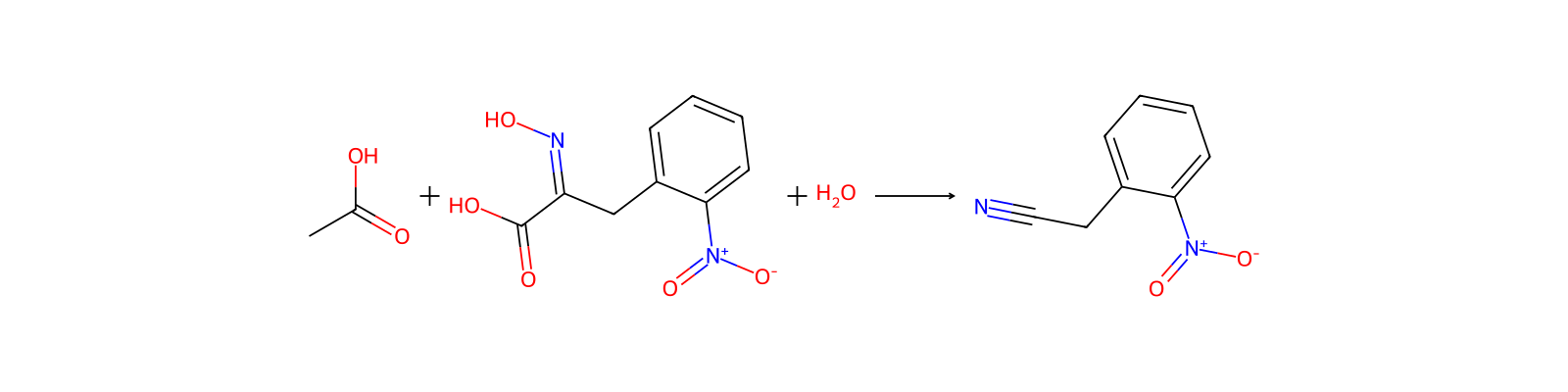
HRID 1237017 reaction equation
HRID 1237017As product
PreviousPage 1 of 3

Compound notes

On this pageBasic informationOverviewNames & identifiersPropertiesSafety & regulationChemistry & industryRelated reactionsCompound notes
Nikkaji
J31.170G
Water Solubility
0.01 g/100 · <0.01 g/100 mL at 20 ºC
BRN
1869400 · 1869400
Exposure limits
25 mg/m3 · NIOSH: IDLH 25 mg/m3
Stability
Stable. Incompatible with strong oxidizing agents.
InChI
1S/C8H6N2O2/c9-6-5-7-3-1-2-4-8(7)10(11)12/h1-4H,5H2
InChIKey
YPRFCQAWSNWRLM-UHFFFAOYSA-N
SMILES
[O-][N+](=O)c1ccccc1CC#N
CAS DataBase Reference
610 · 610-66-2(CAS DataBase Reference)
FDA UNII
7859 F455K6 · 7859F455K6
EPA Substance Registry System
o-Nitrophenylacetonitrile (610-66-2)
UNSPSC Code
12352100 · 12352100
NACRES
22 · NA.22
Symbol(GHS)
7 · GHS07,GHS06
Signal word
Warning
Hazard statements
302 · H302-H311-H332-H302+H312+H332-H315-H319-H335
Precautionary statements
280 h-P309-P310-P261-P280-P305+P351+P338 · P280h-P309-P310-P261-P280-P305+P351+P338
target organs
Respiratory system
PPE
95 · dust mask type N95 (US), Eyeshields, Gloves
Hazard Codes
Xn,Xi
Risk Statements
20 · 20/21/22-36/37/38
Safety Statements
26 · 26-36-24/25
RIDADR
3439 · 3439
WGK Germany
3 · 3
RTECS
1248000 · AM1248000
Hazard Note
Irritant
TSCA
TSCA listed
HazardClass
6.1 · 6.1
PackingGroup
III
HS Code
2926909090 · 2926909090
Storage Class
11 · 11 - Combustible Solids
Hazard Classifications
4 DermalAcute · Acute Tox. 4 DermalAcute Tox. 4 InhalationAcute Tox. 4 OralEye Irrit. 2Skin Irrit. 2STOT SE 3

Safety & protection

Fire FightingFires involving this material can be controlled with a dry chemical, carbon dioxide or Halon extinguisher. (NTP, 1992)
First Aid · 1 item

EYES: First check the victim for contact lenses and remove if present. Flush victim's eyes with water or normal saline solution for 20 to 30 minutes while simultaneously calling a hospital or poison control center. Do not put any ointments, oils, or medication in the victim's eyes without specific instructions from a physician. IMMEDIATELY transport the victim after flushing eyes to a hospital even if no symptoms (such as redness or irritation) develop.

Nonfire Spill Response · 1 item

SMALL SPILLS AND LEAKAGE: Should a spill occur while you are handling this chemical, FIRST REMOVE ALL SOURCES OF IGNITION, then you should dampen the solid spill material with ethanol and transfer the dampened material to a suitable container. Use absorbent paper dampened with ethanol to pick up any remaining material. Seal the absorbent paper, and any of your clothes, which may be contaminated, in a vapor-tight plastic bag for eventual disposal. Solvent wash all contaminated surfaces with ethanol followed by washing with a soap and water solution. Do not reenter the contaminated area until the Safety Officer (or other responsible person) has verified that the area has been properly cleaned.

Personal Protective Equipment (PPE) · 1 item

RECOMMENDED RESPIRATOR: Where the neat test chemical is weighed and diluted, wear a NIOSH-approved half face respirator equipped with an organic vapor/acid gas cartridge (specific for organic vapors, HCl, acid gas and SO2) with a dust/mist filter. (NTP, 1992)

Safety data

PPE
dust mask type N95 (US), Eyeshields, Gloves
wgk
3
tsca
TSCA listed
rtecs
AM1248000
ridadr
3439
hs_code
2926909090
risk_code
20/21/22-36/37/38
Signal word
Warning
Symbol(GHS)
GHS07,GHS06
hazard_code
Xn,Xi
hazard_note
Irritant
safety_code
26-36-24/25
hazard_class
6.1
Storage Class
11 - Combustible Solids
packing_group
III
target organs
Respiratory system
Hazard statements
H302-H311-H332-H302+H312+H332-H315-H319-H335
Hazard Classifications
Acute Tox. 4 DermalAcute Tox. 4 InhalationAcute Tox. 4 OralEye Irrit. 2Skin Irrit. 2STOT SE 3
Precautionary statements
P280h-P309-P310-P261-P280-P305+P351+P338