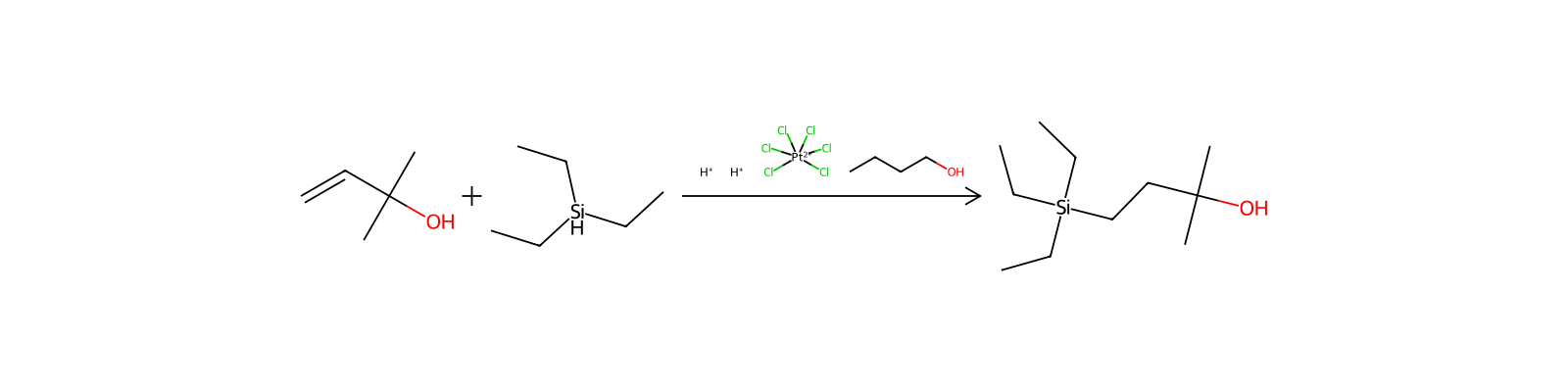
HRID 2355As reactant

617-86-7CC[SiH](CC)CCAQRLNPVMDITEJU-UHFFFAOYSA-NTriethylsilane is an organosilicon compound. It has a role as a reducing agent.
617-86-7DTXSID20870702CHEBI:188370Safety information is for reference only and does not replace the supplier’s Safety Data Sheet (SDS), applicable regulations, or professional assessment.
This chemical does not meet GHS hazard criteria for 0.7% (1 of 143) of reports.
Danger
H225 (99.3%): Highly Flammable liquid and vapor [Danger Flammable liquids]
P210, P233, P240, P241, P242, P243, P261, P264, P264+P265, P271, P273, P280, P302+P352, P303+P361+P353, P304+P340, P305+P351+P338, P319, P321, P332+P317, P337+P317, P362+P364, P370+P378, P391, P403+P233, P403+P235, P405, and P501 (click each P-code to see the statement)
Aggregated GHS information provided per 143 reports by companies from 21 notifications to the ECHA C&L Inventory. Each notification may be associated with multiple companies.
Chemical: Silane, triethyl-
REACH registered substance: Triethylsilane (EC: 210-535-3)
Triethylsilane: Does not have an individual approval but may be used under an appropriate group standard
DescriptionTriethylsilane is a useful versatile reductant since it has a active hydride. It can be used for mediated the palladium-catalyzed dehalogenation reaction of alkyl or aryl halides, the reduction of primary, secondary, and tertiary chlorides, bromides, and iodides catalyzed by iridium, as well as efficient reduction of multiple bonds, azides, imines, and nitro groups, as well as benzyl group and allyl group deprotection. It is also specifically for the hydrosilation of olefins to give alkyl silanes. It is also the catalyst for synthesis of a spiro-oxindole blocker of Nav1.7 for the treatment of pain, redox initiated cationic polymerization and Beckmann rearrangement of cyclododecanone oxime as well as regioselective reductive coupling of enones and allenes.
UsesTriethylsilane is a trialkylsilicon hydride used in the synthesis of alkylsilanes via hydrosilation of olefins. It acts as a reducing agent in the reduction of 2-chromanols, since it has an active hydride. It acts as a catalyst for redox initiated cationic polymerization, regioselective reductive coupling of enones and allenes, and Beckmann rearrangement of cyclododecanone oxime. It is associated with trifluoroacetic acid and involved in the selective reduction of alkenes.
DefinitionChEBI: Triethylsilane is an organosilicon compound. It has a role as a reducing agent.


