
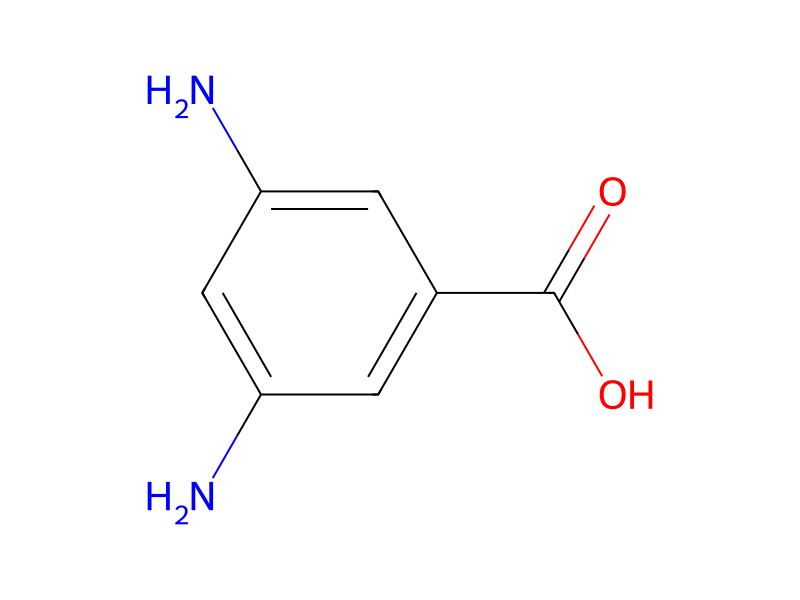
Basic information
- Standard SMILES
Nc1cc(N)cc(C(=O)O)c1- InChIKey
UENRXLSRMCSUSN-UHFFFAOYSA-N- Molecular formula
- C7H8N2O2
- Average molar mass
- 152.15 g/mol
- Monoisotopic mass
- 152.0585775
Overview
RN given refers to parent cpd
Names & identifiers
- Preferred name
- 3,5-Diaminobenzoic acid
- IUPAC
- 3,5-diaminobenzoic acid
- English name
- 3,5-Diaminobenzoic acid
- Molecular formula
- C7H8N2O2
- Molecular weight
- 152.15
Names & synonyms
3,5-Diaminobenzoic acid535-87-5Benzoic acid, 3,5-diamino-DTXSID10444371609U1093NDTXCID9024437RefChem:91414208-621-0MFCD000078071-Carboxy-3,5-Diaminobenzene3,5-diaminobenzoic acid (DABA)CCRIS 2885
Show more names
3,5-DABA3,5-DiaMinoben3, 5-2 aMino acidDiaMinobenzoic aci3,5-Diaminobenzoic a3,5-DIACETYLPYRAZINE3,5-eranjibenjiasuan3,5-diamino-benzoicaci3,5-Diaminebenzoic acid
EINECS 208-621-03,5-diamino benzoic acidBRN 2086484AI3-52307DABzUNII-1609U1093NOprea1_6624444-14-00-01304 (Beilstein Handbook Reference)
Database identifiers
- CAS
535-87-5- PubChem CID
- 12062
- DTXSID
DTXSID1044437- ChEMBL
CHEMBL337700- UNII
- 1609U1093N
- EC Number
- 208-621-0
- Nikkaji
- J43.102H
Properties
Computed structural properties
- XLogP
- 0.2
- Topological polar surface area
- 89.3 Ų
- Hydrogen bond donors
- 3
- Hydrogen bond acceptors
- 4
- Rotatable bonds
- 1
- Heavy atoms
- 11
- Formal charge
- 0
- Complexity
- 151
Experimental & physicochemical properties
Chemical ClassesNitrogen Compounds -> Aminobenzoic Acids
Physical DescriptionGray or brown powder; [Alfa Aesar MSDS]
Collision Cross Section136.6 Ų [M-H]- [CCS Type: DT; Buffer gas: N2; Ionization: ESI-; Dataset: TOXCAST; Source Identifier: DTXSID1044437]
Physicochemical properties
- Melting point
- 235 · 235-238 °C (dec.) (lit.)
- Boiling point
- 274.61 °C · 274.61°C (rough estimate)
- Density
- 1.2804 · 1.2804 (rough estimate)
- vapor pressure
- 0 Pa · 0Pa at 25℃
- refractive index
- 1.52 · 1.5200 (estimate)
- Flash point
- 235 · 235-240°C
- storage temp.
- Keep in dark place,Sealed in dry,Room Temperature
- solubility
- DMSO (Sparingly), Methanol (Slightly)
- form
- Powder
- pka
- 1 · pK1:5.30 (25°C)
- color
- White to gray
- Water Solubility
- Very soluble in water.
- Decomposition
- 235 · 235-240 ºC
- Merck
- 14 · 14,2978
- BRN
- 2086484 · 2086484
- InChI
- 1S/C7H8N2O2/c8-5-1-4(7(10)11)2-6(9)3-5/h1-3H,8-9H2,(H,10,11)
- InChIKey
- UENRXLSRMCSUSN-UHFFFAOYSA-N
- SMILES
- Nc1cc(N)cc(c1)C(O)=O
- LogP
- -0.51 · -0.51
- CAS DataBase Reference
- 535 · 535-87-5(CAS DataBase Reference)
- EWG's Food Scores
- 1 · 1
- FDA UNII
- 1609 U1093N · 1609U1093N
- EPA Substance Registry System
- 3 · Benzoic acid, 3,5-diamino- (535-87-5)
- UNSPSC Code
- 12352200 · 12352200
- NACRES
- 22 · NA.22
- Symbol(GHS)
- 7 · GHS07,GHS08
- Signal word
- Warning
- Hazard statements
- 315 · H315-H319-H341-H335
- Precautionary statements
- 261 · P261-P280a-P304+P340-P305+P351+P338-P501a-P201-P202-P264-P280-P302+P352+P332+P313+P362+P364-P305+P351+P338+P337+P313-P308+P313-P405-P501
- Hazard Codes
- Xi
- Risk Statements
- 36 · 36/37/38
- Safety Statements
- 26 · 26-36-37/39
- WGK Germany
- 3 · 3
- RTECS
- 6186000 · DG6186000
- Hazard Note
- Irritant
- TSCA
- TSCA listed
- HS Code
- 29224995 · 29224995
- Storage Class
- 11 · 11 - Combustible Solids
- REACH Registrations
- Inactive
Safety & regulation
GHS classification
GHS Classification
Warning
H315 (100%): Causes skin irritation [Warning Skin corrosion/irritation]
P261, P264, P264+P265, P271, P280, P302+P352, P304+P340, P305+P351+P338, P319, P321, P332+P317, P337+P317, P362+P364, P403+P233, P405, and P501 (click each P-code to see the statement)
Aggregated GHS information provided per 48 reports by companies from 8 notifications to the ECHA C&L Inventory. Each notification may be associated with multiple companies.
Not Classified
Hazard information
Regulatory Information
Status: Cease Manufacture Update: 10-03-2017 https://echa.europa.eu/registration-dossier/-/registered-dossier/19028
Benzoic acid, 3,5-diamino-: Does not have an individual approval but may be used under an appropriate group standard
Hazards SummaryA skin, respiratory tract, and strong eye irritant; [Alfa Aesar MSDS]
Hazard Classes and CategoriesSkin Irrit. 2 (100%)
Safety data
- wgk
- 3
- tsca
- TSCA listed
- rtecs
- DG6186000
- hs_code
- 29224995
- risk_code
- 36/37/38
- Signal word
- Warning
- Symbol(GHS)
- GHS07,GHS08
- hazard_code
- Xi
- hazard_note
- Irritant
- safety_code
- 26-36-37/39
- Storage Class
- 11 - Combustible Solids
- Hazard statements
- H315-H319-H341-H335
- REACH Registrations
- Inactive
- Precautionary statements
- P261-P280a-P304+P340-P305+P351+P338-P501a-P201-P202-P264-P280-P302+P352+P332+P313+P362+P364-P305+P351+P338+P337+P313-P308+P313-P405-P501
Chemistry & industry
Uses & manufacturing
UsesUsed for the detection and determination of nitrites; [Merck Index]
General Manufacturing InformationBenzoic acid, 3,5-diamino-: ACTIVE
Applications
Uses3,5-diaminobenzoic acid be used as organic intermediates.
Uses3,5-Diaminobenzoic acid is an analog of diatriazoate, which has been shown to have antigenicity properties towards the monoclonal antibodies. It is used as pharmaceutical intermediate.
Upstream & downstream products
Upstream raw materials
Downstream products
Related reactions
14 records


Linked notes
Loading…