
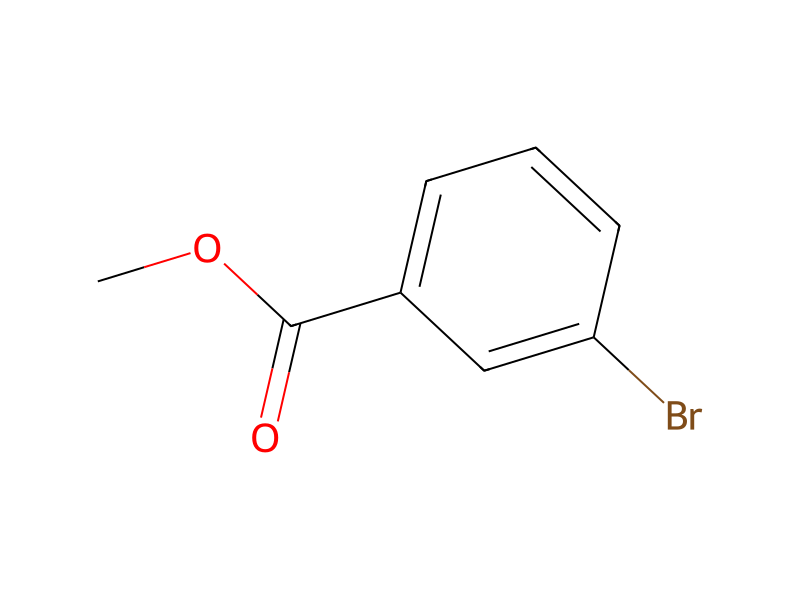
Basic information
- CAS
618-89-3- Standard SMILES
COC(=O)c1cccc(Br)c1- InChIKey
KMFJVYMFCAIRAN-UHFFFAOYSA-N- Molecular formula
- C8H7BrO2
- Average molar mass
- 215.04 g/mol
- Monoisotopic mass
- 213.96294156
Names & identifiers
- Preferred name
- Methyl 3-bromobenzoate
- IUPAC
- methyl 3-bromobenzoate
- English name
- Methyl 3-bromobenzoate
- Molecular formula
- C8H7BrO2
- Molecular weight
- 215.04
Names & synonyms
METHYL 3-BROMOBENZOATEBenzoic acid, 3-bromo-, methyl esterm-Bromobenzoic acid methyl esterMethyl m-bromo benzoateNSC 7319EINECS 210-569-9DTXSID6060688Methyl mbromobenzoateRefChem:157457DTXCID00431393Bromobenzoic acid, methyl esterBenzoic acid, mbromo, methyl ester
Show more names
RARECHEM AL BF 00523-Bromobenzoate MethylMethyl-3-Bromobenzoate 98%Methyl 3-Bromobenzoate >Methyl 3-bromobenzoate, 95%Methyl 3-bromobenzoate, 98+%3-bromo-benzoicacimethylesterBenzoicacid, m-bromo-, methyl
Benzoic acid, 3bromo, methyl ester210-569-9InChI=1/C8H7BrO2/c1-11-8(10)6-3-2-4-7(9)5-6/h2-5H,1HKMFJVYMFCAIRAN-UHFFFAOYSA-N618-89-33-Bromobenzoic Acid Methyl EsterMethyl m-bromobenzoate3-Bromobenzoic acid, methyl ester
Database identifiers
- CAS
618-89-3- PubChem CID
- 12070
- DTXSID
DTXSID6060688- EC Number
- 210-569-9
- Nikkaji
- J96.121C
Properties
Computed structural properties
- XLogP
- 2.9
- Topological polar surface area
- 26.3 Ų
- Hydrogen bond donors
- 0
- Hydrogen bond acceptors
- 2
- Rotatable bonds
- 2
- Heavy atoms
- 11
- Formal charge
- 0
- Complexity
- 147
Experimental & physicochemical properties
Chemical ClassesOther Classes -> Halogenated Esters
SpringerMaterials Properties13C nuclear magnetic resonance spectrum
Vapor Pressure0.02 [mmHg]
Physical DescriptionCrystalline solid; mp = 29-30 deg C; [Alfa Aesar MSDS]
Physicochemical properties
- Melting point
- 31 · 31-33 °C(lit.)
- Boiling point
- 127 · 127-128 °C15 mm Hg(lit.)
- Density
- 1.5313 · 1.5313 (rough estimate)
- refractive index
- 1.5575 · 1.5575
- Flash point
- 230 °F · >230 °F
- storage temp.
- Sealed in dry,Room Temperature
- form
- Crystalline Solid or Liquid
- color
- White to light yellow
Safety & regulation
GHS classification
GHS Classification
Warning
H302 (33.3%): Harmful if swallowed [Warning Acute toxicity, oral]
P261, P264, P264+P265, P270, P271, P280, P301+P317, P302+P352, P304+P340, P305+P351+P338, P317, P319, P321, P330, P332+P317, P337+P317, P362+P364, P403+P233, P405, and P501 (click each P-code to see the statement)
Aggregated GHS information provided per 3 reports by companies from 2 notifications to the ECHA C&L Inventory. Each notification may be associated with multiple companies.
Hazard information
Hazards SummaryMay cause irritation; [Alfa Aesar MSDS]
Hazard Classes and CategoriesSkin Irrit. 2 (66.7%)
Safety data
- PPE
- Eyeshields, Gloves, type N95 (US)
- wgk
- 3
- tsca
- TSCA listed
- hs_code
- 29163990
- risk_code
- 36/37/38
- Signal word
- Danger
- Symbol(GHS)
- GHS06
- hazard_code
- Xi
- safety_code
- 37/39-26-24/25
- Storage Class
- 11 - Combustible Solids
- Hazard statements
- H301+H331-H315-H319-H335
- Precautionary statements
- P501-P261-P270-P271-P264-P280-P302+P352-P337+P313-P305+P351+P338-P362+P364-P332+P313-P301+P310+P330-P304+P340+P311-P403+P233-P405
Chemistry & industry
Uses & manufacturing
General Manufacturing InformationBenzoic acid, 3-bromo-, methyl ester: ACTIVE
Applications
UsesMethyl 3-bromobenzoate is an halogenated benzoate derivative used as a reagent in organic synthesis.Methyl 3-bromobenzoate is used in the synthesis of a novel series of tetrahydro dibenzazocine as inhibitors of 17β-hydroxysteroid dehydrogenase type 3.
UsesMethyl 3-bromobenzoate is used as a reagent in organic synthesis. It is used in the synthesis of tetrahydro dibenzazocine, which acts as an inhibitor of 17beta-hydroxysteroid dehydrogenase type 3. Further, it is used to prepare 3-tert-butylphosphanyl-benzoic acid methyl ester by reacting with tert-butyltrimethylsilylphosphine.
General DescriptionMethyl 3-bromobenzoate is an aryl bromide. It undergoes stereoconvergent cross-coupling with potassium trifluoro(1-phenylethyl)borate to form 1,1-diarylethane derivative. The Negishi cross-coupling reaction between methyl 3-bromobenzoate and diarylzinc reagents in the presence of a palladium catalyst has been reported. Methyl-3-bromobenzoate can be converted into the corresponding benzonitrile using dichloro[bis{1-(dicyclohexylphosphanyl)piperidine}]palladium as a C-C cross-coupling catalyst and K4[Fe(CN)6] as a cyanating agent.
Upstream & downstream products
Downstream products
Related reactions
110 records


Compound notes
Loading…