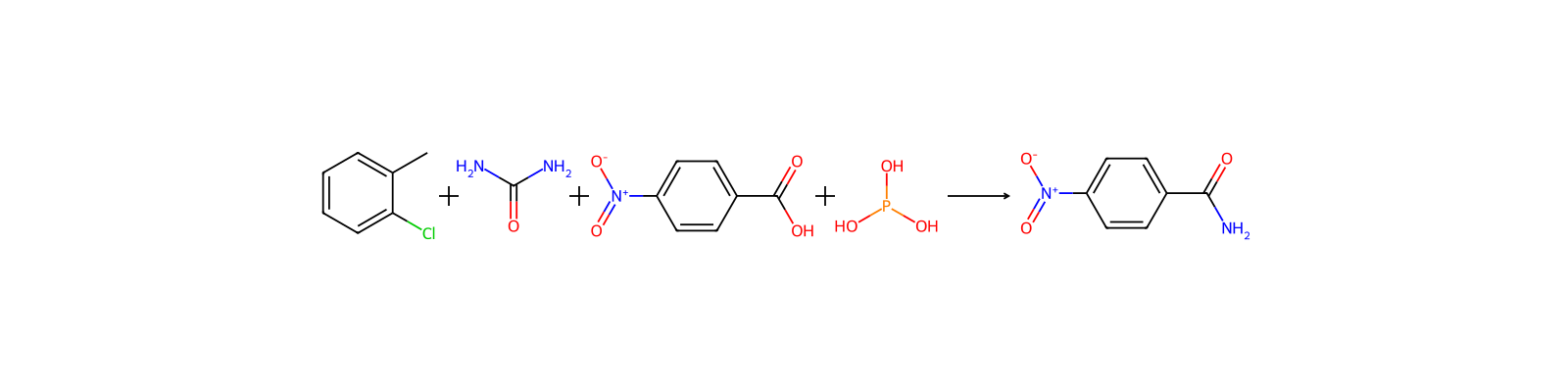

Basic information
- Standard SMILES
NC(=O)c1ccc([N+](=O)[O-])cc1- InChIKey
ZESWUEBPRPGMTP-UHFFFAOYSA-N- Molecular formula
- C7H6N2O3
- Average molar mass
- 166.13 g/mol
- Monoisotopic mass
- 166.03784205
Overview
P-nitrobenzamide is a white powder. (NTP, 1992)
Names & identifiers
- Preferred name
- 4-Nitrobenzamide
- IUPAC
- 4-nitrobenzamide
- English name
- p-Nitrobenzamide
- Molecular formula
- C7H6N2O3
- Molecular weight
- 166.13
Names & synonyms
4-NITROBENZAMIDEp-NitrobenzamideBenzamide, 4-nitro-4-nitro-benzamideDTXSID8022086NSC 2902EINECS 210-613-7AI3-01346DTXCID002086RefChem:1000394-NITROBENZOIC ACID, AMIDE210-613-7
Show more names
NitrobenzaMidep-nitro-benzamid4-nitro-benzamidBenzamide,4-nitro-Benzamide,p-nitro-TIMTEC-BB SBB0082014-Nitrobenzamide>
ZESWUEBPRPGMTP-UHFFFAOYSA-N619-80-7Benzamide, p-nitro-MFCD00007994NSC-2902p-Nitrobenzamide, 98%4-Nitrobenzamide, 98%NITROBENZAMIDE, P-
Database identifiers
- CAS
619-80-7- PubChem CID
- 12091
- DTXSID
DTXSID8022086- ChEMBL
CHEMBL1483601- UNII
- 683NB4HAX7
- EC Number
- 210-613-7
- Nikkaji
- J62.020C
Properties
Computed structural properties
- XLogP
- 0.8
- Topological polar surface area
- 88.9 Ų
- Hydrogen bond donors
- 1
- Hydrogen bond acceptors
- 3
- Rotatable bonds
- 1
- Heavy atoms
- 12
- Formal charge
- 0
- Complexity
- 191
Experimental & physicochemical properties
SpringerMaterials PropertiesChemical shift
LogP0.82
Solubilityless than 0.1 mg/mL at 64 °F (NTP, 1992)
Melting Point394 to 399 °F (NTP, 1992)
Physical DescriptionP-nitrobenzamide is a white powder. (NTP, 1992)
Physicochemical properties
- Melting point
- 199 · 199-201 °C(lit.)
- Boiling point
- 294.32 °C · 294.32°C (rough estimate)
- Density
- 1.4334 · 1.4334 (rough estimate)
- refractive index
- 1.588 · 1.5880 (estimate)
- pka
- 15.02 · 15.02±0.50(Predicted)
- form
- powder to crystal
- color
- White to Orange to Green
- Water Solubility
- 0.01 g/100 · <0.01 g/100 mL at 18 ºC
- BRN
- 639263 · 639263
- Stability
- Stable. Incompatible with strong oxidizing agents, strong bases.
- InChI
- InChI=1S/C7H6N2O3/c8-7(10)5-1-3-6(4-2-5)9(11)12/h1-4H,(H2,8,10)
- InChIKey
- ZESWUEBPRPGMTP-UHFFFAOYSA-N
- SMILES
- C(N)(=O)C1=CC=C([N+]([O-])=O)C=C1
- CAS DataBase Reference
- 619 · 619-80-7(CAS DataBase Reference)
- EWG's Food Scores
- 1 · 1
- NIST Chemistry Reference
- 4 · Benzamide, 4-nitro-(619-80-7)
- EPA Substance Registry System
- p-Nitrobenzamide (619-80-7)
- UNSPSC Code
- 12352100 · 12352100
- NACRES
- 22 · NA.22
- Symbol(GHS)
- 7 · GHS07
- Signal word
- Warning
- Hazard statements
- 302 · H302
- Precautionary statements
- 301 · P301+P312+P330
- PPE
- 2 · Eyeshields, Faceshields, Gloves, type P2 (EN 143) respirator cartridges
- Hazard Codes
- T,Xn
- Risk Statements
- 23 · 23/24/25-22-20/21/22
- Safety Statements
- 27 · 27-28-36/37/39-45-36
- WGK Germany
- 3 · 3
- RTECS
- 5601000 · CV5601000
- TSCA
- TSCA listed
- HS Code
- 29242990 · 29242990
- Storage Class
- 11 · 11 - Combustible Solids
- Hazard Classifications
- 4 Oral · Acute Tox. 4 Oral
- REACH Registrations
- Active
Safety & regulation
GHS classification
GHS Classification
Danger
H301 (71.7%): Toxic if swallowed [Danger Acute toxicity, oral]
P261, P262, P264, P264+P265, P270, P271, P280, P301+P316, P301+P317, P302+P352, P304+P340, P305+P351+P338, P316, P319, P321, P330, P332+P317, P337+P317, P361+P364, P362+P364, P403+P233, P405, and P501 (click each P-code to see the statement)
Aggregated GHS information provided per 53 reports by companies from 7 notifications to the ECHA C&L Inventory. Each notification may be associated with multiple companies.
Hazard information
Regulatory InformationStatus: Active Update: 16-03-2020 https://echa.europa.eu/registration-dossier/-/registered-dossier/26217
Fire HazardsFlash point data for this compound are not available, however, it is probably combustible. (NTP, 1992)
Reactive GroupAmides and Imides
Reactivity Profile
A nitrated amide. Organic amides/imides react with azo and diazo compounds to generate toxic gases. Flammable gases are formed by the reaction of organic amides/imides with strong reducing agents. Amides are very weak bases (weaker than water). Imides are less basic yet and in fact react with strong bases to form salts. That is, they can react as acids. Mixing amides with dehydrating agents such as P2O5 or SOCl2 generates the corresponding nitrile. The combustion of these compounds generates mixed oxides of nitrogen (NOx).
Air and Water ReactionsInsoluble in water.
Hazard Classes and CategoriesAcute Tox. 3 (71.7%)
Safety & protection
Fire FightingFires involving this compound can be controlled with dry chemical, carbon dioxide or Halon extinguishers. (NTP, 1992)
First Aid
EYES: First check the victim for contact lenses and remove if present. Flush victim's eyes with water or normal saline solution for 20 to 30 minutes while simultaneously calling a hospital or poison control center. Do not put any ointments, oils, or medication in the victim's eyes without specific instructions from a physician. IMMEDIATELY transport the victim after flushing eyes to a hospital even if no symptoms (such as redness or irritation) develop.
Nonfire Spill Response
SMALL SPILLS AND LEAKAGE: You should dampen the solid spill material with acetone, then transfer the dampened material to a suitable container. Use absorbent paper dampened with acetone to pick up any remaining material. Seal your contaminated clothing and the adsorbent paper in a vapor-tight plastic bag for eventual disposal. Solvent wash all contaminated surfaces with acetone followed by washing with a strong soap and water solution. Do not reenter the contaminate area until the Safety Officer (or other responsible person) has verified that the area has been properly cleaned.
Personal Protective Equipment (PPE)
RECOMMENDED RESPIRATOR: Where the neat test chemical is weighed and diluted, wear a NIOSH-approved half face respirator equipped with an organic vapor/acid gas cartridge (specific for organic vapors, HCl, acid gas and SO2) with a dust/mist filter. (NTP, 1992)
Safety data
- PPE
- Eyeshields, Faceshields, Gloves, type P2 (EN 143) respirator cartridges
- wgk
- 3
- tsca
- TSCA listed
- rtecs
- CV5601000
- hs_code
- 29242990
- risk_code
- 23/24/25-22-20/21/22
- Signal word
- Warning
- Symbol(GHS)
- GHS07
- hazard_code
- T,Xn
- safety_code
- 27-28-36/37/39-45-36
- Storage Class
- 11 - Combustible Solids
- Hazard statements
- H302
- REACH Registrations
- Active
- Hazard Classifications
- Acute Tox. 4 Oral
- Precautionary statements
- P301+P312+P330
Chemistry & industry
Uses & manufacturing
General Manufacturing InformationBenzamide, 4-nitro-: ACTIVE
Applications
Uses4-Nitrobenzamide was used in the preparation of 4-nitrobenziminosulfurane.
General DescriptionWhite powder.
Upstream & downstream products
Downstream products
Suppliers19 total
宁波君龙新材料有限公司0574 88552216 19032109277 · [email protected]
上海莉凯化工技术有限公司16628776521 · [email protected]
杭州鼎燕化工有限公司13588754826 13588754826 · [email protected]
宁波台康化工有限公司0574-87365517 18074210286 · [email protected]
陕西缔都医药化工有限公司+86-29-87569262 +86-15003564040 · [email protected]
XIAMEN EQUATION CHEMICAL CO.,LTD+86-5926515854 +86-18060954864 · [email protected]
济南启诚化工有限公司0531-15628998092 15628998092
上海阿拉丁生化科技股份有限公司6206333 13167063860 · [email protected]
上海源叶生物科技有限公司13636370518 · [email protected]
湖北中隆康盛精细化工有限公司027-83850381 18171045381
XIAMEN AMITY INDUSTRY AND TRADE CO., LTD.+8618950047208 · [email protected]
上海先臣化工有限公司+86-021-64606569 +86-18049800532 · [email protected]
上海宝杨宝欣生物科技有限公司021-56698539 19921169802 · [email protected]
湖北奕化新材料科技有限公司17754433341 18086038039
大连天驰玖珑药业科技有限公司13942036801 · [email protected]
大连天驰玖珑药业科技有限公司0411-84176838 13942036801 · [email protected]
CD Chemical Group Limited+86-13651442114 · [email protected]
杭州药睿易成生物医药有限公司18072846723 · [email protected]
山东彬睿特新材料有限公司0533-2866658 15615638350 · [email protected]
Related reactions
36 records


Linked notes
Loading…