Basic information
- CAS
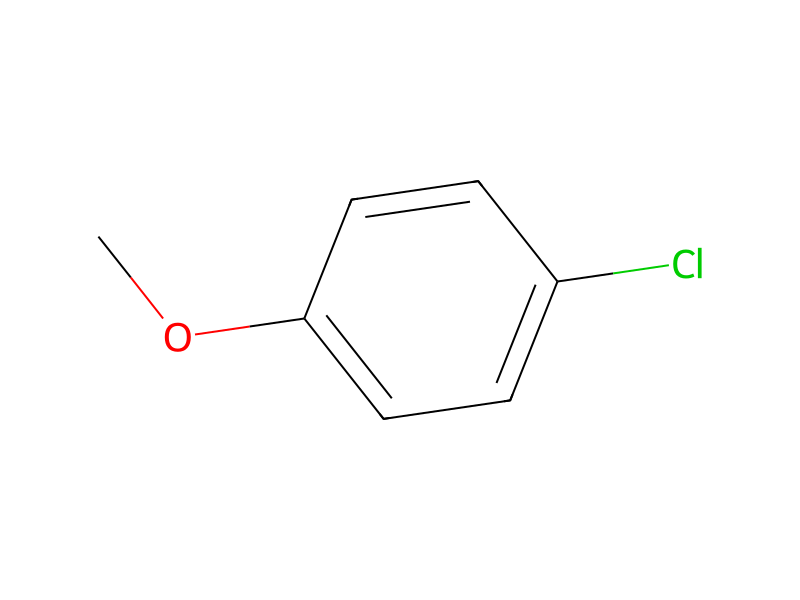
623-12-1- Standard SMILES
COc1ccc(Cl)cc1- InChIKey
YRGAYAGBVIXNAQ-UHFFFAOYSA-N- Molecular formula
- C7H7ClO
- Average molar mass
- 142.58 g/mol
- Monoisotopic mass
- 142.01854252
Overview
structure in first source
Names & identifiers
- Preferred name
- 4-Chloroanisole
- IUPAC
- 1-chloro-4-methoxybenzene
- English name
- 4-Chloroanisole
- Molecular formula
- C7H7ClO
- Molecular weight
- 142.58
Names & synonyms
4-Chloroanisole1-Chloro-4-methoxybenzene623-12-1P-CHLOROANISOLEBenzene, 1-chloro-4-methoxy-p-Chlorophenyl methyl etherAnisole, p-chloro-Anisyl chloridep-Chloromethoxybenzene4-Chlorophenol methyl ether0F18BLY08QNSC-4129
Show more names
para-Chloroanisolep-chloroanisol4-ChloroanisolChloro anisole3 4-Chloroanisole
DTXSID1060764RefChem:98541DTXCID7043295210-772-21-methoxy-4-chlorobenzene1-chloro-4-methoxy-benzene4-methoxyphenyl chlorideMFCD00000616
Database identifiers
- CAS
623-12-1- PubChem CID
- 12167
- DTXSID
DTXSID1060764- UNII
- 0F18BLY08Q
- EC Number
- 210-772-2
- Nikkaji
- J96.203A
Properties
Computed structural properties
- XLogP
- 2.8
- Topological polar surface area
- 9.2 Ų
- Hydrogen bond donors
- 0
- Hydrogen bond acceptors
- 1
- Rotatable bonds
- 1
- Heavy atoms
- 9
- Formal charge
- 0
- Complexity
- 77
Experimental & physicochemical properties
Chemical ClassesOther Classes -> Halogenated Anisoles
SpringerMaterials Properties13C nuclear magnetic resonance spectrum
Vapor Pressure0.81 [mmHg]
Physical DescriptionColorless liquid; [Alfa Aesar MSDS]
Physicochemical properties
- Melting point
- -18 °C · -18 °C (lit.)
- Boiling point
- 198 · 198-202 °C (lit.)
- Density
- 1.164 g/mL · 1.164 g/mL at 25 °C (lit.)
- vapor pressure
- 1.08 hPa · 1.08hPa at 25℃
- refractive index
- 20 · n20/D 1.535(lit.)
- Flash point
- 173 °F · 173 °F
- storage temp.
- Sealed in dry,Room Temperature
- form
- Liquid
- color
- Clear colorless to yellow
- Water Solubility
- immiscible
- BRN
- 1858901 · 1858901
- Henry's Law Constant
- 5.8 · 5.8×10-2 mol/(m3Pa) at 25℃, Pfeifer et al. (2001)
- Stability
- Stable. Combustible. Incompatible with strong oxidizing agents.
- InChI
- 1S/C7H7ClO/c1-9-7-4-2-6(8)3-5-7/h2-5H,1H3
- InChIKey
- YRGAYAGBVIXNAQ-UHFFFAOYSA-N
- SMILES
- COc1ccc(Cl)cc1
- LogP
- 2.78 at · 2.78 at 25℃
- CAS DataBase Reference
- 623 · 623-12-1(CAS DataBase Reference)
- FDA UNII
- 0 F18BLY08Q · 0F18BLY08Q
- NIST Chemistry Reference
- 1 · Benzene, 1-chloro-4-methoxy-(623-12-1)
- EPA Substance Registry System
- 1 · Benzene, 1-chloro-4-methoxy- (623-12-1)
- UNSPSC Code
- 12352100 · 12352100
- NACRES
- 22 · NA.22
- Symbol(GHS)
- 7 · GHS07
- Signal word
- Warning
- Hazard statements
- 227 · H227
- Precautionary statements
- 210 e-P280a-P370+P378a-P501a-P210-P280-P403+P235-P501 · P210e-P280a-P370+P378a-P501a-P210-P280-P403+P235-P501
- PPE
- Eyeshields, Gloves, type ABEK (EN14387) respirator filter
- Hazard Codes
- Xn
- Safety Statements
- 23 · 23-24/25
- RIDADR
- 2810 · UN 2810
- WGK Germany
- 3 · 3
- TSCA
- TSCA listed
- HS Code
- 29093090 · 29093090
- Storage Class
- 10 · 10 - Combustible liquids
- REACH Registrations
- Active
Safety & regulation
GHS classification
GHS Classification
This chemical does not meet GHS hazard criteria for 44.4% (4 of 9) of reports.
Warning
H302 (44.4%): Harmful if swallowed [Warning Acute toxicity, oral]
P261, P264, P264+P265, P270, P271, P280, P301+P317, P302+P352, P304+P340, P305+P351+P338, P317, P319, P321, P330, P332+P317, P337+P317, P362+P364, P403+P233, P405, and P501 (click each P-code to see the statement)
Aggregated GHS information provided per 9 reports by companies from 4 notifications to the ECHA C&L Inventory. Each notification may be associated with multiple companies.
Hazard information
Regulatory Information
Chemical: Benzene, 1-chloro-4-methoxy-
Status: Active Update: 15-12-2017 https://echa.europa.eu/registration-dossier/-/registered-dossier/21462
Benzene, 1-chloro-4-methoxy-: Does not have an individual approval but may be used under an appropriate group standard
Hazards SummaryMay cause irritation; [Alfa Aesar MSDS]
Peroxide Forming Chemical
p-Chloroanisole
D*: Other compounds that may form peroxides
No amount of peroxides were found in new commerically available containers
Removal of Peroxides from Ethers with Cerous Hydroxide
Hazard Classes and CategoriesAcute Tox. 4 (44.4%)
Safety data
- PPE
- Eyeshields, Gloves, type ABEK (EN14387) respirator filter
- wgk
- 3
- tsca
- TSCA listed
- ridadr
- UN 2810
- hs_code
- 29093090
- Signal word
- Warning
- Symbol(GHS)
- GHS07
- hazard_code
- Xn
- safety_code
- 23-24/25
- Storage Class
- 10 - Combustible liquids
- Hazard statements
- H227
- REACH Registrations
- Active
- Precautionary statements
- P210e-P280a-P370+P378a-P501a-P210-P280-P403+P235-P501
Chemistry & industry
Uses & manufacturing
General Manufacturing InformationBenzene, 1-chloro-4-methoxy-: INACTIVE
Applications
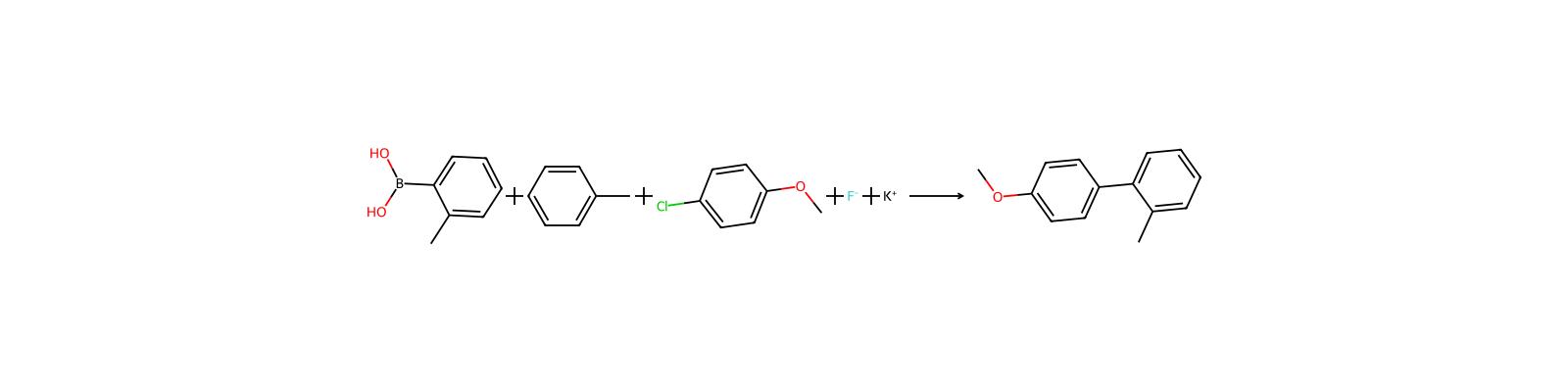
Uses4-Chloroanisole was found to react with Cu (II)-smectite forming a blue clay-organic complex. 4-Chloroanisole was chosen as the main test substrate for the optimisation studies as it is electronically deactivated and thus resistant to oxidative addition and consequently very reluctant to enter a catalytic manifold.
General Description4-Chloroanisole is an electron-rich chloroarene. It undergoes Ullmann-type homocoupling catalyzed by in situ generated Pd colloids. Reaction of 4-chloroanisole with Cu(II)-smectite in n-hexane, carbon tetrachloride or dichloromethane has been studied. The nucleophilic photosubstitution reactions, photocyanation and photohydrolysis of 4-chloroanisole has been studied by time resolved spectroscopy.
Upstream & downstream products
Upstream raw materials
Downstream products
Suppliers100 total
国药集团化学试剂有限公司86-21-63210123 · [email protected]
梯希爱(上海)化成工业发展有限公司021-67121386 · [email protected]
上海阿拉丁生化科技股份有限公司400-6206333 13167063860 · [email protected]
温州共赢化学有限公司+86-0086-577-64498589 +86-15355981851 · [email protected]
河北创海生物科技有限公司+86-86-13131129325 · [email protected]
T&W GROUP021-61551611 13296011611 · [email protected]
Baoji Guokang Healthchem co.,ltd+8615604608665 15604608665 · [email protected]
Dayang Chem (Hangzhou) Co.,Ltd.+86-0571-88938639 17705817739 · [email protected]
韶远科技(上海)有限公司021-50795510 4000665055 · [email protected]
上海将来实业股份有限公司400-0066400 13621662912 · [email protected]
Syntechem Co.,Ltd[email protected]
上海迈瑞尔生化科技有限公司4006356688 18621169109 · [email protected]
阿法埃莎(中国)化学有限公司400-6106006 · [email protected]
安耐吉化学&3A(安徽泽升科技股份有限公司)400-0056266 · [email protected]
上海瀚鸿科技股份有限公司021-54306202 13764082696 · [email protected]
上海柯维化学技术有限公司021-64609169 18901607656 · [email protected]
上海景颜化工科技有限公司13817811078 · [email protected]
山东西亚化学有限公司13355009207 13355009207 · [email protected]
玛雅试剂+86 (573) 82222445 (0)18006601000 452520369 · [email protected]
四川库利南科技有限公司400-1166-196 18981987031 · [email protected]
上海耐士化工科技有限公司400-188-0725 +86 21 34310725 13611771617
天津希恩思生化科技有限公司400 638 7771 · [email protected]
艾科试剂4008-755-333 18080918076 · [email protected]
上海思域化工科技有限公司86-21-34053660 · [email protected]
赛默飞世尔科技(中国)有限公司800-810-5118 · [email protected]
江苏艾康生物医药研发有限公司025-66113011 13913916777 · [email protected]
TCI AMERICA800-4238616 · [email protected]
TOKYO CHEMICAL INDUSTRY CO., LTD.03-36680489 · [email protected]
TCI Europe320-37350700 · [email protected]
北京环宇世纪化学科技有限公司hysj_bj.com
上海将来实业股份有限公司400-0066400 13621662912 · [email protected]
上海将来实业股份有限公司021-61552785 · [email protected]
美岚实业(上海)有限公司021-58958189 · [email protected]
上海爱蝶实业有限公司021-58957966 18930537195 · [email protected]
广拓化学(上海)有限公司021-60899189-8001 18918189673 · [email protected]
北京福源坊科技有限公司010-57903446 15869909019 · [email protected]
上海麦克林生化科技股份有限公司15221275939 15221275939 · [email protected]
上海洽凡生化科技有限公司+86-021-61654350 · [email protected]
上海有朋化工有限公司021-69005955 13701776567 · [email protected]
北京海力扬化学科技有限公司13718199399 · [email protected]
北京欣赛维化学科技有限公司010-56218822 13717722232 · [email protected]
四川海诺威科技有限公司13708085536 13708085536 · [email protected]
上海凯赛化工有限公司021-33516722 13701817765 · [email protected]
上海彤源化工有限公司021-021-69182866 13701855675 · [email protected]
上海孚一生物科技有限公司+86 (21) 61124340
北京华扬致成科技有限公司13716033033 · [email protected]
上海蓝润化学有限公司021-69515658 ; 69515628 13701998368 · [email protected]
上海容立化学科技有限公司021-69992220 13701886816 · [email protected]
上海康拓化工有限公司021-69185552 13701777608 · [email protected]
Sigma-Aldrich西格玛奥德里奇(上海)贸易有限公司021-61415566 800-8193336 · [email protected]
Related reactions
759 records


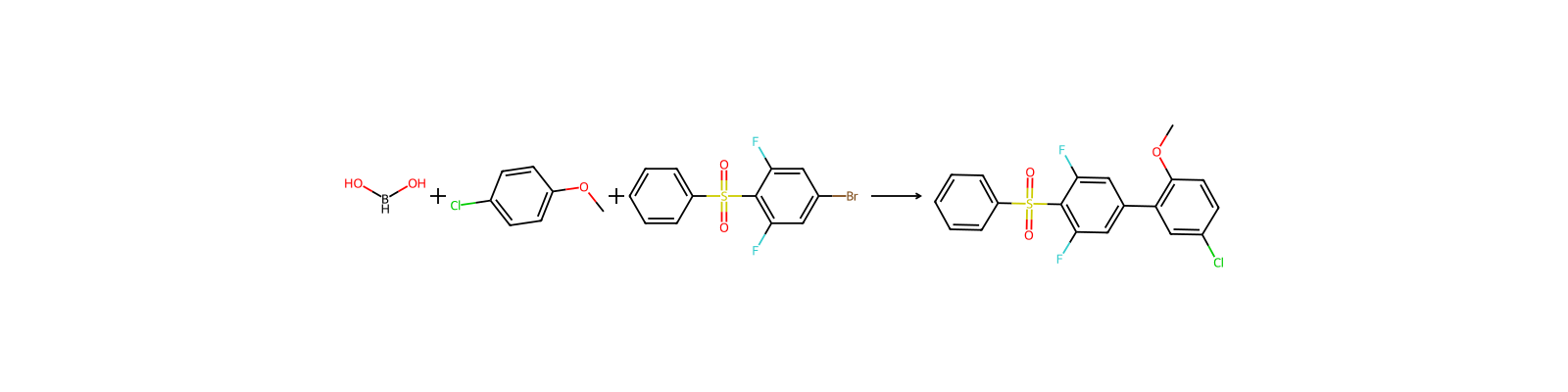


Compound notes
Loading…