
Furfural acetate

Basic information
- CAS
623-17-6- Standard SMILES
CC(=O)OCc1ccco1- InChIKey
CKOYRRWBOKMNRG-UHFFFAOYSA-N- Molecular formula
- C7H8O3
- Average molar mass
- 140.14 g/mol
- Monoisotopic mass
- 140.04734411
Overview
Furfuryl acetate appears as colorless to clear yellow or orange liquid with a pungent odor. (NTP, 1992)
Names & identifiers
- Preferred name
- Furfural acetate
- IUPAC
- furan-2-ylmethyl acetate
- English name
- Furfuryl acetate
- Molecular formula
- C7H8O3
- Molecular weight
- 140.14
Names & synonyms
Furfuryl acetate623-17-62-Furanmethanol, acetateFURFURAL ACETATEAcetic acid furfuryl ester2-Furanmethanol acetateFurfuryl alcohol, acetate2-Acetoxymethylfuran2-Furanmethyl acetateAcetic acid furfurylester2-Furylcarbinyl acetate2-Furanmethanol, 2-acetate
Show more names
furfurylFEMA 24902-furfurylacetateFuran-2-ylmethyl acetateFURFURALACETATEFurfuryl acetatFurfury acetate
FEMA No. 2490CCRIS 6242DTXSID70253463CJC9ALG3XNSC 5585EINECS 210-775-9BRN 0116128AI3-11016
Database identifiers
- CAS
623-17-6- PubChem CID
- 12170
- DTXSID
DTXSID7025346- ChEMBL
CHEMBL1522321- ChEBI
CHEBI:191539- UNII
- 3CJC9ALG3X
- EC Number
- 210-775-9
- Nikkaji
- J1.222J
Properties
Computed structural properties
- XLogP
- 0.7
- Topological polar surface area
- 39.4 Ų
- Hydrogen bond donors
- 0
- Hydrogen bond acceptors
- 3
- Rotatable bonds
- 3
- Heavy atoms
- 10
- Formal charge
- 0
- Complexity
- 122
Experimental & physicochemical properties
Chemical ClassesOther Classes -> Esters, Other
SpringerMaterials PropertiesDielectric constant
FragrancesFragrance Ingredient (Furfuryl acetate) -> IFRA transparency List
Food AdditivesFLAVOR ENHANCER, FLAVORING AGENT OR ADJUVANT -> FDA Substance added to food
Density
1.1175 at 68 °F (NTP, 1992) - Denser than water; will sink
1.110-1.119
Flavoring AgentsEU Flavoring substances
Solubility
5 to 10 mg/mL at 73 °F (NTP, 1992)
insoluble in water; soluble in oils
miscible (in ethanol)
Flash Point150 °F (NTP, 1992)
Boiling Point
347 to 351 °F at 760 mmHg (NTP, 1992)
175.00 to 177.00 °C. @ 760.00 mm Hg
175-177 °C
Safety & regulation
Safety information is for reference only and does not replace the supplier’s Safety Data Sheet (SDS), applicable regulations, or professional assessment.
GHS classification
GHS Classification
This chemical does not meet GHS hazard criteria for 4.6% (65 of 1406) of reports.
Warning
H302 (93.6%): Harmful if swallowed [Warning Acute toxicity, oral]
P261, P264, P270, P271, P280, P301+P317, P302+P352, P304+P340, P317, P321, P330, P362+P364, and P501 (click each P-code to see the statement)
Aggregated GHS information provided per 1406 reports by companies from 5 notifications to the ECHA C&L Inventory. Each notification may be associated with multiple companies.
Hazard information
Regulatory Information
Chemical: 2-Furanmethanol, acetate
Regulation (EC) No 1831/2003 (amended)
2-Furanmethanol, acetate: Does not have an individual approval but may be used under an appropriate group standard
Fire HazardsThis chemical is combustible. (NTP, 1992)
Health HazardsSYMPTOMS: Symptoms of exposure to this compound may include edema and skin, eye, mucous membrane and respiratory tract irritation.
Hazards SummarySafe when used as a flavoring agent in food; [EFSA] A skin, eye, mucous membrane, and respiratory tract irritant; [NTP] May cause irritation; [Alfa Aesar MSDS]
Reactive GroupEsters, Sulfate Esters, Phosphate Esters, Thiophosphate Esters, and Borate Esters
Reactivity Profile
FURFURYL ACETATE is an ester. Esters react with acids to liberate heat along with alcohols and acids. Strong oxidizing acids may cause a vigorous reaction that is sufficiently exothermic to ignite the reaction products. Heat is also generated by the interaction of esters with caustic solutions. Flammable hydrogen is generated by mixing esters with alkali metals and hydrides. This compound reacts with strong oxidizing agents, strong acids, strong bases and strong reducing agents. This compound reacts violently with cyanoacetic acid, formic acid, mineral acids, nitric acid and (nitric acid + N204 + sulfuric acid). (NTP, 1992)
Chemistry & industry
Pharmacology
Cellular LocationsCytoplasm
Uses & manufacturing
UsesUsed as a flavoring agent; [FDA]
Use Classification
Fragrance Ingredients
Flavoring Agents -> JECFA Flavorings Index
Flavouring Agent -> FLAVOURING_AGENT -> JECFA Functional Classes
General Manufacturing Information2-Furanmethanol, 2-acetate: ACTIVE
Applications
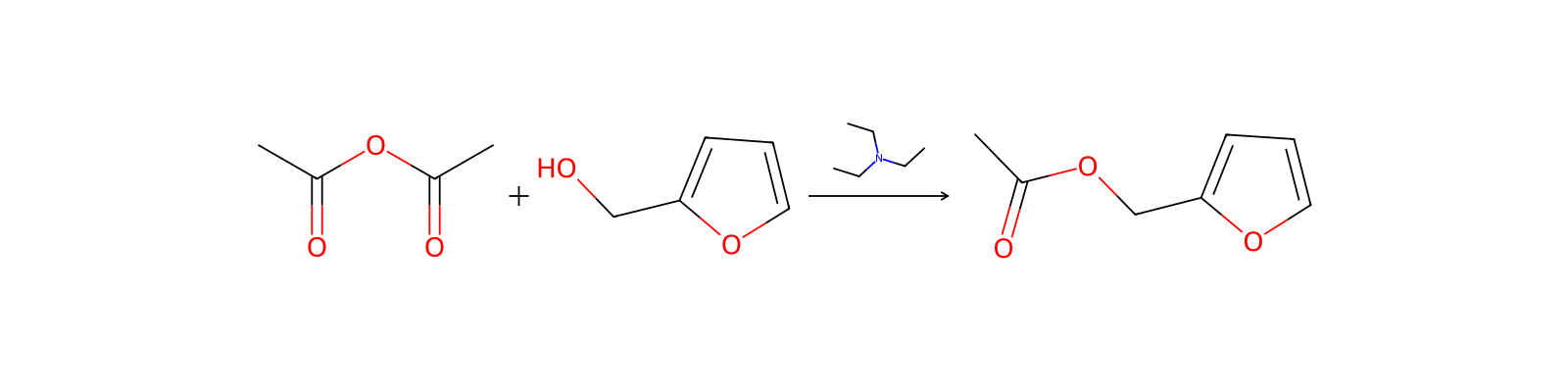
DescriptionFurfuryl acetate is the ester formed by the esterification between furfuryl alcohol and acetate. It can be used as a food spices and flavoring ingredient. It can also be used as the intermediate of dye, resin and spices. It is found in alcoholic beverage. Furfuryl acetate is present in wheat bread, crisp bread, roasted onion, pork liver, beer, rum, cocoa and coffee.
OccurrenceReported found in roasted almonds, beer, white bread, cocoa, coffee, roasted flberts, roasted onion, roasted peanuts, cooked pork liver, wheaten and crispbread, oats, rum, beer, licorice, dried bonito, sukiyaki and Bourbon vanilla
UsesFurfuryl acetate is a flavoring ingredient. It was used in the synthesis of 5-acetoxymethyl-2-vinylfuran and 5-hydroxymethyl-2-vinylfuran via Vilsmeier-Haack and Wittig reactions.
General DescriptionColorless to clear yellow or orange liquid with a pungent odor.
Upstream & downstream products
Upstream raw materials
Suppliers
Loading…
Open inquiries
Loading…
Related reactions
4 records


Compound notes
Loading…