Ethanol-d5
HCID 12201693
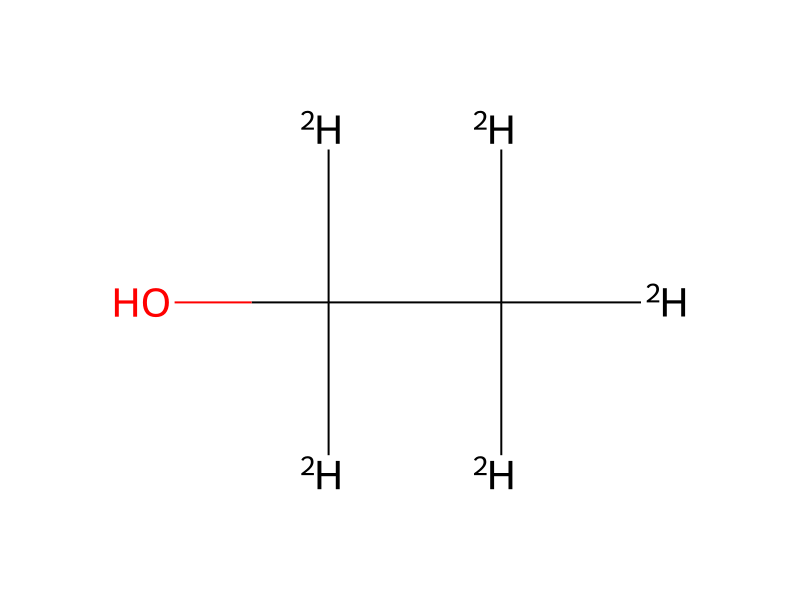
Basic information
- CAS
1859-08-1- Standard SMILES
[2H]C([2H])([2H])C([2H])([2H])O- InChIKey
LFQSCWFLJHTTHZ-ZBJDZAJPSA-N- Molecular formula
- C2H6O
- Average molar mass
- 51.1 g/mol
- Monoisotopic mass
- 51.07324854
Names & identifiers
- Preferred name
- Ethanol-d5
- IUPAC
- 1,1,2,2,2-pentadeuterioethanol
- English name
- Ethanol-d5
- Molecular formula
- C2HD5O
- Molecular weight
- 51.1
Names & synonyms
Ethanol-d51859-08-1DTXSID20480249RefChem:340957DTXCID20431059Ethyl-d5 alcohol1,1,2,2,2-pentadeuterioethanolEthanol-1,1,2,2,2-d5d5-ethanol(H)ethan-1-ol(?H?)ethan-1-ol((2)H)ethan-1-ol
Show more names
Lux-d5CDA 19-d5GerM-X-d5IMS 99-d5Jaysol-d5SDA 3A-d5Tecsol-d5Alcohol-d5Algrain-d5
(~2~H_5_)EthanolSCHEMBL721180SCHEMBL1332633LFQSCWFLJHTTHZ-ZBJDZAJPSA-NAKOS015915652D99172Ethanol-1,1,2,2,2-d5, 99.5 atom % D
Database identifiers
- CAS
1859-08-1、68476-78-8- PubChem CID
- 12201693
- DTXSID
DTXSID20480249- EC Number
- 693-229-6
- Nikkaji
- J624.464E
Properties
Computed structural properties
- XLogP
- -0.1
- Topological polar surface area
- 20.2 Ų
- Hydrogen bond donors
- 1
- Hydrogen bond acceptors
- 1
- Rotatable bonds
- 0
- Heavy atoms
- 3
- Formal charge
- 0
- Complexity
- 2.8
Physicochemical properties
- Boiling point
- 78 · 78-79 °C(lit.)
- Density
- 0.871 g/mL · 0.871 g/mL at 25 °C(lit.)
- refractive index
- 20 · n20/D 1.358(lit.)
- Flash point
- 48 °F · 48 °F
- solubility
- Chloroform (Slightly), DMSO (Soluble)
- form
- Liquid
- pka
- 15.24 · 15.240±0.10(predicted)
- color
- Clear Colourless
- Stability
- Volatile
- Comptox DTXSID
- 20480249 · DTXSID20480249
- UNSPSC Code
- 12142201 · 12142201
- NACRES
- 21 · NA.21
- Symbol(GHS)
- 2 · GHS02,GHS07
- Signal word
- Danger
- Hazard statements
- 225 · H225-H319
- Precautionary statements
- 210 · P210-P233-P240-P241-P242-P305+P351+P338
Safety & regulation
Safety information is for reference only and does not replace the supplier’s Safety Data Sheet (SDS), applicable regulations, or professional assessment.
GHS classification
GHS Classification
Danger
H225 (100%): Highly Flammable liquid and vapor [Danger Flammable liquids]
P210, P233, P240, P241, P242, P243, P261, P264, P271, P280, P302+P352, P303+P361+P353, P304+P340, P319, P321, P332+P317, P362+P364, P370+P378, P403+P233, P403+P235, P405, and P501 (click each P-code to see the statement)
Aggregated GHS information provided per 39 reports by companies from 2 notifications to the ECHA C&L Inventory. Each notification may be associated with multiple companies.
Hazard information
Hazard Classes and CategoriesFlam. Liq. 2 (100%)
Safety data
- wgk
- 3
- ridadr
- UN 1170 3/PG 2
- risk_code
- 11-20/22-36/37/38
- Signal word
- Danger
- Symbol(GHS)
- GHS02,GHS07
- hazard_code
- F,T
- safety_code
- 7-16-23-33-36/37/39-45
- Hazard statements
- H225-H319
- Precautionary statements
- P210-P233-P240-P241-P242-P305+P351+P338
Chemistry & industry
Applications
UsesMost ethyl alcohol(Ethanol-d5) is used in alcoholic beverages in suitable dilutions. Other uses are as solvent in laboratory and industry , in the manufacture of denatured alcohol, pharmaceuticals, in perfumery, in organic synthesis. Used as antiseptic.
General DescriptionEthanol-1,1,2,2,2-d5 (ethyl-d5 alcohol, CD3CD2OH) is deuterated ethyl alcohol. The nuclear magnetic relaxation rates of 13C in 13CCl4 and CD3CD2OH solvent mixture has been determined. The quantification of ethyl-d5 alcohol along with ethyl alcohol in serum by stable isotope gas chromatography-mass spectrometry technique has been reported. It plays a role as a tracer in the time-of-flight secondary ion mass spectrometry (TOF-SIMS) tracer method to assess the boundary lubricating behaviors of boundary lubricating films.
Related reactions
0 records
No related reactions yet