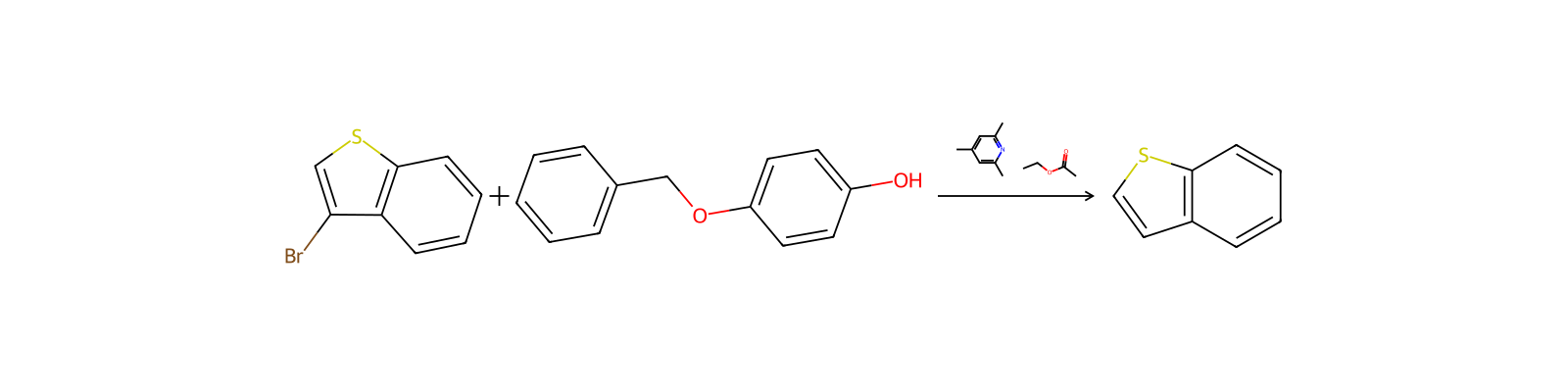

Basic information
- Standard SMILES
Brc1csc2ccccc12- InChIKey
SRWDQSRTOOMPMO-UHFFFAOYSA-N- Molecular formula
- C8H5BrS
- Average molar mass
- 213.1 g/mol
- Monoisotopic mass
- 211.92953326
Names & identifiers
- Preferred name
- Benzo(b)thiophene, 3-bromo-
- IUPAC
- 3-bromo-1-benzothiophene
- English name
- 3-Bromo-1-benzothiophene
- Molecular formula
- C8H5BrS
- Molecular weight
- 213.1
Names & synonyms
7342-82-73-Bromobenzothiophene3-Bromo-benzo[b]thiopheneBenzo[b]thiophene, 3-bromo-Benzo(b)thiophene, 3-bromo-DTXSID802236543-Bromo-benzo(b)thiopheneRefChem:565171DTXCID10146145680-931-23-Bromobenzo[b]thiophene3-Bromo-1-benzothiophene
Show more names
BUTTPARK 147\16-62BromothianaphtheneTIMTEC-BB SBB0034153-BroMothianaphthene 95%3-Bromo-1-benzothiophenec
3-BromothianaphtheneMFCD00023009Benzo[b]thiophene, 3-bromo-,3-bromo benzo[b]thiopheneBIDD:GT0742SCHEMBL264791B55893-bromo benzothiophene
Database identifiers
- CAS
7342-82-7- PubChem CID
- 123250
- DTXSID
DTXSID80223654- EC Number
- 680-931-2
- Nikkaji
- J1.051.045G
Properties
Computed structural properties
- XLogP
- 3.8
- Topological polar surface area
- 28.2 Ų
- Hydrogen bond donors
- 0
- Hydrogen bond acceptors
- 1
- Rotatable bonds
- 0
- Heavy atoms
- 10
- Formal charge
- 0
- Complexity
- 126
Physicochemical properties
- Melting point
- 146 · 146-156 °C
- Boiling point
- 269 °C/752.5 · 269 °C/752.5 mmHg (lit.)
- Density
- 1.629 g/mL · 1.629 g/mL at 25 °C (lit.)
- refractive index
- 20 · n20/D 1.668(lit.)
- Flash point
- 230 °F · >230 °F
- storage temp.
- Keep in dark place,Sealed in dry,Room Temperature
- solubility
- Sparingly Soluble (0.14 g/L) (25°C).
- form
- clear liquid
- color
- Light yellow to Brown
- InChI
- InChI=1S/C8H5BrS/c9-7-5-10-8-4-2-1-3-6(7)8/h1-5H
- InChIKey
- SRWDQSRTOOMPMO-UHFFFAOYSA-N
- SMILES
- C12=CC=CC=C1C(Br)=CS2
- CAS DataBase Reference
- 7342 · 7342-82-7(CAS DataBase Reference)
- NIST Chemistry Reference
- 3 · Benzo[b]thiophene, 3-bromo-,(7342-82-7)
- UNSPSC Code
- 12352100 · 12352100
- NACRES
- 22 · NA.22
- Symbol(GHS)
- 7 · GHS07
- Signal word
- Warning
- Hazard statements
- 315 · H315-H319
- Precautionary statements
- 264 · P264-P280a-P305+P351+P338-P321-P332+P313-P337+P313
- PPE
- 95 · Eyeshields, Gloves, type N95 (US)
- Hazard Codes
- Xi
- Risk Statements
- 36 · 36/37/38
- Safety Statements
- 26 · 26-37/39
- WGK Germany
- 3 · 3
- HazardClass
- IRRITANT
- HS Code
- 29349990 · 29349990
- Storage Class
- 11 · 11 - Combustible Solids
Safety & regulation
GHS classification
GHS Classification
Warning
H302+H312+H332 (16.7%): Harmful if swallowed, in contact with skin or if inhaled [Warning Acute toxicity, oral; acute toxicity, dermal; acute toxicity, inhalation]
P261, P264, P264+P265, P270, P271, P280, P301+P317, P302+P352, P304+P340, P305+P351+P338, P317, P319, P321, P330, P332+P317, P337+P317, P362+P364, P403+P233, P405, and P501 (click each P-code to see the statement)
Aggregated GHS information provided per 6 reports by companies from 3 notifications to the ECHA C&L Inventory. Each notification may be associated with multiple companies.
Hazard information
Hazard Classes and CategoriesAcute Tox. 4 (16.7%)
Safety data
- PPE
- Eyeshields, Gloves, type N95 (US)
- wgk
- 3
- hs_code
- 29349990
- risk_code
- 36/37/38
- Signal word
- Warning
- Symbol(GHS)
- GHS07
- hazard_code
- Xi
- safety_code
- 26-37/39
- hazard_class
- IRRITANT
- Storage Class
- 11 - Combustible Solids
- Hazard statements
- H315-H319
- Precautionary statements
- P264-P280a-P305+P351+P338-P321-P332+P313-P337+P313
Chemistry & industry
Applications
UsesAntifungal activity of synthetic di (hetero) arylamines based on the benzo [b] thiophene moiety.
Uses3-Bromothianaphthene may be used in the synthesis of (benzo[b]thiophen-3-yl)trimethylstannane.
General Description3-Bromothianaphthene is a heteroaryl halide. It undergoes Suzuki-Miyaura reaction with phenylboronic acid (PBA) or 3-thienylboronic acid in the presence of a novel heterogeneous Pd catalyst [Pd@PDEB, PDEB=poly(1,3-diethynylbenzene)]. The substitution reaction of 3-bromothianaphthene with piperidine to form 3-piperidinothianaphthene as the major product has been reported.
Upstream & downstream products
Upstream raw materials
Downstream products
Suppliers50 total
上海阿拉丁生化科技股份有限公司400-6206333 13167063860 · [email protected]
上海凌富药物研究有限公司+86(21)5895 0110 19945755304 · [email protected]
杭州奥得科技有限公司0571-88772972-0 15057128248 · [email protected]
长春三邦医药科技有限公司0431-81884431 · [email protected]
宁波季诺化学品有限公司0574-87314919 057487319282 · [email protected]
Dayang Chem (Hangzhou) Co.,Ltd.+86-0571-88938639 17705817739 · [email protected]
韶远科技(上海)有限公司021-50795510 4000665055 · [email protected]
毕佳索(上海毕得医药科技股份有限公司)400-6005915 · [email protected]
Syntechem Co.,Ltd[email protected]
北京华威锐科化工有限公司0757-86329057 18934348241 · [email protected]
江苏普乐司生物科技有限公司0513-66017706 18551496367 · [email protected]
Hangzhou Sage Chemical Co., Ltd.+86057186818502 13588463833 · [email protected]
浙江光昊光电科技有限公司0576-84521666 13666863188 · [email protected]
阿法埃莎(中国)化学有限公司400-6106006 · [email protected]
安耐吉化学&3A(安徽泽升科技股份有限公司)400-0056266 · [email protected]
上海瀚鸿科技股份有限公司021-54306202 13764082696 · [email protected]
南京圣亿来化工有限公司19951936396 · [email protected]
上海钰康生物科技有限公司18939844854 · [email protected]
南京哈柏医药科技有限公司13376080562 13376090521 · [email protected]
上海泰坦科技股份有限公司400-6009262 15618770481 · [email protected]
南京唯博特医药科技有限公司18066048793; 18014498793 · [email protected]
山东西亚化学有限公司13355009207 13355009207 · [email protected]
天津希恩思生化科技有限公司400 638 7771 · [email protected]
上海健超生物科技有限公司150-2103-5486 18017383231 · [email protected]
TCI AMERICA800-4238616 · [email protected]
TOKYO CHEMICAL INDUSTRY CO., LTD.03-36680489 · [email protected]
TCI Europe320-37350700 · [email protected]
深圳康特腾科技有限公司86-0755-86635001 · [email protected]
上海然素化学科技有限公司13148101715 · [email protected]
上海毕得医药科技股份有限公司400-164-7117 18317119277 · [email protected]
郑州萃智医药科技有限公司19943855286 · [email protected]
上海鑫圭生物科技有限公司15121041756 · [email protected]
杭州杰恒化工有限公司0571-87396432 · [email protected]
上海寰川实业有限公司021-61478794 · [email protected]
上海永叶生物科技有限公司86-021-61559134 15921386130 · [email protected]
南京恰风和医药科技有限公司025-57018978 18251899859 · [email protected]
江苏艾康生物医药研发有限公司025-66028182 17714375163 · [email protected]
陕西缔都医药化工有限公司+86-29-87569262 +86-15003564040 · [email protected]
Sigma-Aldrich西格玛奥德里奇(上海)贸易有限公司021-61415566 800-8193336 · [email protected]
重庆奥舍生物化工有限公司023-63225655 13320248848 · [email protected]
诺尔凯立科技有限公司86-(0)21-31261262 373522135 · [email protected]
上海任跃化学科技有限公司021-62219190; 18321139117 · [email protected]
河南紫罗兰科技有限公司0371-55361188 13409345566 · [email protected]
成都润泽本土化工有限公司028-88469284 18000562381 · [email protected]
Guangzhou Yuheng Pharmaceutical Technology Co., Ltd+8613580539051 · [email protected]
上海伍平生物科技有限公司18501609135 · [email protected]
兰州安杰利生物化学科技有限公司0931-8235634 13321316780
成都沸柏医药科技有限公司028-84641798 18782128315 · [email protected]
上海源叶生物科技有限公司13636370518 · [email protected]
南京博米尔生物科技有限公司025-83453382-8005 · [email protected]
Related reactions
93 records


Linked notes
Loading…