GlyTouCan:G31630FD
SIALIC ACID · NEU5AC · NAN · NANA · Acetylneuraminic acid · NeuAc · LACTAMINIC ACID · (-)-N-ACETYLNEURAMINIC ACID
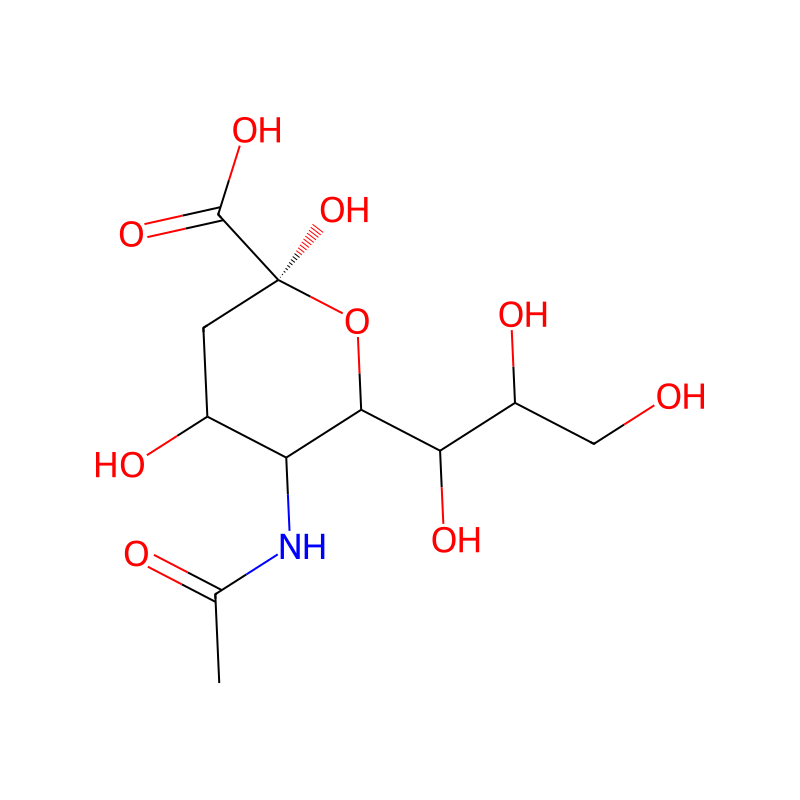
Identifiers & Physical Properties
| CAS No. | 131-48-6 |
|---|---|
| Molecular formula | C11H19NO9 |
| Average molar mass | 309.27 g/mol |
| Monoisotopic mass | 309.10598118 g/mol |
| SMILES | CC(=O)NC1C(O)C[C@@](O)(C(=O)O)OC1C(O)C(O)CO |
| InChIKey | SQVRNKJHWKZAKO-RASJKGJYSA-N |
| PubChem CID | 124040735 |
| EC No. | 205-023-1 |
Chemical & Physical Properties
| XLogP | -3.5 |
|---|---|
| Topological polar surface area | 177 |
| Hydrogen bond donors | 7 |
| Hydrogen bond acceptors | 9 |
| Rotatable bonds | 5 |
| Heavy atoms | 21 |
| Formal charge | 0 |
| Complexity | 403 |
| Melting point | 184-186 °C |
| alpha | -32 º (c=2,water) |
| Boiling point | 449.56°C (rough estimate) |
| Density | 1.3580 (rough estimate) |
| Refractive index | -32 ° (C=1, H2O) |
| Storage conditions | -20°C |
| Solubility | 50 g/L (20°C)50 g/L (20 ºC) |
| pKa (acidity coefficient) | 2.41±0.54(Predicted) |
| Physical state | synthetic, crystalline |
| Color | White to Off-White |
| Biological source | synthetic |
| optical activity | -32 |
| Sensitivity | Air Sensitive |
| Merck | 14,8484 |
| BRN | 1716283 |
| Stability | Stable. Incompatible with strong oxidizing agents. |
| Major applications | food and beverages |
| Cosmetics Ingredients Functions | SKIN CONDITIONINGSKIN PROTECTING |
| InChI | 1S/C11H19NO9/c1-4(14)12-7-5(15)2-11(20,10(18)19)21-9(7)8(17)6(16)3-13/h5-9,13,15-17,20H,2-3H2,1H3,(H,12,14)(H,18,19)/t5-,6+,7+,8+,9+,11-/m0/s1 |
| InChIKey | SQVRNKJHWKZAKO-PFQGKNLYSA-N |
| SMILES | O[C@@]1(O[C@@]([C@@H]([C@H](C1)O)NC(C)=O)([H])[C@@H]([C@@H](CO)O)O)C(O)=O |
| LogP (partition coefficient) | -1.897 (est) |
| CAS DataBase Reference | 131-48-6(CAS DataBase Reference) |
| NCI Dictionary of Cancer Terms | sialic acid |
| FDA UNII | GZP2782OP0 |
| ATC code | M09AX05 |
| EPA Substance Registry System | Neuraminic acid, N-acetyl- (131-48-6) |
| UNSPSC Code | 85151701 |
| NACRES | NA.79 |
| GHS pictogram | GHS07 |
| Signal word | Warning |
| GHS hazard statements | H319 |
| GHS precautionary statements | P264-P280-P305+P351+P338-P337+P313 |
| Hazard symbols | Xi |
| Risk statements (R) | 36/37/38 |
| Safety statements (S) | 22-24/25-36-26 |
| Water hazard class (WGK) | 3 |
| F | 3-10-23 |
| Hazard Note | Irritant |
| TSCA inventory status | TSCA listed |
| Customs code | 29329970 |
| Storage class | 11 - Combustible Solids |
| Hazard class | Eye Irrit. 2 |
Safety & Regulations
| Regulatory information | Neuraminic acid, N-acetyl-: Does not have an individual approval but may be used under an appropriate group standard |
|---|---|
| F | 3-10-23 |
| Water hazard class (WGK) | 3 |
| TSCA inventory status | TSCA listed |
| Customs code | 29329970 |
| Risk statements (R) | 36/37/38 |
| Signal word | Warning |
| GHS pictogram | GHS07 |
| Hazard symbols | Xi |
| hazard_note | Irritant |
| Safety statements (S) | 22-24/25-36-26 |
| Storage class | 11 - Combustible Solids |
| GHS hazard statements | H319 |
| Hazard class | Eye Irrit. 2 |
| GHS precautionary statements | P264-P280-P305+P351+P338-P337+P313 |
Applications & Uses
Description
N-acetylneuraminic acid is an N-acyl derivative of neuraminic or acid amino sugar derivative, derived from N-acetylmannosamine and pyruvic acid. It is an important constituent of glycoproteins and glycolipids. N-acetylneuraminic acid occurs in many polysaccharides, glycoproteins, and glycolipids in animals and bacteria.
Uses
N-Acetylneuraminic acid is an integral part of sialic acids (SAs), important functional sugars that play an important role in maintaining and improving brain health, detoxification, antibacterial, and immune enhancement. n-Acetylneuraminic acid is biologically useful for neurotransmission, leukocyte extravasation, viral or bacterial infection, and carbohydrate-protein recognition. n- Acetylneuraminic acid is used to study its biochemistry, metabolism and absorption in vivo and in vitro.