HomeMCPWorkbenchSkills
HomeWorkbenchNotificationsMe
Huagongshe Open Program:[email protected]AI access: llms.txt · MCP GuidePrivacy Policy · Terms of Service · Supportv1.7.8
  1. Home
  2. /Compound

2,4,6-Trichloroaniline

HCID 12471
NotesReactions
Basic informationOverviewNames & identifiersPropertiesSafety & regulationChemistry & industryRelated reactionsCompound notes
Substructure searchFind similar structures

Basic information

CAS
634-93-5
Standard SMILES
Nc1c(Cl)cc(Cl)cc1Cl
InChIKey
NATVSFWWYVJTAZ-UHFFFAOYSA-N
Molecular formula
C6H4Cl3N
Average molar mass
196.5 g/mol
Monoisotopic mass
194.94093217

Overview

Long needles or fine, light purple fibers. (NTP, 1992)

Names & identifiers

Preferred name
2,4,6-Trichloroaniline
IUPAC
2,4,6-trichloroaniline
English name
2,4,6-Trichloroaniline
Molecular formula
C6H4Cl3N
Molecular weight
196.46

Names & synonyms

2,4,6-TRICHLOROANILINE634-93-5s-TrichloroanilineBenzenamine, 2,4,6-trichloro-Aniline, 2,4,6-trichloro-sym-Trichloroaniline2,4,6-Trichlorobenzenamine2,4,6-Trichlorophenylamine1-Amino-2,4,6-trichlorobenzeneDTXSID60213792,4,6-TCAJ7IC72N9B0
Show more names
2.4.6-Trichlor2,4,6-Trichloranilin2,4,6-TrichloroaniliClonidine Impurity 7
2,4,6-trichloranilineNSC-2114DTXCID401379RefChem:82093211-219-8MFCD00007663CCRIS 601HSDB 2654

Database identifiers

CAS
634-93-5
PubChem CID
12471
DTXSID
DTXSID6021379
ChEMBL
CHEMBL1894620
UNII
J7IC72N9B0
EC Number
211-219-8
Nikkaji
J2.097D

Properties

Computed structural properties

XLogP
3.7
Topological polar surface area
26 Ų
Hydrogen bond donors
1
Hydrogen bond acceptors
1
Rotatable bonds
0
Heavy atoms
10
Formal charge
0
Complexity
108

Experimental & physicochemical properties

Chemical ClassesNitrogen Compounds -> Amines, Aromatic
SpringerMaterials PropertiesBoiling point
LogPlog Kow= 3.69
Color/FormCRYSTALS FROM ALCOHOL, NEEDLES FROM PETROLEUM ETHER
Solubility · 4 items

less than 1 mg/mL at 70.7 °F (NTP, 1992)

Sol in ethanol, ether, and chloroform

Insoluble in phosphoric acid

40 mg/l in water @ 25 °C

Boiling Point · 2 items

504 °F at 760 mmHg (NTP, 1992)

262 °C @ 746 mm Hg

DecompositionWhen heated to decomposition it emits very toxic fumes of /hydrogen chloride/ and nitroxides.
Melting Point · 2 items

163 to 167 °F (NTP, 1992)

78.5 °C

Vapor Pressure · 3 items

1 mmHg at 273.2 °F ; 5 mmHg at 316.0 °F (NTP, 1992)

Safety & regulation

Safety information is for reference only and does not replace the supplier’s Safety Data Sheet (SDS), applicable regulations, or professional assessment.

GHS classification

GHS Classification · 6 items

Danger

H301+H311+H331 (35.9%): Toxic if swallowed, in contact with skin or if inhaled [Danger Acute toxicity, oral; acute toxicity, dermal; acute toxicity, inhalation]

P260, P261, P262, P264, P270, P271, P272, P273, P280, P301+P316, P302+P352, P304+P340, P316, P319, P321, P330, P333+P317, P361+P364, P362+P364, P391, P403+P233, P405, and P501 (click each P-code to see the statement)

Aggregated GHS information provided per 78 reports by companies from 9 notifications to the ECHA C&L Inventory. Each notification may be associated with multiple companies.

Warning

H401: Toxic to aquatic life [Hazardous to the aquatic environment, acute hazard]

Hazard information

Regulatory Information · 2 items

Chemical: Benzenamine, 2,4,6-trichloro-

Status: Active Update: 30-07-2019 https://echa.europa.eu/registration-dossier/-/registered-dossier/11174

DOT LabelPoison
Fire HazardsFlash point data for this chemical are not available. It is probably combustible. (NTP, 1992)
Health HazardsSYMPTOMS: Symptoms of exposure to this compound may include irritation of the skin and eyes.
Hazards Summary · 1 item

A mutagen and tumorigen; Causes methemoglobinemia, abnormal liver enzymes, and convulsions in lethal-dose feeding studies of rats; [RTECS] Emergency treatment: Aniline. [HSDB] A skin and eye irritant; [CAMEO] An irritant; May induce methemoglobinemia; Effects in high-dose animal studies include methemoglobinemia and convulsions; [MSDSonline]

Reactive GroupAryl Halides

Chemistry & industry

Pharmacology

Metabolism/Metabolites · 2 items

YIELDS 3-AMINO-2,4,6-TRICHLOROPHENOL & 4-AMINO-3,5-DICHLOROPHENOL IN RABBITS. /FROM TABLE/

ACARICIDE BENZOYL CHLORIDE PENETRATED SPIDER MITE RAPIDLY & WAS METABOLIZED SLOWLY TO 2,4,6-TRICHLOROANILINE AS ONE OF ITS MINOR METABOLITES.

Uses & manufacturing

Uses · 3 items

Used to make benzene derivatives, fungicides, mono-azo dyestuffs, and hexachlorodiphenyl urea; [HSDB]

LABORATORY CHEMICAL

Industrially, 2,4,6-trichloroaniline is important as an intermediate in the manufacture of benzene derivatives, including 1,3,5-trichlorobenzene and is useful in the formation of fungicides, mono-azo dyestuffs, and the preparation of hexachlorodiphenyl urea.

U.S. Production(1975) NEGLIGIBLE
Methods of ManufacturingCHLORINATION OF ANILINE WITH CHLORINE IN THE PRESENCE OF ANHYDROUS HYDROCHLORIC ACID IN A SOLVENT
General Manufacturing InformationBenzenamine, 2,4,6-trichloro-: ACTIVE
Applications · 3 items

DescriptionTrichloroaniline is particularly important as a chemical intermediate in manufacturing many benzene derivatives and other organic compounds. For instance, 2,4,6-trichloroaniline is an essential precursor of 1,3,5-trichlorobenzene. The latter has been extensively studied and developed for insecticides and fungicides. It, in turn, is a precursor of trichlorodinitrobenzene, which is especially important in combatting crop diseases and is an intermediate for dyestuffs. In military applications, 2,4,6-trichloroaniline is utilized for the preparation of insensitive energetic material that is employed in several Navy weapons systems. The synthesis of 2,4,6-trichloroaniline has almost invariably been accomplished by chlorinating aniline with chlorine or sulfuryl chloride.

Related reactions

40 records
New reaction record
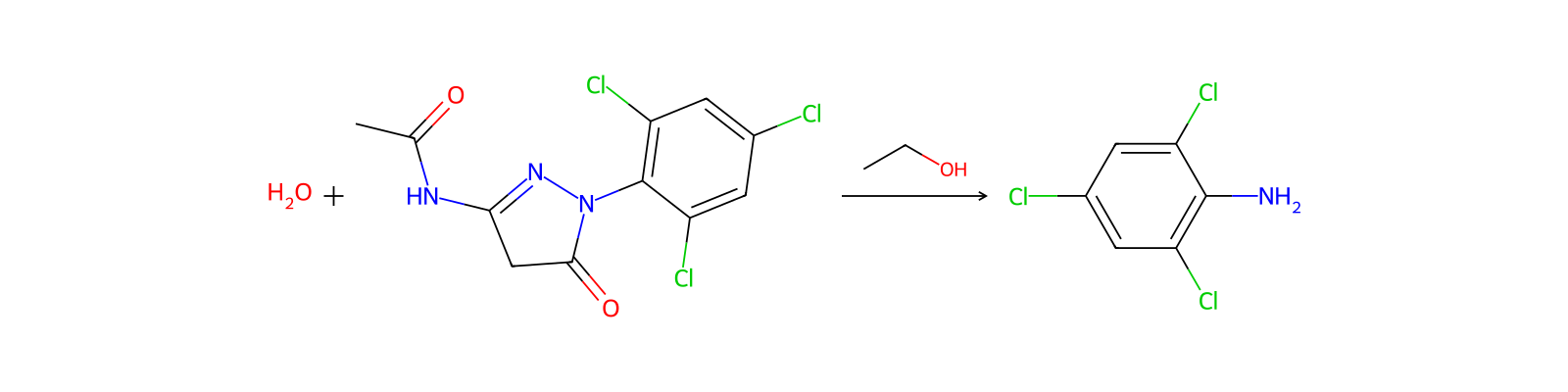
HRID 61317 reaction equation
HRID 61317As reactantuspto-grants-2016_09
HRID 67165 reaction equation
HRID 67165As productuspto-grants-1982_08
HRID 67166 reaction equation
HRID 67166As productuspto-grants-1982_08
HRID 247165 reaction equation
HRID 247165As reactantuspto-grants-1987_11
HRID 261002 reaction equation
HRID 261002As reactantuspto-grants-1979_08
HRID 277223 reaction equation
HRID 277223As reactantuspto-grants-2002_03
HRID 371401 reaction equation
HRID 371401As reactantuspto-grants-1985_07
HRID 439746 reaction equation
HRID 439746As reactantuspto-grants-1996_05
Page 1 of 5

Compound notes

Loading…

On this pageBasic informationOverviewNames & identifiersPropertiesSafety & regulationChemistry & industryRelated reactionsCompound notes

0.00000015 [mmHg]

1.47X10⁻⁷ mm Hg @ 25 °C

Physical Description · 2 items

Long needles or fine, light purple fibers. (NTP, 1992)

Solid; [HSDB] Off-white or tan fibers; [MSDSonline]

Dissociation ConstantspKa= -0.03 (conjugate acid)

Physicochemical properties

Melting point
73 · 73-75 °C (lit.)
Boiling point
262 °C · 262 °C (lit.)
Density
1.6807 · 1.6807 (rough estimate)
vapor pressure
0 · 0-0.631Pa at 25℃
refractive index
1.63 · 1.6300 (estimate)
Flash point
262 °C · 262°C
storage temp.
Storage temperature: no restrictions.
solubility
0.039 g/l · 0.039g/l slightly soluble
pka
0.07 · 0.07±0.10(Predicted)
form
crystals
color
Needles or liquid from pet ether
Water Solubility
0.1 g/100 · <0.1 g/100 mL at 21.5 ºC
BRN
879568 · 879568
Henry's Law Constant
7.4 · 7.4×100 mol/(m3Pa) at 25℃, HSDB (2015)
Stability
Stable, but may be light or air sensitive. Incompatible with acids, acid chlorides, acid anhydrides, chloroformates, strong oxidizing agents.
InChI
1S/C6H4Cl3N/c7-3-1-4(8)6(10)5(9)2-3/h1-2H,10H2
InChIKey
NATVSFWWYVJTAZ-UHFFFAOYSA-N
SMILES
Nc1c(Cl)cc(Cl)cc1Cl
LogP
3.648 · 3.648-3.69 at 25℃
CAS DataBase Reference
634 · 634-93-5(CAS DataBase Reference)
EWG's Food Scores
1 · 1
FDA UNII
7 IC72N9B0 · J7IC72N9B0
NIST Chemistry Reference
2 · Benzenamine, 2,4,6-trichloro-(634-93-5)
EPA Substance Registry System
2 · 2,4,6-Trichloroaniline (634-93-5)
UNSPSC Code
12352100 · 12352100
NACRES
22 · NA.22
Symbol(GHS)
7 · GHS07,GHS09
Signal word
Warning
Hazard statements
303 · H303-H315-H319-H410
Precautionary statements
501 · P501-P273-P264-P280-P302+P352-P312-P391-P337+P313-P305+P351+P338-P362+P364-P332+P313
Hazard Codes
T,N
Risk Statements
23 · 23/24/25-33-50/53
Safety Statements
28 · 28-36/37-45-60-61-28A
RIDADR
2811 · UN 2811 6.1/PG 2
WGK Germany
3 · 3
RTECS
250000 · BZ0250000
Hazard Note
Toxic
TSCA
TSCA listed
HazardClass
6.1 · 6.1
PackingGroup
II
HS Code
29214200 · 29214200
Storage Class
6.1 C · 6.1C - Combustible acute toxic Cat.3toxic compounds or compounds which causing chronic effects
Hazard Classifications
3 OralAquatic · Acute Tox. 3 OralAquatic Chronic 2Skin Irrit. 2Skin Sens. 1
Hazardous Substances Data
634 · 634-93-5(Hazardous Substances Data)
Toxicity
50 orl-rat: · LD50 orl-rat: 2400 mg/kg GISAAA 55(6),86,90
REACH Registrations
Active
Limited Quantities
100 ml · 100ml (liquid) or 0.5 Kg (solid)
Excepted Quantities
Max Inner Pack (1g or 1ml) and Max Outer Pack (500g or 500ml)
TSCA Requirements · 1 item

Pursuant to section 8(d) of TSCA, EPA promulgated a model Health and Safety Data Reporting Rule. The section 8(d) model rule requires manufacturers, importers, and processors of listed chemical substances and mixtures to submit to EPA copies and lists of unpublished health and safety studies. 2,4,6-Trichlorobenzeneamine is included on this list.

Reactivity Profile2,4,6-TRICHLOROANILINE is incompatible with acids, acid chlorides, acid anhydrides, chloroformates, and strong oxidizing agents. (NTP, 1992).
Air and Water ReactionsThis compound may be sensitive to exposure to light and air. Insoluble in water.
Hazard Classes and Categories · 2 items

Acute Tox. 3 (96.2%)

Hazardous to the aquatic environment (Acute) - Category 2

Safety & protection

Fire FightingFires involving this material can be controlled with a dry chemical, carbon dioxide or Halon extinguisher. A water spray may also be used. (NTP, 1992)
First Aid · 1 item

EYES: First check the victim for contact lenses and remove if present. Flush victim's eyes with water or normal saline solution for 20 to 30 minutes while simultaneously calling a hospital or poison control center. Do not put any ointments, oils, or medication in the victim's eyes without specific instructions from a physician. IMMEDIATELY transport the victim after flushing eyes to a hospital even if no symptoms (such as redness or irritation) develop.

Nonfire Spill Response · 1 item

SMALL SPILLS AND LEAKAGE: Should a spill occur while you are handling this chemical, FIRST REMOVE ALL SOURCES OF IGNITION, then you should dampen the solid spill material with 60-70% ethanol and transfer the dampened material to a suitable container. Use absorbent paper dampened with 60-70% ethanol to pick up any remaining material. Seal the absorbent paper, and any of your clothes, which may be contaminated, in a vapor-tight plastic bag for eventual disposal. Solvent wash all contaminated surfaces with 60-70% ethanol followed by washing with a soap and water solution. Do not reenter the contaminated area until the Safety Officer (or other responsible person) has verified that the area has been properly cleaned.

Disposal Methods · 1 item

SRP: At the time of review, criteria for land treatment or burial (sanitary landfill) disposal practices are subject to significant revision. Prior to implementing land disposal of waste residue (including waste sludge), consult with environmental regulatory agencies for guidance on acceptable disposal practices.

Isolation and EvacuationExcerpt from ERG Guide 154 [Substances - Toxic and/or Corrosive (Non-Combustible)]:
Personal Protective Equipment (PPE) · 1 item

RECOMMENDED RESPIRATOR: Where the neat test chemical is weighed and diluted, wear a NIOSH-approved half face respirator equipped with an organic vapor/acid gas cartridge (specific for organic vapors, HCl, acid gas and SO2) with a dust/mist filter. (NTP, 1992)

Toxicology

Environmental Fate · 3 items

TERRESTRIAL FATE: Based on a classification scheme(1), an estimated Koc value of 2,400(SRC), determined from a structure estimation method(2), indicates that 2,4,6-trichloroaniline is expected to have slight mobility in soil(SRC). There appears a rapid and spontaneous binding to soil organic matter and to purified humic and fulvic acid preparations(3). Therefore, soils containing high levels of organic matter are expected to attenuate soil mobility(SRC). Volatilization of 2,4,6-trichloroaniline from moist soil surfaces is expected to be a slow environmental fate process(SRC) given an estimated Henry's Law constant of 1.34X10⁻⁶ atm-cu m/mole(SRC), using a fragment constant estimation method(4). 2,4,6-Trichloroaniline is not expected to volatilize from dry soil surfaces(SRC) based upon an estimated vapor pressure of 1.47X10⁻⁷ mm Hg(SRC), determined from a fragment constant method(5).

AQUATIC FATE: Based on a classification scheme(1), an estimated Koc value of 2,400(SRC), determined from a structure estimation method(2), indicates that 2,4,6-trichloroaniline is expected to adsorb to suspended solids and sediment in water(SRC). Volatilization from water surfaces is not expected(3) based upon an estimated Henry's Law constant of 1.34X10⁻⁶ atm-cu m/mole(SRC), developed using a fragment constant estimation method(4). According to a classification scheme(5), a BCF of 214(6) suggests bioconcentration in aquatic organisms is high. A measured BCF of 870 was found using activated sludge from a municipal sewage treatment plant over a 5 day period(7).

ATMOSPHERIC FATE: According to a model of gas/particle partitioning of semivolatile organic compounds in the atmosphere(1), 2,4,6-trichloroaniline, which has a vapor pressure of 1.47X10⁻⁷ mm Hg at 25 °C(2), will exist in both the vapor and particulate phases in the ambient atmosphere. Vapor-phase 2,4,6-trichloroaniline is degraded in the atmosphere by reaction with photochemically-produced hydroxyl radicals(SRC); the half-life for this reaction in air is estimated to be 14 days(SRC) from its estimated rate constant of 1.11X10⁻¹² cu cm/molecule sec(3). Particulate-phase 2,4,6-trichloroaniline may be removed from the air by wet and dry deposition(SRC). 2,4,6-Trichloroanilne absorbs light in the environmental spectrum (>290 nm), and may undergo photolysis in the ambient environment. Photo-oxidation of 2,4,6-trichloroaniline was found to occur more readily in fulvic acid as opposed to humic acid(4). However, photo oxidation occurred more readily when not bound to any soil material than bound(5).

Adverse EffectsOccupational hepatotoxin - Secondary hepatotoxins: the potential for toxic effect in the occupational setting is based on cases of poisoning by human ingestion or animal experimentation.
Effluent ConcentrationsAnilines, including trichloro isomers, are released to the environment during the industrial production of dyes and pigments and also during microbial and/or chemical degradation and photodecomposition of various pesticides(1).
Soil Adsorption/Mobility · 1 item

Using a structure estimation method based on molecular connectivity indices(1), the Koc for 2,4,6-trichloroaniline can be estimated to be about 2,400(SRC). According to a classification scheme(2), this estimated Koc value suggests that 2,4,6-trichloroaniline is expected to have slight mobility in soil. Also, covalent binding to humic substances is an important process in the formation of soil-bound residues of chlorinated anilines. Additionally, other mechanisms of soil-binding, such as entrapping of residues into cavities within the humus structure, or binding to mineral constituents, may also contribute to the phenomenon of bound residues of anilines in soil(3). Aromatic amines (such as various trichloro aniline isomers) have been observed to undergo rapid and reversible covalent bonding with humic materials in aqueous solution. The initial bonding reaction is followed by a slower and much less reversible reaction believed to represent the addition of the amine to quinoidal structures followed by oxidation of the product to give an amino-substituted quinone. These processes represent pathways by which aromatic amines may be converted to latent forms in the biosphere(4). There appears a rapid and spontaneous binding to soil organic matter and to purified humic and fulvic acid preparations. Therefore, a build up of 2,4,6-trichloroaniline in agricultural soils may occur(5).

Artificial Pollution Sources · 1 item

2,4,6-Trichloroaniline's production and use as an intermediate in the manufacture of benzene derivatives, including 1,3,5-trichlorobenzene, and in the formulation of fungicides, mono-azo dyestuffs, and the preparation of hexachlorodiphenyl urea(1) may result in its release to the environment through various waste streams.

Environmental Biodegradation · 2 items

AEROBIC: Using water samples containing bacteria acclimated to 2,4,6-trichloroaniline, a first-order rate decay of 0.206 day-1 was determined for the degradation of 2,4,6-trichloroaniline(1), with a half-life of 3.36 days(SRC). Negative inductive effects given by chlorosubstitutions in 2,4,6-positions operated strongly and prevented the enzymic conversion of 2,4,6-trichloroaniline using peroxidase enzymes(2). In a soil-bound form, residues of 2,4,6-trichloroaniline underwent aerobic mineralization more readily by soil micro flora than in a free state(3). Chemical binding of aniline residues to the soil organic matter effectively competes with the polymerization process by soil bacteria. Chemical binding to humic compounds acts greatly to retard mineralization(4).

ANAEROBIC: Using sediment-water slurries collected from 9 eutrophic ponds and slow moving streams in the Netherlands, 2,4,6-trichloroaniline underwent reductive dehalogenation forming equimolar amounts of 2,4- and 2,6-dichloroaniline. The lag time for initial degradation was 41 days with a half-life of 143 days(1).

Environmental BioconcentrationA BCF of 3,630 was measured for 2,4,6-trichloroaniline(1) when exposed to fish for a 96 hr period. This suggests the potential for bioconcentration in aquatic organisms is very high, according to a classification scheme(2).
Volatilization from Water/Soil · 1 item

The Henry's Law constant for 2,4,6-trichloroaniline is estimated as 1.34X10⁻⁶ atm-cu m/mole(SRC) from its experimental values for vapor pressure, 1.47X10⁻⁷ mm Hg(1), and water solubility, 40 mg/l(2). This Henry's Law constant indicates that 2,4,6-trichloroaniline is not expected to volatilize from water surfaces(3). 2,4,6-Trichloroaniline is not expected to volatilize from dry soil surfaces(SRC) based upon a vapor pressure of 1.47X10⁻⁷ mm Hg(1).

Non-Human Toxicity Excerpts · 1 item

TESTING OF TWENTY-ONE ENVIRONMENTAL AROMATIC AMINES OR DERIVATIVES FOR LONG-TERM TOXICITY OR CARCINOGENICITY BY DIETARY ADMIN. IN MALE HAM/ICR MICE 2,4,6-TRICHLOROANILINE HAD FAIR DEGREE OF ACTIVITY, /VASCULAR AND LIVER TUMORS/ AS COMPARED TO OTHER COMPOUNDS.

Environmental Abiotic Degradation · 2 items

MONO-, DI-, & TRICHLOROANILINES WERE IRRADIATED IN METHANOL & METHANOL-H2O SOLN BY UV RADIATION; PRODUCTS WERE MONO-, DI-, & TRICHLOROAZOBENZENE.

The rate constant for the vapor-phase reaction of 2,4,6-trichloroaniline with photochemically-produced hydroxyl radicals has been estimated as 1.11X10⁻¹² cu cm/molecule-sec at 25 °C(SRC) using a structure estimation method(1). This corresponds to an atmospheric half-life of about 14 days at an atmospheric concentration of 5X10+5 hydroxyl radicals per cu cm(1). 2,4,6-Trichloroaniline is not expected to undergo hydrolysis in the environment due to the lack of hydrolyzable functional groups(3). It may directly photolyze due to absorbance in the environmental UV spectrum. Photooxidation of 2,4,6-trichloroaniline was found to occur more readily in fulvic acid as opposed to humic acid(4). However, photooxidation occurred more readily when not bound to any soil material than bound(5).

Probable Routes of Human Exposure · 1 item

Occupational exposure to 2,4,6-trichloroaniline may occur through inhalation and dermal contact with this compound at workplaces where 2,4,6-trichloroaniline is produced or used(SRC). The general population may be exposed to 2,4,6-trichloroaniline via drinking water(1) and dermal contact with this compound in dyestuffs, pigments, and pesticides containing 2,4,6-trichloroaniline(2).

Environmental Water Concentrations · 1 item

DRINKING WATER: 2,4,6-Trichloroaniline was detected, concentration not specified, in both finished drinking water and finished water from advanced water treatment. Finished drinking water samples originated from Cincinnati, OH, Miami, FL, New Orleans, LA, Ottumwa, IA, Philadelphia, PA, and Seattle, WA while finished water from advanced water treatment originated from Escondido, Lake Tahoe, Orange County and Pomona (California), Dallas, TX and Washington, D.C.

Regulatory information

TSCA Requirements · 1 item

Pursuant to section 8(d) of TSCA, EPA promulgated a model Health and Safety Data Reporting Rule. The section 8(d) model rule requires manufacturers, importers, and processors of listed chemical substances and mixtures to submit to EPA copies and lists of unpublished health and safety studies. 2,4,6-Trichlorobenzeneamine is included on this list.

Safety data

wgk
3
tsca
TSCA listed
rtecs
BZ0250000
ridadr
UN 2811 6.1/PG 2
hs_code
29214200
Toxicity
LD50 orl-rat: 2400 mg/kg GISAAA 55(6),86,90
risk_code
23/24/25-33-50/53
Signal word
Warning
Symbol(GHS)
GHS07,GHS09
hazard_code
T,N
hazard_note
Toxic
safety_code
28-36/37-45-60-61-28A
hazard_class
6.1
Storage Class
6.1C - Combustible acute toxic Cat.3toxic compounds or compounds which causing chronic effects
packing_group
II
Hazard statements
H303-H315-H319-H410
Limited Quantities
100ml (liquid) or 0.5 Kg (solid)
Excepted Quantities
Max Inner Pack (1g or 1ml) and Max Outer Pack (500g or 500ml)
REACH Registrations
Active
Hazard Classifications
Acute Tox. 3 OralAquatic Chronic 2Skin Irrit. 2Skin Sens. 1
Precautionary statements
P501-P273-P264-P280-P302+P352-P312-P391-P337+P313-P305+P351+P338-P362+P364-P332+P313
Hazardous Substances Data
634-93-5(Hazardous Substances Data)

Uses2,4,6-trichloroaniline is important as an intermediate in the manufacture of benzene derivatives, including 1,3,5-trichlorobenzene and is useful in the formation of fungicides, mono-azo dyestuffs, and the preparation of hexachlorodiphenyl urea.Tetrachloronitrobenzene was prepared from 2:4:6-trichloroaniline,which was converted by a Sandmeyer reaction into 1:2:3:5- tetrachlorobenzene.

General DescriptionLong needles or fine, light purple fibers.

Preparation methods · 1 item

Preparation2,4,6-Trichloroaniline can be prepared by reaction of dry aniline with chlorine gas while in a anhydrous solution of carbon tetrachloride. 2,4,6-Trichloroaniline precipitates from solution as a white solid. If water is introduced to the solution the white material will polymerize to form aniline black.Process for the preparation of 2,4,6-trichloroaniline

Upstream & downstream products

Upstream raw materials

Aniline

Downstream products

1,3,5-Trichlorobenzene4-Amino-3,5-dichloroacetophenone2,2',4,4',6,6'-HEXACHLOROBIPHENYL2,4,6-Trichloroiodobenzene1-BROMO-2,4,6-TRICHLOROBENZENE2,2',3,4,4',5,6,6'-OCTACHLOROBIPHENYL1,2,3,5-Tetrachlorobenzene2-azido-1,3,5-trichlorobenzene

Suppliers100 total

国药集团化学试剂有限公司86-21-63210123 · [email protected]
梯希爱(上海)化成工业发展有限公司021-67121386 · [email protected]
上海阿拉丁生化科技股份有限公司400-6206333 13167063860 · [email protected]
Shandong chuangyingchemical Co., Ltd.18853181302 · [email protected]
宁波君龙新材料有限公司0574 88552216 19032109277 · [email protected]
武汉欣扬瑞和化学科技有限公司13720274133 · [email protected]
河北创海生物科技有限公司+86-86-13131129325 · [email protected]
Dayang Chem (Hangzhou) Co.,Ltd.+86-0571-88938639 17705817739 · [email protected]
科瑞迪化学400-821-5857 021-64326257 · [email protected]
衢州明锋化工有限公司0570-3062502 13819002126;13819008176 · [email protected]
Syntechem Co.,Ltd[email protected]
上海迈瑞尔生化科技有限公司4006356688 18621169109 · [email protected]
武汉易泰科技有限公司上海分公司18930552037 · [email protected]
上海拓克化学科技有限公司+86-021-69895597 13776836200 +86-13776836200 · [email protected]
阿法埃莎(中国)化学有限公司400-6106006 · [email protected]
安耐吉化学&3A(安徽泽升科技股份有限公司)400-0056266 · [email protected]
上海瀚鸿科技股份有限公司021-54306202 13764082696 · [email protected]
山东洛克化工有限公司17653113209 13065062079 · [email protected]
上海景颜化工科技有限公司13817811078 · [email protected]
Shanghai Safer Pharmaceutical Technology Co., Ltd.021-31761238 · [email protected]
山东西亚化学有限公司13355009207 13355009207 · [email protected]
玛雅试剂+86 (573) 82222445 (0)18006601000 452520369 · [email protected]
四川库利南科技有限公司400-1166-196 18981987031 · [email protected]
天津希恩思生化科技有限公司400 638 7771 · [email protected]
北京泰亚杰科技有限公司021-33690831-8001 13552411790;18616022633 · [email protected]
艾科试剂4008-755-333 18080918076 · [email protected]
上海思域化工科技有限公司86-21-34053660 · [email protected]
苏州思变化学技术有限公司0512-65617459 18915409046 · [email protected]
北京伊诺凯科技有限公司400-810-7969 010-59572699 · [email protected]
TOKYO CHEMICAL INDUSTRY CO., LTD.03-36680489 · [email protected]
上海贤鼎生物科技有限公司4009209199 · [email protected]
上海汇凯化学科技有限公司021-61995394 18916691159 · [email protected]
安徽科迪达化工有限公司0554-2106669 · [email protected]
HBCChem, Inc.+1-510-219-6317 · [email protected]
日照力德士化工有限公司010-51268198 · [email protected]
美岚实业(上海)有限公司021-58958189 · [email protected]
上海石洋化工有限公司021-56795766 · [email protected]
上海爱蝶实业有限公司021-58957966 18930537195 · [email protected]
天津普西唐生物医药科技有限公司010-60605840 · [email protected]
上海麦克林生化科技股份有限公司15221275939 15221275939 · [email protected]
上海嵩爰化工科技有限公司010-1234567 18521000990 · [email protected]
上海有朋化工有限公司021-69005955 13701776567 · [email protected]
陕西缔都医药化工有限公司+86-29-87569262 +86-15003564040 · [email protected]
上海凯赛化工有限公司021-33516722 13701817765 · [email protected]
上海彤源化工有限公司021-021-69182866 13701855675 · [email protected]
常州市水草新材料科技有限公司0519-86609972; 13861152845 · [email protected]
上海蓝润化学有限公司021-69515658 ; 69515628 13701998368 · [email protected]
上海容立化学科技有限公司021-69992220 13701886816 · [email protected]
上海康拓化工有限公司021-69185552 13701777608 · [email protected]
Sigma-Aldrich西格玛奥德里奇(上海)贸易有限公司021-61415566 800-8193336 · [email protected]