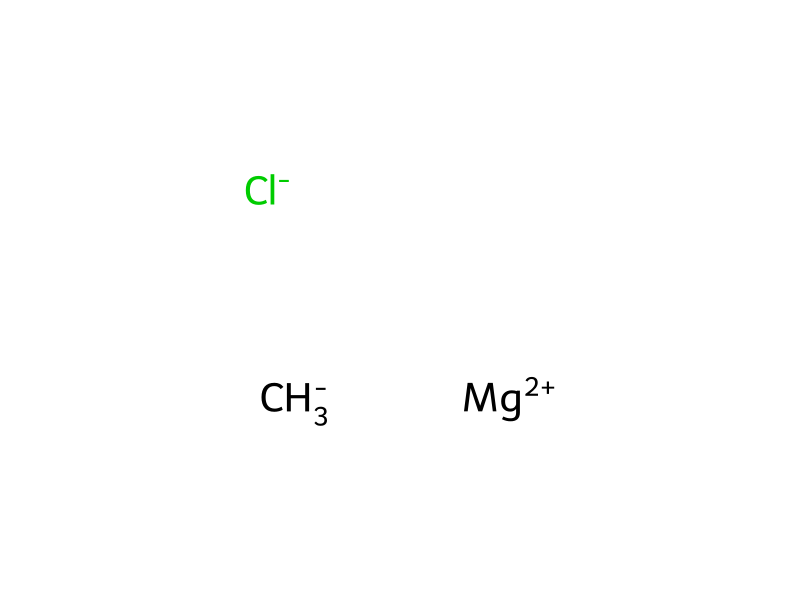
Basic information
- CAS
676-58-4- Standard SMILES
[CH3-].[Cl-].[Mg+2]- InChIKey
RQNMYNYHBQQZSP-UHFFFAOYSA-M- Molecular formula
- CH3ClMg
- Average molar mass
- 74.79 g/mol
Overview
Methylmagnesium chloride is an alkylmagnesium halide and a one-carbon compound.
Names & identifiers
- Preferred name
- Methylmagnesium chloride
- IUPAC
- magnesium;carbanide;chloride
- English name
- Methylmagnesium chloride
- Molecular formula
- CH3ClMg
- Molecular weight
- 74.79
Names & synonyms
METHYLMAGNESIUM CHLORIDE676-58-4ChloromethylmagnesiumMagnesium, chloromethyl-HSDB 5740EINECS 211-629-7M5E1132G4WEC 211-629-7CHEBI:51492Magnesium, chloromethylRefChem:818642UN3053
Show more names
chloromethyl-magnesiuCH3MgClinTHFMethylchloromagnesiumMethyl(chloro) magnesiumMagnesium methyl chlorideMagnesium carbanide chlorideMethylmagnesium chloride 3.0 M
METHYLMAGNESIUM CHLORIDE [HSDB]211-629-7MeMgClmagnesium;carbanide;chloridechloro(methyl)magnesiumMethyl magnesium chlorideCH3MgClUNII-M5E1132G4W
Database identifiers
- CAS
676-58-4- PubChem CID
- 12670
- DTXSID
DTXSID7052365- ChEBI
CHEBI:51492- EC Number
- 211-629-7
Properties
Computed structural properties
- Topological polar surface area
- 0 Ų
- Hydrogen bond donors
- 0
- Hydrogen bond acceptors
- 2
- Rotatable bonds
- 0
- Heavy atoms
- 3
- Formal charge
- 0
- Complexity
- 4.8
Experimental & physicochemical properties
Chemical ClassesMetals -> Metals, Organic Compounds
Density1.02 @25 °C
Physical Description
Wet Solid
In 3 M Tetrahydrofuran solution: Brown liquid with an odor of ether; [MSDSonline]
Other Experimental Properties
Moisture sensitive
... May react violently with water. /Methyl magnesium bromide in ethyl ether/
Physicochemical properties
- Boiling point
- 66 °C · 66 °C
- Density
- 1.013 g/mL · 1.013 g/mL at 25 °C
- vapor pressure
- 200 hPa · 200 hPa ( 20 °C)
- Flash point
- 1 °F · −1 °F
- storage temp.
- 30 °C · Store below +30°C.
- solubility
- Miscible with diethyl ether and tetrahydrofuran.
- form
- Liquid
- color
Safety & regulation
GHS classification
GHS Classification
Danger
H225 (36.5%): Highly Flammable liquid and vapor [Danger Flammable liquids]
P210, P222, P223, P231, P231+P232, P233, P240, P241, P242, P243, P260, P264, P264+P265, P280, P301+P330+P331, P302+P335+P334, P302+P361+P354, P303+P361+P353, P304+P340, P305+P354+P338, P316, P317, P321, P363, P370+P378, P402+P404, P403+P235, P405, and P501 (click each P-code to see the statement)
Aggregated GHS information provided per 263 reports by companies from 14 notifications to the ECHA C&L Inventory. Each notification may be associated with multiple companies.
Hazard information
Regulatory Information
Chemical: Magnesium, chloromethyl-
Magnesium, chloromethyl- is listed on the EPA's Chemical Data Reporting (CDR) system. Manufacturers and importers of Magnesium, chloromethyl- are required to report information about their production and use of this chemical to the EPA under the Toxic Substances Control Act (TSCA). (40 eCFR Part 711)
REACH registered substance: Methylmagnesium chloride (EC: 211-629-7)
Magnesium, chloromethyl-: Does not have an individual approval but may be used under an appropriate group standard
Other Safety InformationIMAP assessments - Magnesium, chloromethyl-: Environment tier I assessment
Fire Potential...DANGEROUS FIRE...RISK.
Hazards Summary
A dangerous fire and explosion risk; [Hawley] Apart from their instability in air and their caustic basic properties, organomagnesium compounds and the precipitated inorganic magnesium salts produced during their use display no pronounced toxicity or side effects of environmental concern. [Ullmann] Reacts violently with water producing highly flammable gases; May form explosive peroxides; A corrosive substance that can cause injury to the skin, eyes, and respiratory tract; Inhalation may cause chemical pneumonitis; [MSDSonline]
Chemistry & industry
Uses & manufacturing
Uses
Used as alkylating agent in organic synthesis and as a Grignard reagent; Also used to make tetramethyllead, styrallyl alcohol, and pharmaceuticals; [HSDB]
Alkylating agent in organic synthesis; grignard reagent
CHEM INT FOR MFR OF TETRAMETHYLLEAD
CHEM INT FOR MFR OF ALCOHOLS, EG, STYRALLYL ALCOHOL
CHEM INT FOR PHARMACEUTICALS, EG, STEROIDS
U.S. Exports
(1979) No Data
(1981) No Data
U.S. Imports
(1979) No Data
(1981) No Data
U.S. Production
2023: <75,000 lb
(1977) AT LEAST 4.58X10+7 GRAMS
(1981) PROBABLY GREATER THAN 2.27X10+6 GRAMS
Industry UsesProcessing aids not otherwise specified
Methods of ManufacturingREACTION OF METHYL CHLORIDE AND MAGNESIUM IN ANHYDROUS DIETHYL ETHER, USUALLY IN THE PRESENCE OF AN INITIATOR
Formulations/PreparationsAVAILABLE AS A SOLN IN TETRAHYDROFURAN.
General Manufacturing Information
All Other Basic Organic Chemical Manufacturing
Magnesium, chloromethyl-: ACTIVE
Applications
UsesMethylmagnesium chloride is used as a Grignard reagent and an alkylating agent in organic synthesis.
Preparation methods
reaction of methyl chloride and magnesium in anhydrous diethyl ether, usually in the presence of an initiator.
Related reactions
0 records
No reaction records under the current filter.
Compound notes
Loading…