HomeMCPWorkbenchSkills
HomeWorkbenchNotificationsMe
llms.txt · MCP GuidePrivacy Policy · Terms of Service · Supportv1.8.3
  1. Home
  2. /Compound

2-Cyanoethyl tetraisopropylphosphorodiamidite

HCID 128153
New reaction
Print
Basic informationNames & identifiersPropertiesSafety & regulationChemistry & industryRelated reactionsCompound notes
Substructure searchFind similar structures

Basic information

CAS
102691-36-1
Standard SMILES
CC(C)N(C(C)C)P(OCCC#N)N(C(C)C)C(C)C
InChIKey
RKVHNYJPIXOHRW-UHFFFAOYSA-N
Molecular formula
C15H32N3OP
Average molar mass
301.41 g/mol
Monoisotopic mass
301.22829965

Names & identifiers

Preferred name
2-Cyanoethyl tetraisopropylphosphorodiamidite
IUPAC
3-bis[di(propan-2-yl)amino]phosphanyloxypropanenitrile
English name
2-Cyanoethyl N,N,N',N'-tetraisopropylphosphorodiamidite
Molecular formula
C15H32N3OP
Molecular weight
301.41

Names & synonyms

102691-36-1Cetipd2-Cyanoethyl-N,N,N',N'-tetraisopropylphosphorodiamiditePhosphorodiamidous acid, tetrakis(1-methylethyl)-, 2-cyanoethyl ester2-CYANOETHYL TETRAISOPROPYLPHOSPHORODIAMIDITEDTXSID8075176RefChem:862807DTXCID50327333-((Bis(diisopropylamino)phosphino)oxy)propanenitrileBis(diisopropylamino)(2-cyanoethoxy)phosphine2-CYANOETHYL N,N,N',N'-TETRAISOPROPYLPHOSPHORODIAMIDITEP-Reagent
Show more names
3-Bis(diisopropylamino)phosphanyloxypropanenitrileTHERAPEUTIC GRADE PHOS REAGENTTETRAISOPROPYLPHOSPHORODIAMIDITE94.0%(GC&
2-Cyanoethyl N,N,N',N'-tetraisopropylphosphordiamiditeMFCD00012213Phosphorodiamidous acid, N,N,N',N'-tetrakis(1-methylethyl)-, 2-cyanoethyl ester2-Cyanoethyl N,N,N',N'-Tetraisopropylphosphoramidite2-cyanoethyl N,N,N',N'-tetraisopropyl-phosphordiamidite3-bis[di(propan-2-yl)amino]phosphanyloxypropanenitrile3-(bis(diisopropylamino)phosphinooxy)propanenitrile3-((Bis(diisopropylamino)phosphino)oxy)-propanenitrile

Database identifiers

CAS
102691-36-1
PubChem CID
128153
DTXSID
DTXSID8075176
UNII
8P2H5F3TEA
EC Number
600-337-9
Nikkaji
J738.473D

Properties

Computed structural properties

XLogP
3.3
Topological polar surface area
39.5 Ų
Hydrogen bond donors
0
Hydrogen bond acceptors
4
Rotatable bonds
9
Heavy atoms
20
Formal charge
0
Complexity
273

Physicochemical properties

Boiling point
100 °C0.5 · 100 °C0.5 mm Hg(lit.)
Density
0.949 g/mL · 0.949 g/mL at 25 °C(lit.)
refractive index
20 · n20/D 1.470(lit.)
Flash point
141 °F · 141 °F
storage temp.
-20 °C · -20°C
solubility
Acetonitrile (Slightly), Benzene, Chloroform (Sparingly), Methanol (Slightly)
form
liquid
pka
6.78 · 6.78±0.70(Predicted)
color
colorless
Sensitive
moisture sensitive, store cold
BRN
3590103 · 3590103
Stability
Explodes When Heated
InChI
1S/C15H32N3OP/c1-12(2)17(13(3)4)20(19-11-9-10-16)18(14(5)6)15(7)8/h12-15H,9,11H2,1-8H3
InChIKey
RKVHNYJPIXOHRW-UHFFFAOYSA-N
SMILES
CC(C)N(C(C)C)P(OCCC#N)N(C(C)C)C(C)C
LogP
4.04 at · 4.04 at 20℃
CAS DataBase Reference
102691 · 102691-36-1(CAS DataBase Reference)
EPA Substance Registry System
Phosphorodiamidous acid, tetrakis(1-methylethyl)-, 2-cyanoethyl ester (102691-36-1)
UNSPSC Code
12352100 · 12352100
NACRES
22 · NA.22
Symbol(GHS)
2 · GHS02,GHS07
Signal word
Warning
Hazard statements
226 · H226-H302-H317-H412
Precautionary statements
210 · P210-P233-P273-P280-P301+P312-P303+P361+P353
PPE
95 · dust mask type N95 (US), Eyeshields, Gloves
Hazard Codes
Xi,Xn
Risk Statements
5 · 5-36/37/38-42/43-36/38
Safety Statements
3 · 3-26-36-24/25-23-45-36/37
RIDADR
1993 · UN 1993 3/PG 3
WGK Germany
3 · 3
F
10 · 10-21-34
Hazard Note
Irritant/May Explode on Heating
HazardClass
8 · 8
PackingGroup
I
HS Code
29299000 · 29299000
Storage Class
3 · 3 - Flammable liquids
Hazard Classifications
4 OralAquatic · Acute Tox. 4 OralAquatic Chronic 3Flam. Liq. 3Skin Sens. 1B
REACH Registrations
Active
Limited Quantities
5 L · 5.0 L (1.3 gallons) (liquid)
Excepted Quantities
Max Inner Pack (30g or 30ml) and Max Outer Pack (1Kg or 1L)

Safety & regulation

Safety information is for reference only and does not replace the supplier’s Safety Data Sheet (SDS), applicable regulations, or professional assessment.

GHS classification

GHS Classification · 4 items

Danger

H226 (97.2%): Flammable liquid and vapor [Warning Flammable liquids]

P210, P233, P240, P241, P242, P243, P260, P261, P264, P264+P265, P270, P271, P272, P280, P284, P301+P317, P302+P352, P303+P361+P353, P304+P340, P305+P351+P338, P321, P330, P332+P317, P333+P317, P337+P317, P342+P316, P362+P364, P370+P378, P403, P403+P235, and P501 (click each P-code to see the statement)

Aggregated GHS information provided per 179 reports by companies from 12 notifications to the ECHA C&L Inventory. Each notification may be associated with multiple companies.

Hazard information

Regulatory Information · 2 items

REACH registered substance: 3-bis(diisopropylamino)phosphanyloxypropanenitrile (EC: 600-337-9)

Phosphorodiamidous acid, tetrakis(1-methylethyl)-, 2-cyanoethyl ester: Does not have an individual approval but may be used under an appropriate group standard

Hazard Classes and CategoriesFlam. Liq. 3 (97.2%)

Safety data

F
10-21-34
PPE
dust mask type N95 (US), Eyeshields, Gloves
wgk
3
ridadr
UN 1993 3/PG 3
hs_code
29299000
risk_code
5-36/37/38-42/43-36/38
Signal word
Warning
Symbol(GHS)
GHS02,GHS07
hazard_code
Xi,Xn
hazard_note
Irritant/May Explode on Heating
safety_code
3-26-36-24/25-23-45-36/37
hazard_class
8
Storage Class
3 - Flammable liquids
packing_group
I
Hazard statements
H226-H302-H317-H412
Limited Quantities
5.0 L (1.3 gallons) (liquid)
Excepted Quantities
Max Inner Pack (30g or 30ml) and Max Outer Pack (1Kg or 1L)
REACH Registrations
Active
Hazard Classifications
Acute Tox. 4 OralAquatic Chronic 3Flam. Liq. 3Skin Sens. 1B
Precautionary statements
P210-P233-P273-P280-P301+P312-P303+P361+P353

Chemistry & industry

Applications · 3 items

Description2-Cyanoethyl N,N,N',N'-tetraisopropylphosphorodiamidite is a colorless viscous liquid, which is soluble in most organic solvents. It is a widely used phosphitylating reagent for the preparation of various phosphorylated biomolecules, such as nucleoside carbohydrate conjugates, phospholipids and glycopeptides. In particular, this reagent is highly effective for automated solid-phase DNA/RNA oligonucleotide synthesis. It has shown great utility in the coupling of nucleobases or carbohydrates via their phosphotriesters in the presence of activators such as 1H-tetrazole, in moderate yields under mild conditions.This compound is cheaper and more stable than 2-cyanoethyl N,N-diisopropylchlorophosphorodiamidite (the other commonly used phosphinylating reagent)[1].

UsesReagent for synthesizing phosphitylated nucleotides.1

Uses2-Cyanoethyl N,N,N′,N′-tetraisopropylphosphordiamidite was used:in preparation of prosphoramidite reagent, required for synthesis of 12-mer oligodeoxynucleotideas phosphorylating agent in synthesis of 1,2-diacyl-sn-glycerophosphatidylserinein situ preparation of deoxyribonucleoside phosphoramiditesin preparation of 2′-deoxy-2′-fluoro-3′-O-(β-cyanoethyl-N,N-diisopropylphosphoramidic)-5′-O-(4-methoxytrityl)-4′-thio-β-D-arabinouridine and 1-(3-O-(β-cyanoethyl-N,N-diisopropylphosphoramidic)-2-deoxy-2-fluoro-5-O-(4,4′-dimethoxytrityl)-4-thio-β-D-arabinofuranosyl)-thymineas reagent for synthesizing phosphitylated nucleotides

Upstream & downstream products

Upstream raw materials

5'-Amino-5'-deoxythymidineBis(diisopropylamino)chlorophosphine2-Cyanoethyl phosphorodichloriditeDiisopropylamine

Downstream products

Ceftibutenanionic starchDMT-dcytidine (N6-benzoyl) cyanoethyl phosphoramidite)DMT-dG(dmf) PhosphoramiditeCytidine, N-benzoyl-5'-O-[bis(4-methoxyphenyl)phenylmethyl]-2'-deoxy-5-(1,7-octadiyn-1-yl)-, 3'-[2-cyanoethyl N,N-bis(1-methylethyl)phosphoramidite]Cytidine, N-benzoyl-5'-O-[bis(4-methoxyphenyl)phenylmethyl]-2'-O-methyl-, 3'-[2-cyanoethyl bis(1-methylethyl)phosphoramidite], (S)- (9CI)DMT-dA(bz) Phosphoramidite3'-dA CEP5'-DMT-3'-O-TBDMS-N1-Me-Pseudouricdine-CE-Phosphoramidite4-Thio-dU CEP(2R,3S,5R)-2-((Bis(4-methoxyphenyl)(phenyl)methoxy)methyl)-5-(2,4-dioxo-5-(3-(2,2,2-trifluoroacetamido)prop-1-ynyl)-3,4-dihydropyrimidin-1(2H)-yl)tetrahydrofuran-3-yl 2-cyanoethyl diisopropylphosphoramiditeDMT-2'O-Methyl-rU Phosphoramidite

Related reactions

26 records
New reaction record
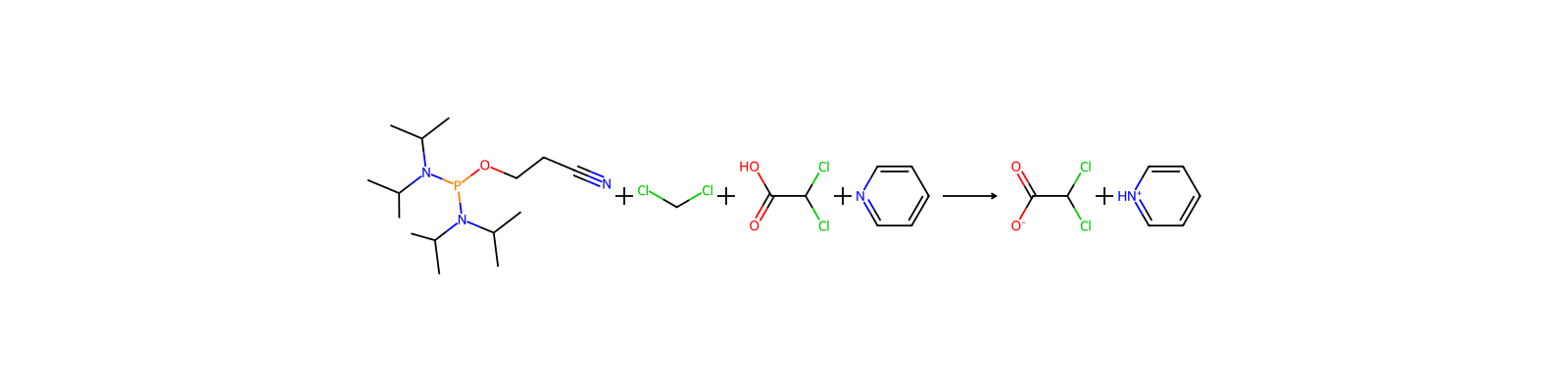
HRID 20907 reaction equation
HRID 20907As reactant
HRID 20916 reaction equation
HRID 20916As reactant
HRID 20924 reaction equation
HRID 20924As reactant
HRID 274988 reaction equation
HRID 274988As reactant
HRID 296177 reaction equation
HRID 296177As reactant
HRID 635499 reaction equation
HRID 635499As reactant
HRID 635504 reaction equation
HRID 635504As reactant
HRID 1055787 reaction equation
HRID 1055787As reactant
PreviousPage 1 of 4

Compound notes

On this pageBasic informationNames & identifiersPropertiesSafety & regulationChemistry & industryRelated reactionsCompound notes