Completing data — usually done within a minute
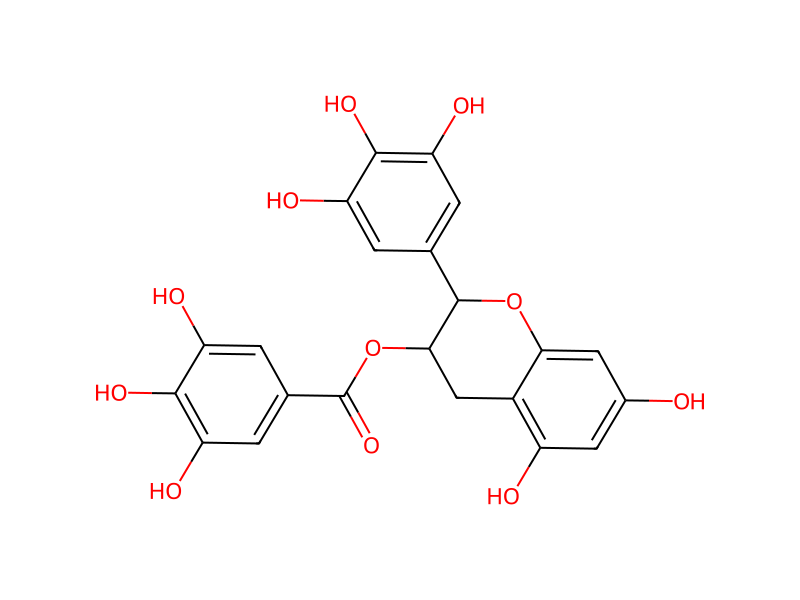
Basic information
- Standard SMILES
O=C(OC1Cc2c(O)cc(O)cc2OC1c1cc(O)c(O)c(O)c1)c1cc(O)c(O)c(O)c1- InChIKey
WMBWREPUVVBILR-UHFFFAOYSA-N- Molecular formula
- C22H18O11
- Average molar mass
- 458.375 g/mol
- Monoisotopic mass
- 458.0849114
Names & identifiers
- Preferred name
- 5,7-Dihydroxy-2-(3,4,5-trihydroxyphenyl)-3,4-dihydro-2H-1-benzopyran-3-yl 3,4,5-trihydroxybenzoate
- IUPAC
- 5,7-Dihydroxy-2-(3,4,5-trihydroxyphenyl)-3,4-dihydro-2H-1-benzopyran-3-yl 3,4,5-trihydroxybenzoate
- English name
- Tea polyphenol
- Molecular formula
- C17H19N3O
- Molecular weight
- 281.36
Names & synonyms
Database identifiers
- CAS
84650-60-2- PubChem CID
- 1287
- DTXSID
DTXSID00859570- ChEMBL
CHEMBL311663- ChEBI
CHEBI:182308- EC Number
- 283-519-7
- Nikkaji
- J948.157E
Properties
Physicochemical properties
- storage temp.
- -20 °C · -20°C
- solubility
- DMSO (Slightly), Methanol (Slightly)
- form
- Solid
- color
- Light Orange
- Odor
- 100 % · at 100.00 %. tea
- Odor Type
- herbal
- Major Application
- pharmaceutical (small molecule)
- Cosmetics Ingredients Functions
- PERFUMINGBLEACHINGORAL CARETONICUV ABSORBERASTRINGENTANTIMICROBIALFRAGRANCEEXFOLIATINGANTI-SEBUMSKIN CONDITIONING - EMOLLIENTSKIN PROTECTINGHUMECTANTANTIOXIDANTSKIN CONDITIONING
- Cosmetic Ingredient Review (CIR)
- Tea polyphenol (84650-60-2)
- Substances Added to Food (formerly EAFUS)
- TEA EXTRACT (THEA SINENSIS L.)
- NCI Dictionary of Cancer Terms
- green tea extract
- NCI Drug Dictionary
- green tea extract
- UNSPSC Code
- 41116107 · 41116107
- NACRES
- 24 · NA.24
- Symbol(GHS)
- 2 · GHS02,GHS07
- Signal word
- Warning
- Hazard statements
- 225 · H225-H319-H226
- Precautionary statements
- 210 · P210-P233-P240-P241-P242-P243-P280-P303+P361+P353-P370+P378-P403+P235-P501-P264-P280-P305+P351+P338-P337+P313P
- WGK Germany
- 3 · 3
- HS Code
- 2101200040 · 2101200040
- Storage Class
- 11 · 11 - Combustible Solids
Safety & regulation
Safety data
- wgk
- 3
- hs_code
- 2101200040
- Signal word
- Warning
- Symbol(GHS)
- GHS02,GHS07
- Storage Class
- 11 - Combustible Solids
- Hazard statements
- H225-H319-H226
- Precautionary statements
- P210-P233-P240-P241-P242-P243-P280-P303+P361+P353-P370+P378-P403+P235-P501-P264-P280-P305+P351+P338-P337+P313P
Chemistry & industry
Applications
DescriptionThe phenolic compounds in tea (tea polyphenols) are also known as catechins. In green tea, the four major catechins are (-)-epigallocatechin-3-gallate (EGCG) and its derivatives including (-)-epigallocatechin (EGC), (-)-epicatechin gallate (ECG), and (-)-epicatechin (EC). EGCG takes around 50-80% of the total catechin in green tea and it has been shown to be responsible for much of the health promoting ability of green tea.Tea polyphenols exhibit anti-carcinogenic, anti-oxidative, anti-allergic, antiviral, anti-hypertensive, anti-atherosclerosis, anti-cardiovascular disease and anti-hypercholesterolemic activities. EGCG has shown to inhibit hepatitis C virus entry and carcinogenesis. Studies suggest that tea polyphenols may help treat health conditions including atherosclerosis, high cholesterol, and cancers including bladder cancer, breast cancer, ovarian cancer, colorectal cancer, esophageal cancer, lung cancer, pancreatic cancer, prostate cancer, skin cancer, and stomach cancer. Tea polyphenols could be helpful in treating inflammatory diseases.
Usesgreen tea extract (Camellia sinensis L.) is a powerful anti-oxidant because of its catechin content, it is also known to be an antibacterial, anti-inflammatory, and a stimulant. In clinical studies, green tea demonstrates an ability to prevent or at least postpone the onset of such illnesses as cancer and heart disease. This is attributed to the catechin component’s ability to penetrate into a cell, thereby protecting the cell from free radicals and associated damage. Because of its anti-oxidant properties, green tea is usually incorporated into anti-aging formulations. When applied topically, it can also reduce skin swelling. In addition, it can be found in sunscreens, given its ability to extend the product’s SPF. The extract and its associated catechins can be obtained from both the plant and its dried leaves. other constituents of green tea include caffeine and phenolic acids.
Upstream & downstream products
Upstream raw materials
Suppliers50 total
Additional notes
DefinitionChEBI: 5,7-Dihydroxy-2-(3,4,5-trihydroxyphenyl)-3,4-dihydro-2H-chromen-3-yl 3,4,5-trihydroxybenzoate is a catechin.
Related reactions
No reaction records under the current filter.
Linked notes
Loading…