HomeMCPWorkbenchSkills
HomeWorkbenchNotificationsMe
llms.txt · MCP GuidePrivacy Policy · Terms of Service · Supportv1.8.3
  1. Home
  2. /Compound

Mandelic Acid

HCID 1292
New reaction
Print
Basic informationOverviewNames & identifiersPropertiesSafety & regulationChemistry & industryRelated reactionsCompound notes
Substructure searchFind similar structures

Basic information

CAS
611-72-3
Standard SMILES
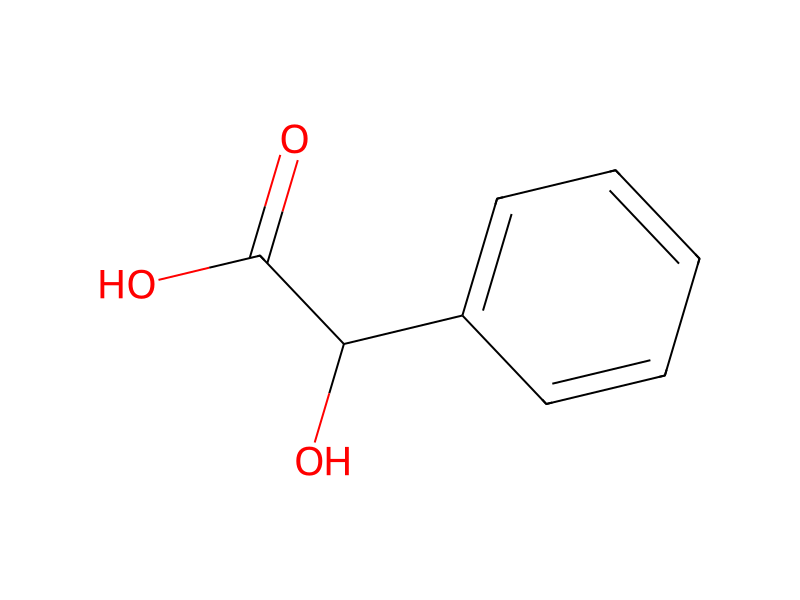
O=C(O)C(O)c1ccccc1
InChIKey
IWYDHOAUDWTVEP-UHFFFAOYSA-N
Molecular formula
C8H8O3
Average molar mass
152.15 g/mol
Monoisotopic mass
152.04734411

Overview

Mandelic acid is a 2-hydroxy monocarboxylic acid that is acetic acid in which two of the methyl hydrogens are substituted by phenyl and hydroxyl groups. It has a role as an antibacterial agent and a human xenobiotic metabolite. It is a member of benzenes and a 2-hydroxy monocarboxylic acid. It is functionally related to an acetic acid. It is a conjugate acid of a mandelate.

Names & identifiers

Preferred name
Mandelic Acid
IUPAC
2-hydroxy-2-phenylacetic acid
English name
DL-Mandelic acid
Molecular formula
C8H8O3
Molecular weight
152.15

Names & synonyms

MANDELIC ACIDdl-Mandelic acid2-hydroxy-2-phenylacetic acid90-64-2Phenylglycolic acidParamandelic acidAmygdalic acidUromalineRacemic mandelic acidPhenylhydroxyacetic acid(RS)-Mandelic acidAcido mandelico
Show more names
DL-MandelicaciDL-MANDELSAEURE SDL-AMYGDALIC ACIDMANDELIC ACID, DL-RARECHEM AL BO 1098TIMTEC-BB SBB007730(R)(S)-MANDELICACIDMANDELIC(D,L-) ACID
Kyselina mandlovaBenzeneacetic acid, alpha-hydroxy-alpha-Hydroxybenzeneacetic acidNSC-7925alpha-Hydroxyphenylacetic acidNH496X0UJXDTXSID6023234CHEBI:35825

Database identifiers

CAS
611-72-3、90-64-2
PubChem CID
1292
DTXSID
DTXSID6023234
ChEMBL
CHEMBL1609
ChEBI
CHEBI:35825

Properties

Computed structural properties

XLogP
0.6
Topological polar surface area
57.5 Ų
Hydrogen bond donors
2
Hydrogen bond acceptors
3
Rotatable bonds
2
Heavy atoms
11
Formal charge
0
Complexity
138

Experimental & physicochemical properties

Chemical ClassesOther Classes -> Organic Acids
CosmeticsAntimicrobial
LogP0.64
Density · 2 items

1.3 @25 °C

1.3 @25 °C

Boiling Point320 °C @760 [mm Hg]
Melting Point119 °C
Vapor Pressure0.0000164 [mmHg]
Physical Description · 2 items

Liquid

Solid; Darkens and decomposes after prolonged light exposure; [Merck Index] White crystalline powder with a faint sweet odor; [Fisher Scientific MSDS]

Physicochemical properties

Melting point
119 · 119-121 °C(lit.)

Safety & regulation

Safety information is for reference only and does not replace the supplier’s Safety Data Sheet (SDS), applicable regulations, or professional assessment.

GHS classification

GHS Classification · 6 items

This chemical does not meet GHS hazard criteria for 25.3% (66 of 261) of reports.

Danger

H302 (23.4%): Harmful if swallowed [Warning Acute toxicity, oral]

P261, P264, P264+P265, P270, P271, P280, P301+P317, P302+P352, P304+P340, P305+P354+P338, P317, P319, P321, P330, P332+P317, P362+P364, P403+P233, P405, and P501 (click each P-code to see the statement)

Aggregated GHS information provided per 261 reports by companies from 11 notifications to the ECHA C&L Inventory. Each notification may be associated with multiple companies.

This chemical does not meet GHS hazard criteria for 1.8% (2 of 111) of reports.

Hazard information

Regulatory Information · 4 items

Chemical: Benzeneacetic acid, .alpha.-hydroxy-

Benzeneacetic acid, .alpha.-hydroxy- is listed on the EPA's Chemical Data Reporting (CDR) system. Manufacturers and importers of Benzeneacetic acid, .alpha.-hydroxy- are required to report information about their production and use of this chemical to the EPA under the Toxic Substances Control Act (TSCA). (40 eCFR Part 711)

REACH registered substance: Mandelic acid (EC: 202-007-6)

Benzeneacetic acid, .alpha.-hydroxy-: Does not have an individual approval but may be used under an appropriate group standard

Other Safety InformationIMAP assessments - Benzeneacetic acid, .alpha.-hydroxy-: Human health tier I assessment
Hazards SummaryCauses gastritis and other liver changes in oral lethal-dose studies of rabbits; [RTECS] An irritant; Chronic exposure may cause kidney injury and digestive tract abnormalities; [Fisher Scientific MSDS]
Hazard Classes and Categories · 2 items

Chemistry & industry

Pharmacology

ATC Code · 4 items

J - Antiinfectives for systemic use

B - Blood and blood forming organs

QB - Blood and blood forming organs

QJ - Antiinfectives for systemic use

Uses & manufacturing

UsesUsed as a urinary antiseptic; [Merck Index]
U.S. Production2023: 75,000 - <500,000 lb
Industry UsesIntermediate
Use ClassificationCosmetics -> Antimicrobial
General Manufacturing Information · 2 items

All Other Chemical Product and Preparation Manufacturing

Benzeneacetic acid, .alpha.-hydroxy-: ACTIVE

Applications · 2 items

DescriptionDL-Mandelic acid is a chemical compound belonging to the family of alpha hydroxy acids (AHAs). It is a racemic mixture containing equal amounts of the D and L enantiomers of Mandelic acid. It is commonly used in skincare products for its exfoliating and antibacterial properties. DL-Mandelic Acid is useful in suppressing pigmentation, treating inflammatory non-cystic acne, and rejuvenating photoaged skin. Moreover, it has proven useful in preparing the skin for laser peeling and helping the skin heal after laser surgery. This product appears as a white crystal substance.

UsesDL-Mandelic acid is used as a chemical reagent, in organic synthesis, and as a pharmaceutical raw material and intermediate, dye intermediate, etc.

Upstream & downstream products

Related reactions

94 records
New reaction record
HRID 28763 reaction equation
HRID 28763As reactant
HRID 41346 reaction equation
HRID 41346As reactant
HRID 41347 reaction equation
HRID 41347As reactant
HRID 41349 reaction equation
HRID 41349As reactant
HRID 64914 reaction equation
HRID 64914As reactant
HRID 71214 reaction equation
HRID 71214As reactant
HRID 82263 reaction equation
HRID 82263As reactant
HRID 128491 reaction equation
HRID 128491As product
PreviousPage 1 of 12

Compound notes

On this pageBasic informationOverviewNames & identifiersPropertiesSafety & regulationChemistry & industryRelated reactionsCompound notes
UNII
NH496X0UJX
EC Number
202-007-6、210-277-1
Nikkaji
J2.433.033H、J2.433.034F、J3.918G
Boiling point
234.6 °C · 234.6°C (rough estimate)
Density
1.289 · 1.2890
refractive index
1.4945 · 1.4945 (estimate)
pka
3.85 · 3.85(at 25℃)
Water Solubility
172.5 g/L · 172.5g/L(24 ºC)
InChI
InChI=1S/C8H8O3/c9-7(8(10)11)6-4-2-1-3-5-6/h1-5,7,9H,(H,10,11)
InChIKey
IWYDHOAUDWTVEP-UHFFFAOYSA-N
SMILES
C1(C=CC=CC=1)C(O)C(=O)O
CAS DataBase Reference
611 · 611-72-3(CAS DataBase Reference)
NIST Chemistry Reference
Benzeneacetic acid, «alpha»-hydroxy-, (.+/-.)-(611-72-3)
Symbol(GHS)
7 · GHS07,GHS05
Signal word
Danger
Hazard statements
302 · H302-H315-H318-H335
Precautionary statements
264 · P264-P270-P301+P312-P330-P501-P280-P305+P351+P338-P310-P264-P280-P302+P352-P321-P332+P313-P362
Risk Statements
21 · 21/22
Safety Statements
22 · 22-24/25
WGK Germany
3 · 3
RTECS
6300000 · OO6300000
HS Code
2918190090 · 2918190090

Acute Tox. 4 (50.5%)

Acute Tox. 4 (23.4%)

Safety & protection

Protective Action Criteria (PAC) · 6 items

25 [mg/m3]

270 [mg/m3]

1600 [mg/m3]

25 [mg/m3]

270 [mg/m3]

1600 [mg/m3]

Toxicology

Adverse EffectsOccupational hepatotoxin - Secondary hepatotoxins: the potential for toxic effect in the occupational setting is based on cases of poisoning by human ingestion or animal experimentation.

Safety data

wgk
3
rtecs
OO6300000
hs_code
2918190090
risk_code
21/22
Signal word
Danger
Symbol(GHS)
GHS07,GHS05
safety_code
22-24/25
Hazard statements
H302-H315-H318-H335
Precautionary statements
P264-P270-P301+P312-P330-P501-P280-P305+P351+P338-P310-P264-P280-P302+P352-P321-P332+P313-P362

Upstream raw materials

Sodium bisulfiteSodium cyanideBenzaldehyde
Additional notes · 1 item

DefinitionChEBI: Mandelic acid is a 2-hydroxy monocarboxylic acid that is acetic acid in which two of the methyl hydrogens are substituted by phenyl and hydroxyl groups. It has a role as an antibacterial agent and a human xenobiotic metabolite. It is a 2-hydroxy monocarboxylic acid and a member of benzenes. It is functionally related to an acetic acid. It is a conjugate acid of a mandelate.