
4-Cyanophenol
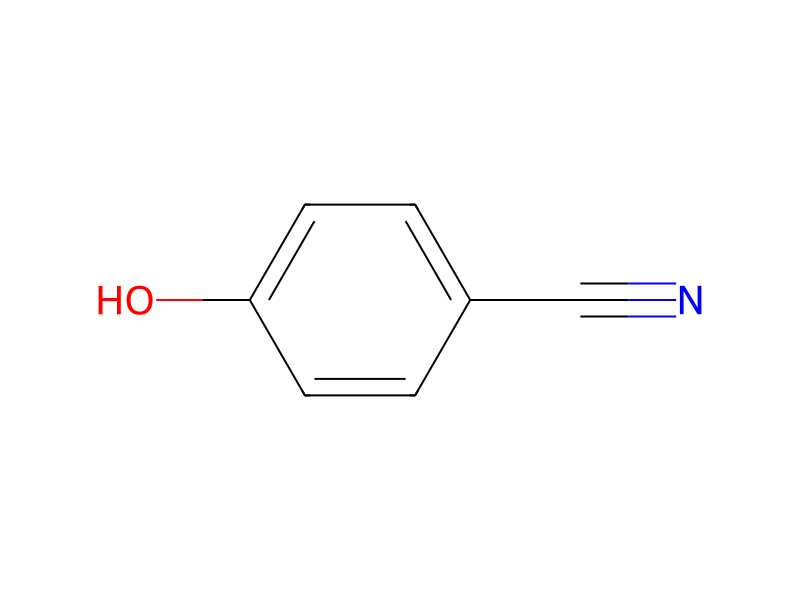
Basic information
- CAS
767-00-0- Standard SMILES
N#Cc1ccc(O)cc1- InChIKey
CVNOWLNNPYYEOH-UHFFFAOYSA-N- Molecular formula
- C7H5NO
- Average molar mass
- 119.12 g/mol
- Monoisotopic mass
- 119.03711378
Overview
4-cyanophenol is a member of phenols. It has a role as an EC 1.4.3.4 (monoamine oxidase) inhibitor. It is functionally related to a benzonitrile.
Names & identifiers
- Preferred name
- 4-Cyanophenol
- IUPAC
- 4-hydroxybenzonitrile
- English name
- 4-Cyanophenol
- Molecular formula
- C7H5NO
- Molecular weight
- 119.12
Names & synonyms
4-Hydroxybenzonitrile4-Cyanophenol767-00-0p-HydroxybenzonitrileP-CYANOPHENOLBenzonitrile, 4-hydroxy-Benzonitrile, p-hydroxy-DTXSID90525094-hydroxycyanobenzene1S13529YJUNSC-400524DTXCID7031082
Show more names
4-HYDROXYBENZOHYDRAZIDEHydroxybenzonitrilePARA-CYANOPHENOLPHBNP-nitrileAKOS 217-25AKOS B004225
CHEBI:38622RefChem:98654212-175-24-CYANO PHENOL4-Hydroxy benzonitrile4-hydroxy-benzonitrile4-Hydroxybenzoic acid nitrileMFCD00002312
Database identifiers
- CAS
767-00-0- PubChem CID
- 13019
- DTXSID
DTXSID9052509- ChEMBL
CHEMBL66381- ChEBI
CHEBI:38622- UNII
- 1S13529YJU
- EC Number
- 212-175-2
- Nikkaji
- J36.035J
Properties
Computed structural properties
- XLogP
- 1.6
- Topological polar surface area
- 44 Ų
- Hydrogen bond donors
- 1
- Hydrogen bond acceptors
- 2
- Rotatable bonds
- 0
- Heavy atoms
- 9
- Formal charge
- 0
- Complexity
- 127
Experimental & physicochemical properties
Chemical ClassesNitrogen Compounds -> Nitriles
SpringerMaterials Properties13C nuclear magnetic resonance spectrum
LogP1.28
Vapor Pressure0.00665 [mmHg]
Physical DescriptionMostly soluble in water (8.98 g/L at 25 deg C); [ChemIDplus] White crystalline chips; [MSDSonline]
Collision Cross Section118.1 Ų [M-H]- [CCS Type: DT; Buffer gas: N2; Ionization: ESI-; Dataset: TOXCAST; Source Identifier: DTXSID9052509]
Physicochemical properties
- Melting point
- 110 · 110-113 °C(lit.)
- Boiling point
- 146 °C · 146 °C / 2mmHg
- Density
- 1.1871 · 1.1871 (rough estimate)
- refractive index
- 1.58 · 1.5800 (estimate)
- storage temp.
Safety & regulation
Safety information is for reference only and does not replace the supplier’s Safety Data Sheet (SDS), applicable regulations, or professional assessment.
GHS classification
GHS Classification
Warning
H302 (96.8%): Harmful if swallowed [Warning Acute toxicity, oral]
P261, P264, P264+P265, P270, P271, P280, P301+P317, P302+P352, P304+P340, P305+P351+P338, P319, P321, P330, P332+P317, P337+P317, P362+P364, P403+P233, P405, and P501 (click each P-code to see the statement)
Aggregated GHS information provided per 62 reports by companies from 13 notifications to the ECHA C&L Inventory. Each notification may be associated with multiple companies.
Hazard information
Regulatory Information
Chemical: Benzonitrile, 4-hydroxy-
REACH registered substance: 4-hydroxybenzonitrile (EC: 212-175-2)
4-Hydroxybenzonitrile: Does not have an individual approval but may be used under an appropriate group standard
Hazards SummaryA skin and eye irritant; [eChemPortal: ERMA] An irritant; [MSDSonline] See NITRILES.
Hazard Classes and CategoriesAcute Tox. 4 (96.8%)
Safety data
- PPE
- dust mask type N95 (US), Eyeshields, Faceshields, Gloves
- wgk
- 3
- tsca
- TSCA listed
- rtecs
- DI4375000
- hs_code
- 2926909090
- risk_code
- 22-36/37/38
- Signal word
- Warning
- Symbol(GHS)
- GHS07
- hazard_code
- Xn,Xi
Chemistry & industry
Uses & manufacturing
UsesUsed in the production of herbicides; [Ullmann]
General Manufacturing InformationBenzonitrile, 4-hydroxy-: ACTIVE
Applications
UsesIntermediates of Liquid Crystals
Uses4-Cyanophenol is a precursor for the synthesis of a vasodilator, Levcromakalim. Bromination of 4-cyanophenol results in bromoxynil, a commercial herbicide. It can also be used as a component of deep eutectic solvent (DES) mixture.
Preparation methods
Preparation4-Cyanophenol is produced by reaction of 4-bromophenol with copper (I) cyanide, by ammoxidation of p-cresol, by reaction of 4-chlorobenzonitrile with sodium methoxide, or by the catalyzed gas phase reaction of ethyl 4-hydroxybenzoate with ammonia.
Upstream & downstream products
Upstream raw materials
Related reactions
516 records







Compound notes
Loading…