
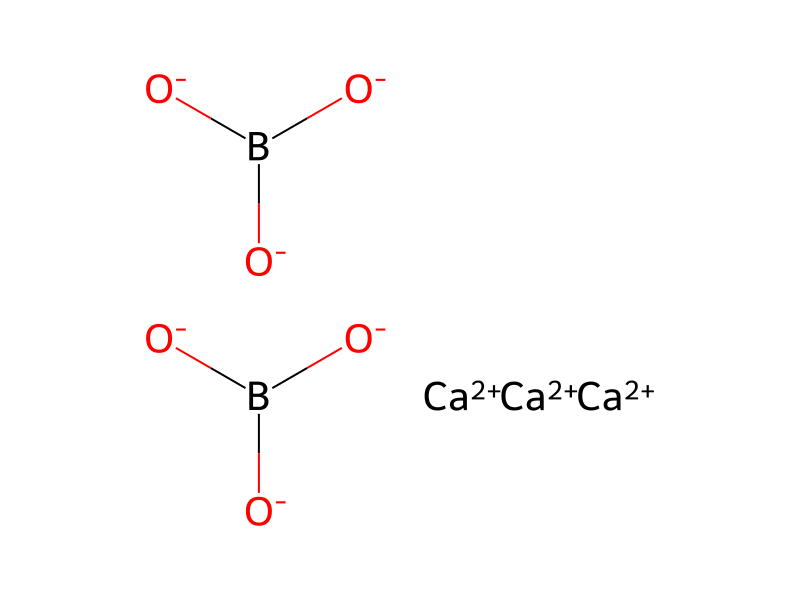
Basic information
- CAS
12007-56-6- Standard SMILES
[Ca+2].[Ca+2].[Ca+2].[O-]B([O-])[O-].[O-]B([O-])[O-]- InChIKey
VLCLHFYFMCKBRP-UHFFFAOYSA-N- Molecular formula
- B2Ca3O6
- Average molar mass
- 237.9 g/mol
- Monoisotopic mass
- 237.87587146
Names & identifiers
- Preferred name
- Boric acid, calcium salt
- IUPAC
- tricalcium diborate
- English name
- CALCIUM BORATE
- Molecular formula
- BCaH7O
- Molecular weight
- 73.94
Names & synonyms
tricalcium;diborateBoric acid, calcium salt12040-58-3Orthoboric acid, calcium salt13840-55-6Boric acid (H3BO3), calcium saltCalcium tetraboron heptaoxideEINECS 234-511-7EINECS 234-920-0EINECS 237-559-7Calcium hydrogen borateCaB4O7
Show more names
colemaniteboricacid(h2-b4-o7),calciumsalt(1:1)BoroncalciumoxideCALCIUM PYROBORATECALCIUM TETRABORATEboroncalciumoxide(b4cao7)boric acid (h2-b4-o7), calcium salt
Calcium borate (3/2)Boric acid (H3BO3), calcium salt (1:?)UNII-80UKT9A6QUEC 234-920-0Boric acid (H2-B4-O7), calcium salt (1:1)SCHEMBL57637DTXSID70930103DB-254160
Database identifiers
- CAS
12007-56-6、12040-58-3、13840-55-6- PubChem CID
- 134660
- DTXSID
DTXSID70930103- EC Number
- 234-920-0、237-559-7
Properties
Computed structural properties
- Topological polar surface area
- 138 Ų
- Hydrogen bond donors
- 0
- Hydrogen bond acceptors
- 6
- Rotatable bonds
- 0
- Heavy atoms
- 11
- Formal charge
- 0
- Complexity
- 8
Experimental & physicochemical properties
Physical DescriptionDry Powder
Physicochemical properties
- Density
- 1.904 · 1.904[at 20℃]
- Water Solubility
- 2 O, · soluble H2O, acids; evolves oxygen [HAW93]
- FDA UNII
- 80 UKT9A6QU · 80UKT9A6QU
- EPA Substance Registry System
- Boron calcium oxide (B4CaO7) (12007-56-6)
- Symbol(GHS)
- 8 · GHS08
- Signal word
- Danger
- Hazard statements
- 360 · H360
- TSCA
- TSCA listed
- REACH Registrations
- Inactive
Safety & regulation
GHS classification
GHS Classification
This chemical does not meet GHS hazard criteria for 100% (129 of 129) of all reports.
Not Classified
Aggregated GHS information provided per 129 reports by companies from 1 notifications to the ECHA C&L Inventory.
This chemical does not meet GHS hazard criteria for 100% (34 of 34) of all reports.
Not Classified
Aggregated GHS information provided per 34 reports by companies from 1 notifications to the ECHA C&L Inventory.
Hazard information
Regulatory Information
Boric acid, calcium salt is listed on the EPA's Chemical Data Reporting (CDR) system. Manufacturers and importers of Boric acid, calcium salt are required to report information about their production and use of this chemical to the EPA under the Toxic Substances Control Act (TSCA). (40 eCFR Part 711)
Hazard Classes and Categories
Not Classified
Not Classified
Safety data
- tsca
- TSCA listed
- Signal word
- Danger
- Symbol(GHS)
- GHS08
- Hazard statements
- H360
- REACH Registrations
- Inactive
Chemistry & industry
Uses & manufacturing
U.S. Production2023: 250,000 - <550,000 lb
Industry UsesNot Known or Reasonably Ascertainable
General Manufacturing Information
Not Known or Reasonably Ascertainable
Boric acid, calcium salt: ACTIVE
Boric acid (H3BO3), calcium salt (1:?): ACTIVE
Applications
UsesMicrobiological fouling of plastic materials is an unwanted nuisance and a problem in many household and industrial environments. The humid and highmoisture environments where plastic materials are often used provide excellent growth environments for unwanted microorganisms such as mold, fungi, and mildew. In addition to degrading and fouling plastic materials, these microorganisms can cause unsightly stains and unpleasant odors. Calcium pyroborate has been employed in various plastic materials that contain a microbicidally effective amount of calcium pyroborate that protects plastic materials from microbiological attack. It is also used in fungicidal and corrosion inhibiting paint pigments.
Preparation methods
PreparationCalcium pyroborate has the molecular formula of Ca2B2O5, it can be prepared by the reaction of: 2CaCl2 (solid) + 2H2BO3 (solid) + heat →Ca2B2O5 + 4HCl (gas)
Upstream & downstream products
Upstream raw materials
Suppliers
Related reactions
7 records


Compound notes
Loading…