
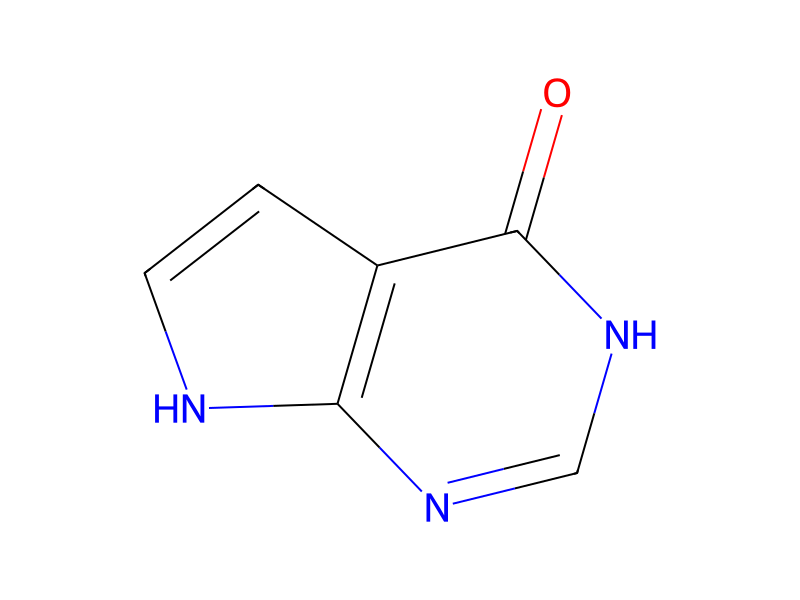
Basic information
- Standard SMILES
O=c1[nH]cnc2[nH]ccc12- InChIKey
FBMZEITWVNHWJW-UHFFFAOYSA-N- Molecular formula
- C6H5N3O
- Average molar mass
- 135.12 g/mol
- Monoisotopic mass
- 135.04326179
Names & identifiers
- Preferred name
- 7-Deazahypoxanthine
- IUPAC
- 3,7-dihydropyrrolo[2,3-d]pyrimidin-4-one
- English name
- Pyrrolo[2,3-d]pyrimidin-4-ol
- Molecular formula
- C6H5N3O
- Molecular weight
- 135.12
Names & synonyms
3680-71-57-Deazahypoxanthine3,7-Dihydro-4H-pyrrolo[2,3-d]pyrimidin-4-one4-Hydroxypyrrolopyrimidine1,7-DIHYDRO-4H-PYRROLO[2,3-D]PYRIMIDIN-4-ONENSC 59251NSC 1241641,7-Dihydro-4H-pyrrolo(2,3-d)pyrimidin-4-oneDTXSID301902813,7-Dihydro-4H-pyrrolo(2,3-d)pyrimidin-4-oneRefChem:105983DTXCID40112772
Show more names
1H-Pyrrolo[2,3-d]pyrimidin-4-ol3,7-DIHYDRO-PYRROLO[2,3-D]PYRIMIDIN-4-ONE1,7-dih7-Deaza-6-hydroxy
FBMZEITWVNHWJW-UHFFFAOYSA-N7H-Pyrrolo[2,3-d]pyrimidin-4-olPyrrolo[2,3-d]pyrimidin-4-ol3H-pyrrolo[2,3-d]pyrimidin-4(7H)-one4-hydroxypyrrolo[2,3-d]pyrimidine1H-PYRROLO[2,3-D]PYRIMIDIN-4(7H)-ONE1194710-85-44-Hydroxy-7H-pyrrolo[2,3-d]pyrimidine
Database identifiers
- CAS
3680-71-5- PubChem CID
- 135408689
- DTXSID
DTXSID30190281- ChEMBL
CHEMBL186582- UNII
- 8W6UF5S8F3
- EC Number
- 640-613-6
- Nikkaji
- J641.018I
Properties
Computed structural properties
- XLogP
- -0.2
- Topological polar surface area
- 57.3 Ų
- Hydrogen bond donors
- 2
- Hydrogen bond acceptors
- 2
- Rotatable bonds
- 0
- Heavy atoms
- 10
- Formal charge
- 0
- Complexity
- 189
Physicochemical properties
- Melting point
- 345 · 345-348°C
- Boiling point
- 473.1 · 473.1±18.0 °C(Predicted)
- Density
- 1.62 · 1.62±0.1 g/cm3(Predicted)
- RTECS
- 9440000 · UY9440000
- storage temp.
- 2 · 2-8°C
- solubility
- Soluble in dimethyl sulfoxide.
- form
- Solid
- pka
- 11.99 · 11.99±0.20(Predicted)
- color
- Brown
- Sensitive
- Moisture & Light Sensitive
- InChI
- InChI=1S/C6H5N3O/c10-6-4-1-2-7-5(4)8-3-9-6/h1-3H,(H2,7,8,9,10)
- InChIKey
- FBMZEITWVNHWJW-UHFFFAOYSA-N
- SMILES
- C1NC(=O)C2C=CNC=2N=1
- CAS DataBase Reference
- 3680 · 3680-71-5(CAS DataBase Reference)
- UNSPSC Code
- 12352100 · 12352100
- NACRES
- 22 · NA.22
- Symbol(GHS)
- 7 · GHS07
- Signal word
- Warning
- Hazard statements
- 317 · H317-H319
- Precautionary statements
- 280 · P280-P302+P352-P305+P351+P338
- Hazard Codes
- Xi
- Risk Statements
- 36 · 36-43
- Safety Statements
- 26 · 26-36/37
- WGK Germany
- 3 · 3
- HazardClass
- IRRITANT
- HS Code
- 29335990 · 29335990
- Storage Class
- 11 · 11 - Combustible Solids
- Hazard Classifications
- 2 Skin · Eye Irrit. 2Skin Sens. 1
Safety & regulation
GHS classification
GHS Classification
Warning
H315 (12.8%): Causes skin irritation [Warning Skin corrosion/irritation];H317 (89.4%): May cause an allergic skin reaction [Warning Sensitization, Skin];H319 (100%): Causes serious eye irritation [Warning Serious eye damage/eye irritation];H335 (10.6%): May cause respiratory irritation [Warning Specific target organ toxicity, single exposure; Respiratory tract irritation]
P261, P264, P264+P265, P271, P272, P280, P302+P352, P304+P340, P305+P351+P338, P319, P321, P332+P317, P333+P317, P337+P317, P362+P364, P403+P233, P405, and P501 (click each P-code to see the statement)
Aggregated GHS information provided per 47 reports by companies from 6 notifications to the ECHA C&L Inventory. Each notification may be associated with multiple companies.;Information may vary between notifications depending on impurities, additives, and other factors. The percentage value in parenthesis indicates the notified classification ratio from companies that provide hazard codes. Only hazard codes with percentage values above 10% are shown. For more detailed information, please visit ECHA C&L website.
Hazard information
Hazard Classes and CategoriesSkin Irrit. 2 (12.8%);Skin Sens. 1 (89.4%);Eye Irrit. 2 (100%);STOT SE 3 (10.6%)
Safety data
- wgk
- 3
- hs_code
- 29335990
- risk_code
- 36-43
- Signal word
- Warning
- Symbol(GHS)
- GHS07
- hazard_code
- Xi
- safety_code
- 26-36/37
- hazard_class
- IRRITANT
- Storage Class
- 11 - Combustible Solids
- Hazard statements
- H317-H319
- Hazard Classifications
- Eye Irrit. 2Skin Sens. 1
- Precautionary statements
- P280-P302+P352-P305+P351+P338
Chemistry & industry
Applications
UsesXanthine oxidase-activated prodrug of thymidine phosphorylase inhibitor
UsesPyrrolo[2,3-d]pyrimidin-4-ol is used as pharmaceutical intermediate.
Upstream & downstream products
Upstream raw materials
Downstream products
Suppliers50 total
上海阿拉丁生化科技股份有限公司400-6206333 13167063860 · [email protected]
T&W GROUP021-61551611 13296011611 · [email protected]
韶远科技(上海)有限公司021-50795510 4000665055 · [email protected]
Ark Pharm, Inc.847-367-3680 · [email protected]
北京华威锐科化工有限公司0757-86329057 18934348241 · [email protected]
武汉易泰科技有限公司上海分公司18930552037 · [email protected]
江苏弘和药物研发有限公司5108538618 · [email protected]
上海德默医药科技有限公司400-021-7337 2355568890 · [email protected]
安耐吉化学&3A(安徽泽升科技股份有限公司)400-0056266 · [email protected]
武汉凯威斯科技有限公司86-027-67849912 · [email protected]
安庆奇创药业有限公司18061456370
上海恩诺生物科技有限公司+86 (21) 6435-5022
上海瀚鸿科技股份有限公司021-54306202 13764082696 · [email protected]
安徽联创生物医药股份有限公司0551-68779238 18056025720 · [email protected]
Shangchem Co., Ltd.+86-21-68182121
嘉兴市艾森化工有限公司0573-85285100 18627885956 · [email protected]
上海泰坦科技股份有限公司400-6009262 15618770481 · [email protected]
武汉永璨生物科技有限公司17702719238 · [email protected]
上海隆盛化工有限公司58099637 13585536065 · [email protected]
上海攀鸿化工科技有限公司021-56491756 13512199871 · [email protected]
山东鼎皓生物科技有限公司0531-82616988 18300239268 · [email protected]
杰达维(上海)医药科技发展有限公司/J & W PharmLab021-64340559 · [email protected]
Creative Peptides[email protected]
杭州东帆化学有限公司86-0571-85151182
安徽海康药业有限责任公司86-0556-5800026 17709662922 · [email protected]
山东西亚化学有限公司13355009207 13355009207 · [email protected]
四川库利南科技有限公司400-1166-196 18981987031 · [email protected]
skychemical Co.Ltd021-20958197 20965099 · [email protected]
上海舒盟医药科技有限公司021-54540637 18621091017 · [email protected]
南京斯贝源医药科技有限公司+86-25-68710855, +86-25-68710897 · [email protected]
武汉爱瑞克科技有限公司027- 51832457 94518350
青岛凯亚隆医药科技有限公司053288191853 13061484198
上海乔木化学科技有限公司021-60451683 15021268886 · [email protected]
河南多贝化工有限公司0370-2785118 17550508557 · [email protected]
上海思域化工科技有限公司86-21-34053660 · [email protected]
苏州思变化学技术有限公司0512-65617459 18915409046 · [email protected]
南京精瑞久安生物技术有限公司025-58196018 800028039 · [email protected]
上海特伯化学科技有限公司+86-21-60341587 · [email protected]
江苏艾康生物医药研发有限公司025-66113011 13913916777 · [email protected]
TCI AMERICA800-4238616 · [email protected]
TOKYO CHEMICAL INDUSTRY CO., LTD.03-36680489 · [email protected]
TCI Europe320-37350700 · [email protected]
上海卡洛化学有限公司21-33526724 18930996265 · [email protected]
深圳康特腾科技有限公司86-0755-86635001 · [email protected]
上海睿升化工科技有限公司+86-021-50935922
广州爱纯医药科技有限公司020-39119399 18927568969 · [email protected]
重庆卡兰医药有限公司023-62879767 · [email protected]
上海将来实业股份有限公司021-61552785 · [email protected]
HBCChem, Inc.+1-510-219-6317 · [email protected]
重庆普瑞生物医药科技有限公司023-89130144 18523560356 · [email protected]
Related reactions
11 records


Linked notes
Loading…