
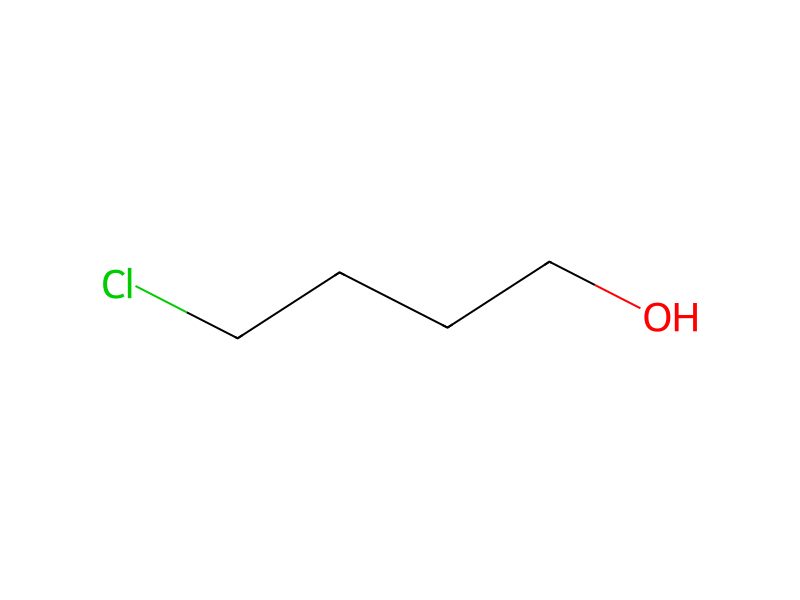
Basic information
- Standard SMILES
OCCCCCl- InChIKey
HXHGULXINZUGJX-UHFFFAOYSA-N- Molecular formula
- C4.H9.Cl.O
- Average molar mass
- 108.57 g/mol
- Monoisotopic mass
- 108.03419259
Overview
4-chlorobutanol is a primary alcohol that is butan-1-ol substituted by a chloro group at position 4. It has a role as a metabolite. It is a primary alcohol and an organochlorine compound. It is functionally related to a butan-1-ol.
Names & identifiers
- Preferred name
- 4-Chloro-1-butanol
- IUPAC
- 4-chlorobutan-1-ol
- English name
- 4-Chloro-1-butanol
- Molecular formula
- C4H9ClO
- Molecular weight
- 108.57
Names & synonyms
4-Chloro-1-butanol928-51-84-ChlorobutanolTetramethylene chlorohydrin1-BUTANOL, 4-CHLORO-42EI3I5AY0NSC-10810DTXSID2061301CHEBI:87310RefChem:98294DTXCID8048818213-175-5
Show more names
oro-1-butanoL4-Chlorolbutanol4-Choro-1-bytanol4-chloro-1-butano4-CHLOROBUTANOL-14-ChIoro-1-butanoI
4-Chlorobutan-1-ol4-Chloro-1-butane-ol4-chloro-butan-1-ol4-Chlorbutan-1-olMFCD000029674-Chloro-1-butanol (Technical Grade)4-Chlorbutan-1-ol [German]1-chloro-4-butanol
Database identifiers
- CAS
928-51-8- PubChem CID
- 13569
- DTXSID
DTXSID2061301- ChEMBL
CHEMBL2260957- ChEBI
CHEBI:87310- UNII
- 42EI3I5AY0
- EC Number
- 213-175-5
- Nikkaji
- J35.120B
Properties
Computed structural properties
- XLogP
- 0.8
- Topological polar surface area
- 20.2 Ų
- Hydrogen bond donors
- 1
- Hydrogen bond acceptors
- 1
- Rotatable bonds
- 3
- Heavy atoms
- 6
- Formal charge
- 0
- Complexity
- 23.5
Experimental & physicochemical properties
Chemical ClassesOther Classes -> Halogenated Alcohols
SpringerMaterials PropertiesSchoenflies notation
LogP0.85
Density1.088 @ 20°C
Vapor Pressure0.35 [mmHg]
Physical DescriptionClear colorless liquid; Contains <= 12% hydrochloric acid (CAS# 7647-01-0) and <= 3% tetrahydrofuran (CAS# 109-99-9); [Sigma-Aldrich MSDS]
Physicochemical properties
- Boiling point
- 84 · 84-85 °C/16 mmHg (lit.)
- Density
- 1.088 g/mL · 1.088 g/mL at 25 °C (lit.)
- refractive index
- 20 · n20/D 1.453(lit.)
- Flash point
- 97 °F · 97 °F
- storage temp.
- 2 · 2-8°C
- solubility
- Soluble in methanol, chloroform, and dimethyl sufoxide.
- form
- Liquid
- pka
- 15.01 · 15.01±0.10(Predicted)
- color
- Clear colorless to light yellow
- BRN
- 1731408 · 1731408
- InChI
- InChI=1S/C4H9ClO/c5-3-1-2-4-6/h6H,1-4H2
- InChIKey
- HXHGULXINZUGJX-UHFFFAOYSA-N
- SMILES
- C(O)CCCCl
- CAS DataBase Reference
- 928 · 928-51-8(CAS DataBase Reference)
- EWG's Food Scores
- 1 · 1
- FDA UNII
- 42 EI3I5AY0 · 42EI3I5AY0
- NIST Chemistry Reference
- 4 · 4-Chloro-1-butanol(928-51-8)
- EPA Substance Registry System
- 1 · 1-Butanol, 4-chloro- (928-51-8)
- UNSPSC Code
- 12352100 · 12352100
- NACRES
- 22 · NA.22
- Symbol(GHS)
- 2 · GHS02,GHS05,GHS07,GHS08
- Signal word
- Warning
- Hazard statements
- 226 · H226-H290-H302-H315-H319-H335-H351
- Precautionary statements
- 202 · P202-P210-P301+P312-P303+P361+P353-P305+P351+P338-P308+P313
- target organs
- Respiratory system
- PPE
- Faceshields, Gloves, Goggles, type ABEK (EN14387) respirator filter
- Hazard Codes
- Xn,C,F
- Risk Statements
- 10 · 10-22-36/37/38-20/21/22-34-40
- Safety Statements
- 23 · 23-24/25-36/37/39-26-16-36/37
- RIDADR
- 2920 · UN 2920 8/PG 2
- WGK Germany
- 3 · 3
- RTECS
- 1325000 · EL1325000
- Hazard Note
- Harmful
- TSCA
- TSCA listed
- HazardClass
- 3.2 · 3.2
- PackingGroup
- III
- HS Code
- 29055910 · 29055910
- Storage Class
- 3 · 3 - Flammable liquids
- Hazard Classifications
- 4 OralCarc · Acute Tox. 4 OralCarc. 2Eye Irrit. 2Flam. Liq. 3Met. Corr. 1Skin Irrit. 2STOT SE 3
- Limited Quantities
- 5 L · 5.0 L (1.3 gallons) (liquid)
- Excepted Quantities
- Max Inner Pack (30g or 30ml) and Max Outer Pack (1Kg or 1L)
Safety & regulation
GHS classification
GHS Classification
Warning
H226 (91.7%): Flammable liquid and vapor [Warning Flammable liquids]
P210, P233, P240, P241, P242, P243, P261, P264, P264+P265, P270, P271, P280, P301+P317, P302+P352, P303+P361+P353, P304+P340, P305+P351+P338, P319, P321, P330, P332+P317, P337+P317, P362+P364, P370+P378, P403+P233, P403+P235, P405, and P501 (click each P-code to see the statement)
Aggregated GHS information provided per 48 reports by companies from 8 notifications to the ECHA C&L Inventory. Each notification may be associated with multiple companies.
Hazard information
Hazards Summary
Causes muscle contraction or spasticity, ulceration or bleeding from the stomach, and other liver changes in oral lethal-dose studies of mice; [RTECS] Causes burns; Inhalation may cause corrosive injuries to upper respiratory tract and lungs; Harmful by ingestion; Targets the CNS, liver, and kidney; [Sigma-Aldrich MSDS] See 1-Chloro-2-propanol and 2-Chloro-1-propanol.
Hazard Classes and CategoriesFlam. Liq. 3 (91.7%)
Safety & protection
Protective Action Criteria (PAC)
1.6 [mg/m3]
18 [mg/m3]
110 [mg/m3]
Toxicology
Adverse EffectsDermatotoxin - Skin burns.
Safety data
- PPE
- Faceshields, Gloves, Goggles, type ABEK (EN14387) respirator filter
- wgk
- 3
- tsca
- TSCA listed
- rtecs
- EL1325000
- ridadr
- UN 2920 8/PG 2
- hs_code
- 29055910
- risk_code
- 10-22-36/37/38-20/21/22-34-40
- Signal word
- Warning
- Symbol(GHS)
- GHS02,GHS05,GHS07,GHS08
- hazard_code
- Xn,C,F
- hazard_note
- Harmful
- safety_code
- 23-24/25-36/37/39-26-16-36/37
- hazard_class
- 3.2
- Storage Class
- 3 - Flammable liquids
- packing_group
- III
- target organs
- Respiratory system
- Hazard statements
- H226-H290-H302-H315-H319-H335-H351
- Limited Quantities
- 5.0 L (1.3 gallons) (liquid)
- Excepted Quantities
- Max Inner Pack (30g or 30ml) and Max Outer Pack (1Kg or 1L)
- Hazard Classifications
- Acute Tox. 4 OralCarc. 2Eye Irrit. 2Flam. Liq. 3Met. Corr. 1Skin Irrit. 2STOT SE 3
- Precautionary statements
- P202-P210-P301+P312-P303+P361+P353-P305+P351+P338-P308+P313
Chemistry & industry
Uses & manufacturing
General Manufacturing Information1-Butanol, 4-chloro-: ACTIVE
Applications
UsesTetramethylene chlorohydrin is used inorganic synthesis.
Uses4-Chloro-1-butanol is employed as an internal standard in the analysis of genotoxic impurities in active pharmaceutical ingredients by GC-MS technique.
Uses4-Chloro-1-butanol was employed as an internal standard in the analysis of genotoxic impurities in active pharmaceutical ingredients by GC-MS technique.
General Description4-Chloro-1-butanol, an alkylating agent, is one of the genotoxic impurity in active pharmaceutical ingredients. Reaction of 4-chloro-1-butanol and Reichardt′s dye has been monitored spectrophotometrically for the determination of genotoxic impurities in pharmaceuticals.
Upstream & downstream products
Downstream products
Suppliers50 total
梯希爱(上海)化成工业发展有限公司021-67121386 · [email protected]
衢州润东化工有限公司0570-8789886 18892685668 · [email protected]
上海阿拉丁生化科技股份有限公司400-6206333 13167063860 · [email protected]
北京安司莫森技术有限公司010-82954736 13391601435 · [email protected]
韶远科技(上海)有限公司021-50795510 4000665055 · [email protected]
科瑞迪化学400-821-5857 021-64326257 · [email protected]
Syntechem Co.,Ltd[email protected]
上海迈瑞尔生化科技有限公司4006356688 18621169109 · [email protected]
北京华威锐科化工有限公司0757-86329057 18934348241 · [email protected]
阿法埃莎(中国)化学有限公司400-6106006 · [email protected]
安耐吉化学&3A(安徽泽升科技股份有限公司)400-0056266 · [email protected]
铜陵立事达化学科技有限公司19064063435 18606623089 · [email protected]
上海瀚鸿科技股份有限公司021-54306202 13764082696 · [email protected]
上海景颜化工科技有限公司13817811078 · [email protected]
嘉兴市艾森化工有限公司0573-85285100 18627885956 · [email protected]
孝感深远化工有限公司15527621225; 15527621225 · [email protected]
玛雅试剂+86 (573) 82222445 (0)18006601000 452520369 · [email protected]
四川库利南科技有限公司400-1166-196 18981987031 · [email protected]
上海耐士化工科技有限公司400-188-0725 +86 21 34310725 13611771617
南京维奥化工有限公司Please Send Email 18652950785 · [email protected]
Connect Chemicals GmbH+49 2102 2077 19 · [email protected]
艾科试剂4008-755-333 18080918076 · [email protected]
上海思域化工科技有限公司86-21-34053660 · [email protected]
苏州思变化学技术有限公司0512-65617459 18915409046 · [email protected]
赛默飞世尔科技(中国)有限公司800-810-5118 · [email protected]
江苏艾康生物医药研发有限公司025-66113011 13913916777 · [email protected]
上海健超生物科技有限公司150-2103-5486 18017383231 · [email protected]
TCI AMERICA800-4238616 · [email protected]
TOKYO CHEMICAL INDUSTRY CO., LTD.03-36680489 · [email protected]
TCI Europe320-37350700 · [email protected]
上海贤鼎生物科技有限公司4009209199 · [email protected]
深圳振强药物研发有限公司0755-66853366 13670046396 · [email protected]
深圳康特腾科技有限公司86-0755-86635001 · [email protected]
越林试剂021-62960152 · [email protected]
北京环宇世纪化学科技有限公司hysj_bj.com
上海湄水化工科技有限公司021-60549325 18616193163
上海将来实业股份有限公司400-0066400 13621662912 · [email protected]
上海将来实业股份有限公司021-61552785 · [email protected]
HBCChem, Inc.+1-510-219-6317 · [email protected]
日照力德士化工有限公司010-51268198 · [email protected]
美岚实业(上海)有限公司021-58958189 · [email protected]
重庆星灿医药科技有限公司13594048950 19923294409 · [email protected]
上海爱蝶实业有限公司021-58957966 18930537195 · [email protected]
成都零六生物科技有限公司400-1166-196 13458535857 · [email protected]
广拓化学(上海)有限公司021-60899189-8001 18918189673 · [email protected]
湖南华腾制药有限公司400-8592883 · [email protected]
上海馨远医药科技有限公司021-24206007 13764915196 · [email protected]
上海御略医药科技有限公司021-60345187 13671753212 · [email protected]
上海马氏化学科技有限公司19916721580 · [email protected]
上海麦克林生化科技股份有限公司15221275939 15221275939 · [email protected]
Additional notes
DefinitionChEBI: A primary alcohol that is butan-1-ol substituted by a chloro group at position 4.
Related reactions
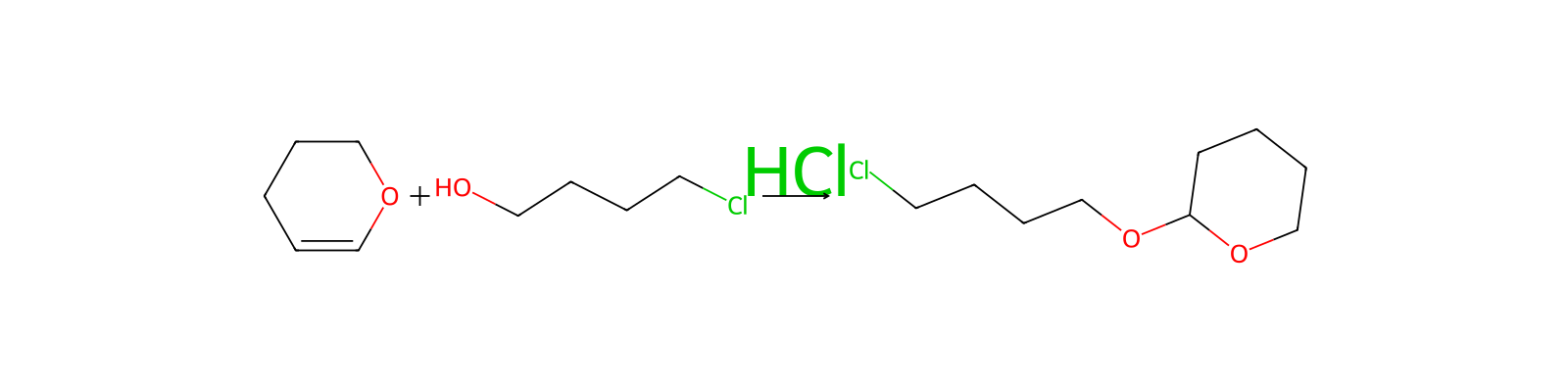
83 records



Linked notes
Loading…