
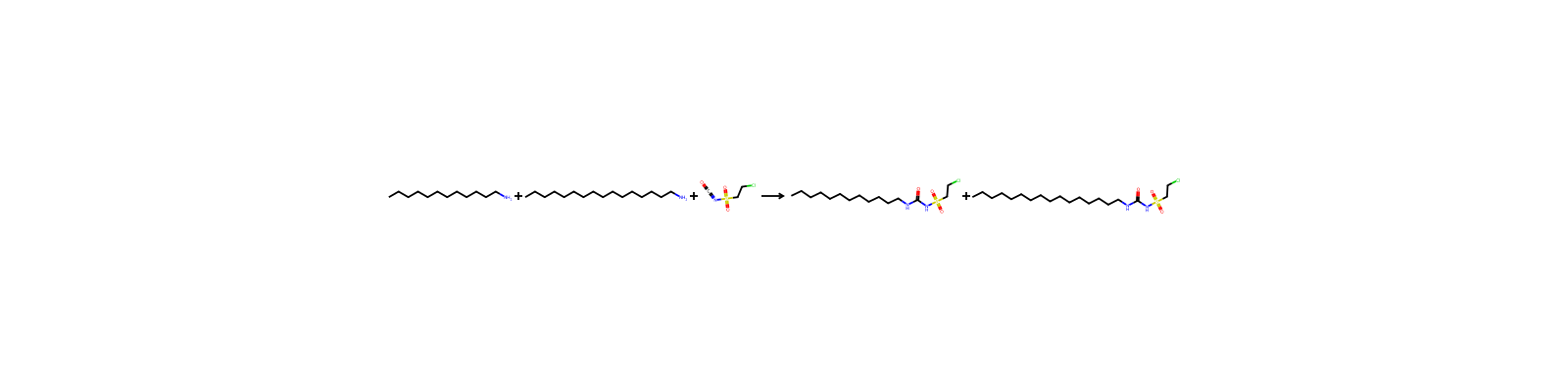
HRID 6145As reactant

124-22-1CCCCCCCCCCCCNJRBPAEWTRLWTQC-UHFFFAOYSA-NDodecanamine appears as a yellow liquid with an ammonia-like odor. Insoluble in water and less dense than water. Hence floats on water. Contact may irritate skin, eyes and mucous membranes. May be toxic by ingestion, inhalation or skin absorption. Used to make other chemicals.
124-22-1、68155-27-1DTXSID3021984CHEMBL109904CHEBI:193593Cosmetic ingredients (Lauramine) -> CIR (Cosmetic Ingredient Review)
Personal care product
Antistatic
0.8015 g/cu cm @ 20 °C/4 °C
0.81 g/cm³
Miscible in ethanol, ethyl ether, and benzene.
In water, 0.078 g/l at 25 °C and pH 11.8.
Solubility in water: poor
Safety information is for reference only and does not replace the supplier’s Safety Data Sheet (SDS), applicable regulations, or professional assessment.
This chemical does not meet GHS hazard criteria for 3.7% (32 of 855) of reports.
Danger
H290 (52.4%): May be corrosive to metals [Warning Corrosive to Metals]
P234, P260, P261, P264, P264+P265, P270, P271, P273, P280, P301+P316, P301+P317, P301+P330+P331, P302+P361+P354, P304+P340, P305+P354+P338, P316, P317, P319, P321, P330, P331, P363, P390, P391, P403+P233, P405, P406, and P501 (click each P-code to see the statement)
Aggregated GHS information provided per 855 reports by companies from 26 notifications to the ECHA C&L Inventory. Each notification may be associated with multiple companies.
Danger
Chemical: 1-Dodecanamine
1-Dodecanamine is listed on the EPA's Chemical Data Reporting (CDR) system. Manufacturers and importers of 1-Dodecanamine are required to report information about their production and use of this chemical to the EPA under the Toxic Substances Control Act (TSCA). (40 eCFR Part 711)
REACH registered substance: Dodecylamine (EC: 204-690-6)
Dodecylamine: Does not have an individual approval but may be used under an appropriate group standard
Excerpt from ERG Guide 153 [Substances - Toxic and/or Corrosive (Combustible)]:
Combustible. Gives off irritating or toxic fumes (or gases) in a fire.
MONOAMINE...& DIAMINE OXIDASE...OCCUR WIDELY...MOST CONCN IN LIVER, KIDNEY, & INTESTINAL MUCOSA. ...ASSUMED THAT THEY PLAY AN IMPORTANT ROLE IN "DETOXICATION" OF AMINES...AMMONIA FORMED IS CONVERTED TO UREA. HYDROGEN PEROXIDE IS ACTED ON BY CATALASE...ALDEHYDE FORMED /GIVES A/...CARBOXYLIC ACID. /AMINES/
Agents that modify interfacial tension of water; usually substances that have one lipophilic and one hydrophilic group in the molecule; includes soaps, detergents, emulsifiers, dispersing and wetting agents, and several groups of antiseptics.
CIR ingredient: Lauramine
Used in cationic surfactants and to make dodecylguanidine acetate (fungicide); [HSDB] Used in dye and pigment production and as a surfactant for non-metallic mineral mining and quarrying; [EPA ChAMPS]
Metal Extraction and Refining [Category: Industry]
CHEM INT FOR THE FUNGICIDE, DODECYLGUANIDINE ACETATE; CHEM INT FOR CATIONIC SURFACTANTS
Cationic surface-active agent.
2023: 100,000 - <250,000 lb
(1971) 3.1X10+8 GRAMS
REACTION OF DODECANOIC ACID WITH AMMONIA TO FORM LAURONITRILE, FOLLOWED BY CATALYTIC HYDROGENATION TO FORM DODECYLAMINE




259 °C
259 °C
A corrosive substance that can cause injury to the skin, eyes, and respiratory tract; Inhalation may cause pulmonary edema; [ICSC] Severe skin irritation and necrosis observed in animals; Emergency treatment: Corrosives-alkaline; [HSDB] No deaths observed in rats dosed by gavage at 2000 mg/kg; Non-hydroxylated fatty nitrogen derived amines: Low acute oral and dermal toxicity in animals; [EPA ChAMPS] A severe skin and eye irritant; [RTECS]
DODECANAMINE neutralizes acids in exothermic reactions to form salts plus water. May be incompatible with isocyanates, halogenated organics, peroxides, phenols (acidic), epoxides, anhydrides, and acid halides. Flammable gaseous hydrogen may be generated in combination with strong reducing agents, such as hydrides.
1-Dodecylamine
Marine pollutant
Excerpt from ERG Guide 153 [Substances - Toxic and/or Corrosive (Combustible)]:
Use water spray, powder, foam, carbon dioxide.
Fresh air, rest. Half-upright position. Artificial respiration may be needed. Refer for medical attention.
Remove contaminated clothes. Rinse skin with plenty of water or shower. Refer for medical attention .
First rinse with plenty of water for several minutes (remove contact lenses if easily possible), then refer for medical attention.
Rinse mouth. Do NOT induce vomiting. Give one or two glasses of water to drink. Refer for medical attention .
SRP: At the time of review, criteria for land treatment or burial (sanitary landfill) disposal practices are subject to significant revision. Prior to implementing land disposal of waste residue (including waste sludge), consult with environmental regulatory agencies for guidance on acceptable disposal practices.
Personal protection: chemical protection suit including self-contained breathing apparatus. Do NOT let this chemical enter the environment. Sweep spilled substance into covered sealable containers. Carefully collect remainder. Then store and dispose of according to local regulations.
TERRESTRIAL FATE: Based on a classification scheme(1), an estimated Koc value of 9,300(SRC) determined from an estimated log Kow of 4.8(2,SRC) and a regression-derived equation(3) indicates that dodecylamine is expected to be immobile in soil(SRC). A pKa of 10.63(4) indicates dodecylamine will exist predominately in the protonated form at environmental pHs and as a result, volatilization from moist soil surfaces is not expected to be an important fate process(SRC). Dodecylamine is not expected to volatilize from dry soil surfaces(SRC) based upon a vapor pressure of 8.05X10⁻³ mm Hg(5). A 60% of theoretical BOD in an activated sludge inoculum over a 12 day incubation period suggests that dodecylamine may biodegrade in soil(6).
AQUATIC FATE: Based on a classification scheme(1), an estimated Koc value of 9,300(SRC) determined from an estimated log Kow of 4.8(2,SRC) and a regression-derived equation(3) indicates that dodecylamine is expected to adsorb to suspended solids and sediment in the water column(SRC). A pKa of 10.63(4) indicates that volatilization from water surfaces is not expected to be an important fate process since this compound will exist predominately in the protonated form at environmental pHs(SRC). According to a classification scheme(5), an estimated BCF of 2,400(3,SRC), from an estimated log Kow(2,SRC), suggests the potential for bioconcentration in aquatic organisms is very high(SRC). A 60% of theoretical BOD in an activated sludge inoculum over a 12 day incubation period, suggests that dodecylamine may biodegrade in water(6).
ATMOSPHERIC FATE: According to a model of gas/particle partitioning of semivolatile organic compounds in the atmosphere(1), dodecylamine, which has a vapor pressure of 8.05X10⁻³ mm Hg at 25 °C(2), is expected to exist solely as a vapor in the ambient atmosphere. Vapor-phase dodecylamine is degraded in the atmosphere by reaction with photochemically-produced hydroxyl radicals(SRC); the half-life for this reaction in air is estimated to be 8.4 hours(SRC) from its rate constant of 4.6X10⁻¹¹ cu cm/molecule-sec estimated using a structure estimation method(3).
Dodecylamine was detected in the following samples of mixed pickles, mg/kg: cucumber in aromatic vinegar, 2.7; cucumber in aromatic vinegar brine, 1.9 mg/l; pepperoni, 6.4; pepperoni brine, 0.7 mg/l; pickled onions, 3.6; pickled onions brine, 0.1 mg/l(1).
The safety of Lauramine and Stearamine has not been documented and substantiated. The CIR Expert Panel cannot conclude whether these ingredients are safe for use in cosmetic products until the appropriate safety data have been obtained and evaluated.
The available data are insufficient to support safety
Burning sensation. Cough. Sore throat. Laboured breathing. Shortness of breath. Symptoms may be delayed.
Redness. Pain. Skin burns.
Redness. Pain. Severe deep burns.
Abdominal pain. Burning sensation. Shock or collapse.
The Koc of dodecylamine is estimated as 9,300(SRC), using an estimated log Kow of 4.8(1,SRC) and a regression-derived equation(2). According to a classification scheme(3), this estimated Koc value suggests that dodecylamine is expected to be immobile in soil. An H-Type isotherm was observed for the sorption of dodecylamine to sodium montmorillonite in aqueous solution; this type of isotherm indicates that the solute is preferentially sorbed to such an extent that no measurable amount remains in solution(4).
A 60% of theoretical BOD (30 ppm dodecylamine) in an activated sludge inoculum over a 12 day incubation period, suggests that dodecylamine may biodegrade in the environment(1). No biodegradation was observed for 100 ppm dodecylamine in an activated sludge over a 12 day incubation period(1).
An estimated BCF of 2,400 was calculated for dodecylamine(SRC), using an estimated log Kow of 4.8(1,SRC) and a regression-derived equation(2). According to a classification scheme(3), this BCF suggests the potential for bioconcentration in aquatic organisms is very high.
The Henry's Law constant for dodecylamine is estimated as 2.7X10⁻⁴ atm-cu m/mole(SRC), using a fragment constant estimation method(1). This Henry's Law constant indicates that the neutral form of dodecylamine is expected to volatilize from water surfaces(2). Based on this Henry's Law constant, the volatilization half-life from a model river (1 m deep, flowing 1 m/sec, wind velocity of 3 m/sec)(2) is estimated as approximately 14 days(SRC). The volatilization half-life from a model lake (1 m deep, flowing 0.05 m/sec, wind velocity of 0.5 m/sec)(2) is estimated as 110 days(SRC). A pKa of 10.63(3) indicates dodecylamine will exist predominately in the protonated form at environmental pHs and therefore volatilization from water and moist soil surfaces is not expected to be an important fate process(SRC). Dodecylamine is not expected to volatilize from dry soil surfaces(SRC) based upon a vapor pressure of 8.05X10⁻³ mm Hg(4).
Lauric acid, broad cut/lauric acid, narrow cut + ammonia (nitrile formation/hydrogenation).
All Other Basic Organic Chemical Manufacturing
1-Dodecanamine: ACTIVE
WASTEWATER CONTAINING 1 G UO2/L WAS TREATED WITH DODECYLAMINE ACETATE (50 MG) & 20 MG TAKASA FROTH. UO2 RECOVERY IN FROTH WAS 98%.
EVALUATED FOR INHIBITORY ACTIVITY AGAINST S MUTANS 6715, DODECYLAMINE SHOWED GOOD ACTIVITY. FURTHER IN VITRO STUDIES AGAINST OTHER PLAQUE-FORMING BACTERIA ARE NEEDED TO DETERMINE BEST CLINICAL AGENT.
UsesDodecylamine was used in preparation of novel surfactant copper(II) complexes. It is used as a catalyst and template agent in the sol-gel process for the fabrication of monodispersed mesoporous bioactive glass sub-micron spheres.
UsesDodecylamine (DDA) can be used: As a modifier in the preparation of dodecylamine incorporated sodium montmorillonite. It is used as an adsorbent for hexavalent chromium.In the synthesis of DDA-poly(aspartic acid) as a biodegradable water-soluble polymeric material.As an organic surfactant in the synthesis of Sn(IV)-containing layered double hydroxide (LDHs), which can be further used as ion exchangers, absorbents, ion conductors, and catalysts.As a complexing, reducing and capping agent in the synthesis of pentagonal silver nanowires.
General DescriptionDodecylamine is a yellow liquid with an ammonia-like odor. Insoluble in water and less dense than water. Hence floats on water. Contact may irritate skin, eyes and mucous membranes. May be toxic by ingestion, inhalation or skin absorption. Used to make other chemicals.
DefinitionChEBI: Dodecylamine is a primary aliphatic amine.