
Completing data — usually done within a minute
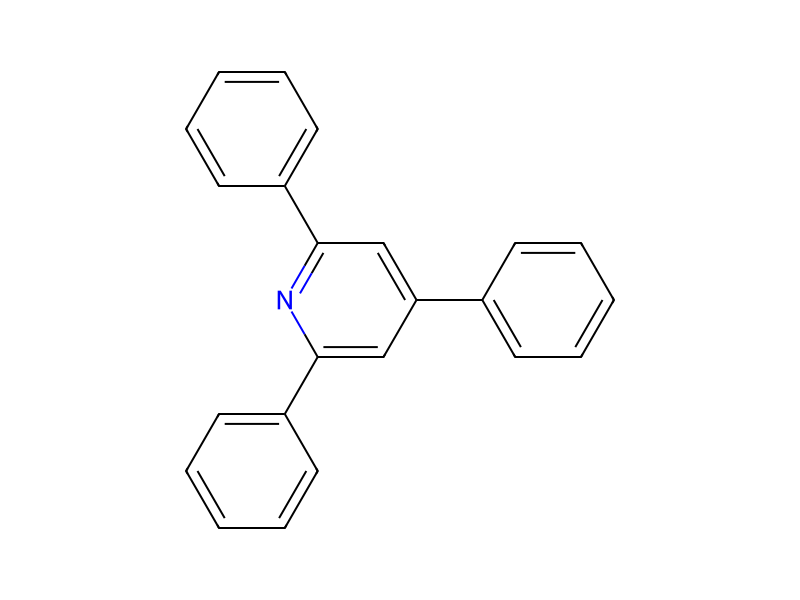
Basic information
- Standard SMILES
c1ccc(-c2cc(-c3ccccc3)nc(-c3ccccc3)c2)cc1- InChIKey
FRZHWQQBYDFNTH-UHFFFAOYSA-N- Molecular formula
- C23H17N
- Average molar mass
- 307.396 g/mol
- Monoisotopic mass
- 307.13609954
Names & identifiers
- Preferred name
- Pyridine, 2,4,6-triphenyl-
- IUPAC
- 2,4,6-Triphenylpyridine
- English name
- 2,4,6-Triphenylpyridine
- Molecular formula
- C23H17N
- Molecular weight
- 307.39
Names & synonyms
TIMTEC-BB SBB0078522,4,6-Triphenyl-pyridin2,4,6-TriphenylpyridinePYRIDINE,2,4,6-TRIPHENYL
Database identifiers
- CAS
580-35-8- PubChem CID
- 136370
- DTXSID
DTXSID30206730- ChEMBL
CHEMBL27882- EC Number
- 622-170-0
- Nikkaji
- J95.011D
Properties
Physicochemical properties
- Melting point
- 139 to · 139.0 to 143.0 °C
- Boiling point
- 220 · 220-230 °C(Press: 0.3 Torr)
- Density
- 1.103 · 1.103±0.06 g/cm3(Predicted)
- storage temp.
- Sealed in dry,Room Temperature
- form
- powder to crystal
- pka
- 3.95 · 3.95±0.10(Predicted)
- color
- White to Almost white
- λmax
- 312 nm · 312nm(EtOH)(lit.)
- InChI
- InChI=1S/C23H17N/c1-4-10-18(11-5-1)21-16-22(19-12-6-2-7-13-19)24-23(17-21)20-14-8-3-9-15-20/h1-17H
- InChIKey
- FRZHWQQBYDFNTH-UHFFFAOYSA-N
- SMILES
- C1(C2=CC=CC=C2)=NC(C2=CC=CC=C2)=CC(C2=CC=CC=C2)=C1
- Symbol(GHS)
- 5 · GHS05,GHS06
- Signal word
- Danger
- Hazard statements
- 315 · H315-H335-H413-H318-H301
- Precautionary statements
- 264 · P264-P270-P301+P310-P321-P330-P405-P501-P280-P305+P351+P338-P310-P264-P280-P302+P352-P321-P332+P313-P362
- HS Code
- 2933.39 · 2933.39.9200
Safety & regulation
Safety data
- hs_code
- 2933.39.9200
- Signal word
- Danger
- Symbol(GHS)
- GHS05,GHS06
- Hazard statements
- H315-H335-H413-H318-H301
- Precautionary statements
- P264-P270-P301+P310-P321-P330-P405-P501-P280-P305+P351+P338-P310-P264-P280-P302+P352-P321-P332+P313-P362
Chemistry & industry
Applications
Description2,4,6-Triphenylpyridine, as a well-known electron-deficient heterocyclic unit, has been widely used as the conjugated molecular bridge linker to the polymer main chain. Pyridine and aromatic heterocyclic derivatives have been widely used as electron transporting/hole blocking materials in LED devices and LED blends because these units have many excellent properties of being a better chromophore, with high electron affinity, high thermal and oxidative stability, and ability for good charge injection and transporting building blocks[1].In addition, introduction of the pyridinyl moiety into the polymer backbone not only increases the electron affinity of the polymer, which makesthepolymer moreresistantto oxidation and also gives the polymer better electron-transporting properties, but also avoids fluorescence quenching due to the intersystem crossing (ISC) effect of the heavy atom. Some of them have been introduced into the polymer backbones to realize the desirable opto electronic materials.
Uses2,4,6-Triphenylpyridine is a pyridine compound that acts as a neutral leaving group in palladium(0)-catalysed nucleophilic allylation reactions. In addition, three novel conjugated polymers based on the 2,4,6-triphenylpyridine moiety can be synthesised via the palladium-catalysed Sonogashira coupling reaction. These three polymers, P-1, P-2 and P-3, all exhibit strong fluorescence emission, characterised by a large Stokes shift and high quantum yield.
Upstream & downstream products
Upstream raw materials
Downstream products
Suppliers50 total
陕西缔都医药有限责任公司029-81124775 17791530730 · [email protected]
梯希爱(上海)化成工业发展有限公司021-67121386 · [email protected]
上海阿拉丁生化科技股份有限公司400-6206333 13167063860 · [email protected]
武汉英诺医药科技有限公司+86-027-59232304 15387063101 · [email protected]
毕佳索(上海毕得医药科技股份有限公司)400-6005915 · [email protected]
上海麦克林生化科技股份有限公司021-50706066 15221275939 · [email protected]
咸宁深蓝生物医药研发有限公司18171815831 · [email protected]
郑州汇聚化工有限公司13393710386 · [email protected]
上海仲因实业有限公司2537653158 16621191650 · [email protected]
上海卡伦姆生化科技有限公司15837198050 · [email protected]
北京索莱宝科技有限公司010-50973130 17801761073 · [email protected]
安耐吉化学&3A(安徽泽升科技有限公司)021-58432009 400-005-6266 · [email protected]
欧利希(湖北)医药科技有限公司17316404525 17316404525 · [email protected]
烟台盛凯伦生物制品有限公司13356901049 · [email protected]
郑州研德生物科技有限公司0371-63682289 15538176268 · [email protected]
常州鹏森福新材料科技有限公司18961278960 · [email protected]
武汉丰泰威远科技有限公司027-87465837 19945049750 · [email protected]
山东西亚化学有限公司13355009207 13355009207 · [email protected]
北京伊诺凯科技有限公司15652467323 · [email protected]
斯百全化学(上海)有限公司021-021-021-67601398-809-809-809 15221380277 · [email protected]
TOKYO CHEMICAL INDUSTRY CO., LTD.03-36680489 · [email protected]
盐城奥科联合医药科技有限公司0515-89701588 13770166955 · [email protected]
上海丽康新材料有限公司+86-16631818819 +86-17736933208 · [email protected]
上海毕得医药科技股份有限公司400-164-7117 18317119277 · [email protected]
北京奥秘佳得医药科技有限公司+86-13522808617 · [email protected]
江苏艾康生物医药研发有限公司025-66028182 17714375163 · [email protected]
上海市凯瑜琳医药科技有限公司021-18721936-595 18721936595 · [email protected]
吉林中科研伸科技有限公司0431-80534353 19917294565 · [email protected]
Henan Alfa Chemical Co., Ltd+8618339805032 · [email protected]
上海博景化工有限公司021-37199966 13681836088 · [email protected]
上海佰安麦材料科技有限公司13656718387 · [email protected]
北京伊万景瑞生物科技有限公司15866847540 · [email protected]
武汉多普乐生物医药有限公司+86-02787215551 19945035818 · [email protected]
北京华威锐科化工科技有限公司89508211 18501085097 · [email protected]
上海源叶生物科技有限公司13636370518 · [email protected]
上海鹤成医药科技有限公司13564747822 · [email protected]
武汉沃格达生物科技有限公司15071299552 · [email protected]
成都华纯科技有限公司400-1166-196 15982826727 · [email protected]
山东弗珍化学科技有限公司13146841504 · [email protected]
常州市泓成康生物科技有限公司18796480679 15295163861 · [email protected]
郑州艾克姆化工有限公司0371-0371-55629727 13323845623 · [email protected]
烟台盛凯伦化学科技有限公司13356901049 · [email protected]
上海贤鼎生物科技有限公司021-021-52271985 17721149837 · [email protected]
合肥钼凯医药科技有限公司18130062233 · [email protected]
烟台博运生物科技有限公司13793517650 13793517650 · [email protected]
CHEMSOON CO.,LTD.+8613761723174 · [email protected]
上海臻励生物科技有限公司021-16621358918; 18516310516;16621358918;13045646768 · [email protected]
上海玉函化工有限公司021-61469567 13774476675 · [email protected]
上海易恩化学技术有限公司400-400-1332688 18019345275 · [email protected]
上海皓鸿生物医药科技有限公司400-8210725 400821072 · [email protected]
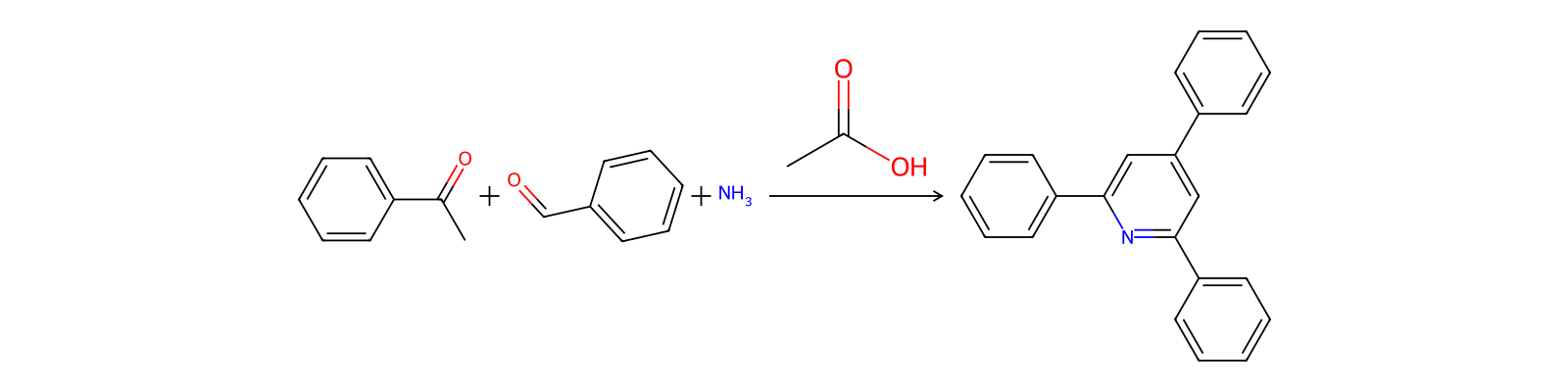
Related reactions
3 records

Linked notes
Loading…