HomeMCPWorkbenchSkills
HomeWorkbenchNotificationsMe
llms.txt · MCP GuidePrivacy Policy · Terms of Service · Supportv1.8.3
  1. Home
  2. /Compound

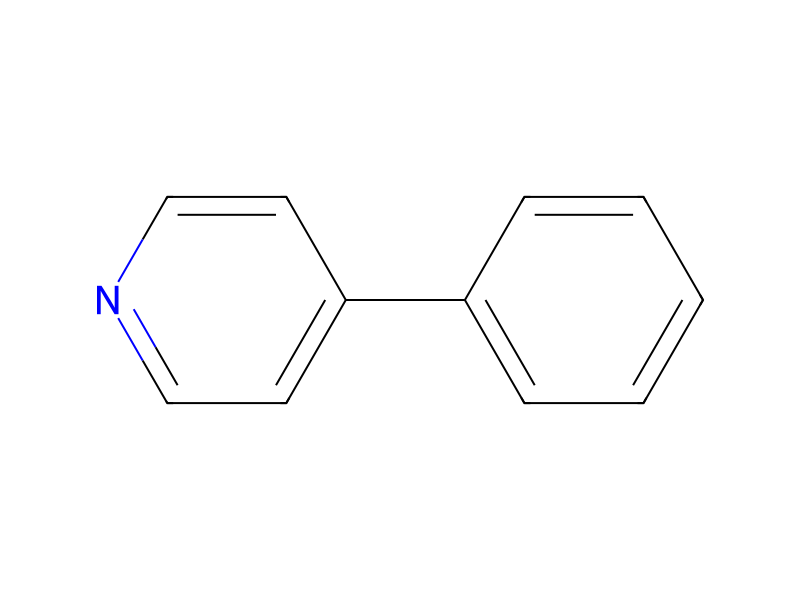
4-Phenylpyridine

HCID 13651
New reaction
Print
Basic informationOverviewNames & identifiersPropertiesSafety & regulationChemistry & industryRelated reactionsCompound notes
Substructure searchFind similar structures

Basic information

CAS
52642-16-7
Standard SMILES
c1ccc(-c2ccncc2)cc1
InChIKey
JVZRCNQLWOELDU-UHFFFAOYSA-N
Molecular formula
C11H9N
Average molar mass
155.2 g/mol
Monoisotopic mass
155.07349929

Overview

4-Phenylpyridine is a phenylpyridine.

Names & identifiers

Preferred name
4-Phenylpyridine
IUPAC
4-phenylpyridine
English name
4-Phenylpyridine
Molecular formula
C11H9N
Molecular weight
155.2

Names & synonyms

4-PHENYLPYRIDINE939-23-1p-Phenylpyridine452KD9YCG7NSC-70375NSC-77935DTXSID5022140RefChem:526451DTXCID602140213-357-4Pyridine, 4-phenyl-4-Azabiphenyl
Show more names
4-phenyl-pyridinNSC 70375NSC 779354-Phenylpridine4-PYRIDYLBENZENE
4-Phenyl-pyridineMFCD00006420phenyl-pyridine4-Phenylpyridin4-Aza-1,1'-biphenylCHEMBL10907452642-16-75SH

Database identifiers

CAS
52642-16-7、939-23-1
PubChem CID
13651
DTXSID
DTXSID5022140
ChEMBL
CHEMBL109074
ChEBI
CHEBI:173662
UNII
452KD9YCG7
EC Number
213-357-4
Nikkaji
J45.971B

Properties

Computed structural properties

XLogP
2.6
Topological polar surface area
12.9 Ų
Hydrogen bond donors
0
Hydrogen bond acceptors
1
Rotatable bonds
1
Heavy atoms
12
Formal charge
0
Complexity
121

Experimental & physicochemical properties

Chemical ClassesNitrogen Compounds -> Pyridines
SpringerMaterials PropertiesChemical structure
LogP · 2 items

2.59

2.58

Boiling Point281.00 °C. @ 760.00 mm Hg
Melting Point77 - 78 °C
Vapor Pressure0.0028 [mmHg]
Physical Description · 2 items

Light brown crystalline solid; [Sigma-Aldrich MSDS]

Solid

Physicochemical properties

Melting point
69 · 69-73 °C (lit.)
Boiling point
274 · 274-275 °C (lit.)
Density
1.1088 · 1.1088 (rough estimate)

Safety & regulation

Safety information is for reference only and does not replace the supplier’s Safety Data Sheet (SDS), applicable regulations, or professional assessment.

GHS classification

GHS Classification · 4 items

Warning

H315 (100%): Causes skin irritation [Warning Skin corrosion/irritation]

P261, P264, P264+P265, P271, P280, P302+P352, P304+P340, P305+P351+P338, P319, P321, P332+P317, P337+P317, P362+P364, P403+P233, P405, and P501 (click each P-code to see the statement)

Aggregated GHS information provided per 42 reports by companies from 5 notifications to the ECHA C&L Inventory. Each notification may be associated with multiple companies.

Hazard information

Hazards SummaryIntravenous LD50 (mouse) = 89 mg/kg; [RTECS] A skin and strong eye irritant; [Sigma-Aldrich MSDS] See 4-Picoline.
Hazard Classes and CategoriesSkin Irrit. 2 (100%)

Safety data

F
10
PPE
dust mask type N95 (US), Eyeshields, Gloves
wgk
3
tsca
TSCA listed
rtecs
UT7141000
hs_code
2933399090
risk_code
36/37/38
Signal word
Warning
Symbol(GHS)
GHS07
hazard_code
Xi
safety_code
26-36
hazard_class
IRRITANT, KEEP COLD
Storage Class
11 - Combustible Solids

Chemistry & industry

Pharmacology

Cellular LocationsMembrane

Uses & manufacturing

General Manufacturing InformationPyridine, 4-phenyl-: INACTIVE

Applications

Uses4-Phenylpyridine is a useful synthetic intermediate. 4-Phenylpyridine has been shown to induce inhibition of mitochondrial respiration in mice.

Upstream & downstream products

Upstream raw materials

Cuprous iodidePhenylmagnesium chlorideEthyl chloroformateSodium nitriteTetrahydrofuranAmmonium chlorideHydrochloric acidAcetic acidPyridineIsopropyl alcoholActivated carbonSulfuric acidAmmonia1,2,3,6-Tetrahydro-4-phenyl-pyridine

Related reactions

14 records
New reaction record
HRID 318525 reaction equation
HRID 318525As reactant
HRID 412052 reaction equation
HRID 412052As reactant
HRID 507497 reaction equation
HRID 507497As reactant
HRID 653113 reaction equation
HRID 653113As reactant
HRID 746662 reaction equation
HRID 746662As reactant
HRID 1062849 reaction equation
HRID 1062849As product
HRID 1158706 reaction equation
HRID 1158706As reactant
HRID 1160051 reaction equation
HRID 1160051As reactant
PreviousPage 1 of 2

Compound notes

On this pageBasic informationOverviewNames & identifiersPropertiesSafety & regulationChemistry & industryRelated reactionsCompound notes
refractive index
1.621 · 1.6210 (estimate)
storage temp.
Inert atmosphere,Room Temperature
solubility
Chloroform, Methanol
form
Crystalline Powder
pka
5.45 · 5.45±0.10(Predicted)
color
Light yellow to beige
Water Solubility
SOLUBLE
BRN
110490 · 110490
InChI
1S/C11H9N/c1-2-4-10(5-3-1)11-6-8-12-9-7-11/h1-9H
InChIKey
JVZRCNQLWOELDU-UHFFFAOYSA-N
SMILES
c1ccc(cc1)-c2ccncc2
LogP
2.59 · 2.590
CAS DataBase Reference
939 · 939-23-1(CAS DataBase Reference)
EWG's Food Scores
1 · 1
FDA UNII
452 KD9YCG7 · 452KD9YCG7
NIST Chemistry Reference
4 · 4-phenyl-pyridine(939-23-1)
EPA Substance Registry System
4 · 4-Phenylpyridine (939-23-1)
UNSPSC Code
12352100 · 12352100
NACRES
22 · NA.22
Symbol(GHS)
7 · GHS07
Signal word
Warning
Hazard statements
315 · H315-H319-H335
Precautionary statements
261 · P261-P264-P271-P280-P302+P352-P305+P351+P338
target organs
Respiratory system
PPE
95 · dust mask type N95 (US), Eyeshields, Gloves
Hazard Codes
Xi
Risk Statements
36 · 36/37/38
Safety Statements
26 · 26-36
WGK Germany
3 · 3
RTECS
7141000 · UT7141000
F
10 · 10
TSCA
TSCA listed
HazardClass
IRRITANT, KEEP COLD
HS Code
2933399090 · 2933399090
Storage Class
11 · 11 - Combustible Solids
Hazard Classifications
2 Skin · Eye Irrit. 2Skin Irrit. 2STOT SE 3
target organs
Respiratory system
Hazard statements
H315-H319-H335
Hazard Classifications
Eye Irrit. 2Skin Irrit. 2STOT SE 3
Precautionary statements
P261-P264-P271-P280-P302+P352-P305+P351+P338
Methyl anisate

Downstream products

4-Phenylpyridine-N-oxide2,4,6-Triphenylpyridine

Additional notes

DefinitionChEBI: 4-Phenylpyridine is a phenylpyridine.