HomeMCPWorkbenchSkills
HomeWorkbenchNotificationsMe
llms.txt · MCP GuidePrivacy Policy · Terms of Service · Supportv1.8.3
  1. Home
  2. /Compound

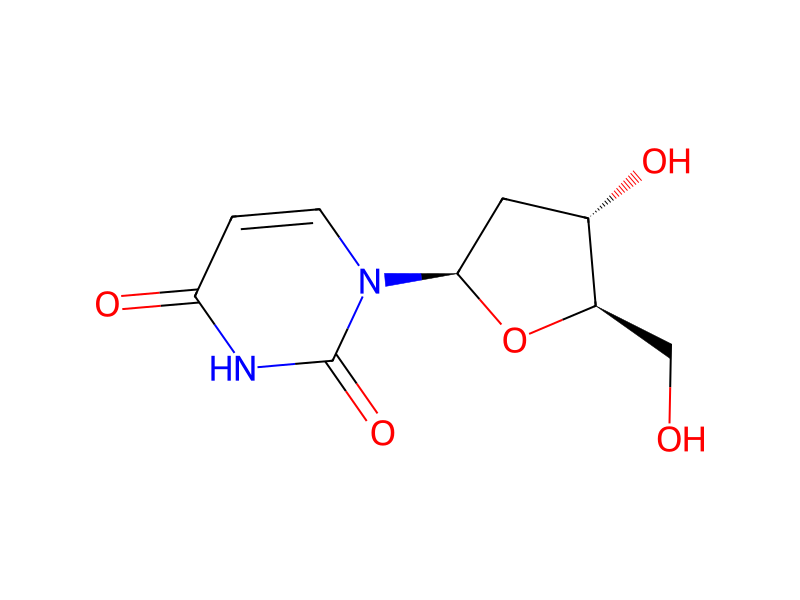
Deoxyuridine

HCID 13712
New reaction
Print
Basic informationOverviewNames & identifiersPropertiesSafety & regulationChemistry & industryRelated reactionsCompound notes
Substructure searchFind similar structures

Basic information

CAS
951-78-0
Standard SMILES
O=c1ccn([C@H]2C[C@H](O)[C@@H](CO)O2)c(=O)[nH]1
InChIKey
MXHRCPNRJAMMIM-SHYZEUOFSA-N
Molecular formula
C9H12N2O5
Average molar mass
228.2 g/mol
Monoisotopic mass
228.07462149

Overview

2'-deoxyuridine is a pyrimidine 2'-deoxyribonucleoside having uracil as the nucleobase. It has a role as a mouse metabolite, a Saccharomyces cerevisiae metabolite, an Escherichia coli metabolite and a human metabolite. It is functionally related to a uracil.

Names & identifiers

Preferred name
Deoxyuridine
IUPAC
1-[(2R,4S,5R)-4-hydroxy-5-(hydroxymethyl)oxolan-2-yl]pyrimidine-2,4-dione
English name
2'-Deoxyuridine
Molecular formula
C9H12N2O5
Molecular weight
228.2

Names & synonyms

2'-DEOXYURIDINE951-78-0deoxyuridineUracil deoxyriboside2-DeoxyuridineUridine, 2'-deoxy-dURDDeoxyribose uracil2'-Desoxyuridine1-(2-deoxy-beta-D-erythro-pentofuranosyl)uracil1-[(2R,4S,5R)-4-hydroxy-5-(hydroxymethyl)oxolan-2-yl]pyrimidine-2,4-dione1-(2-Deoxy-beta-D-erythro-pentofuranoxyl)uracil
Show more names
DU1-((2R,4S,5R)-4-Hydroxy-5-(hydroxyMethyl)tetrahydrofuran-2-yl)pyriMidine-2,4(1H,3H)-dione2'-dUNSC 23615UracildeoxyrDeoxy-uridinDEOXYURIDINE-2'
W78I7AY22CDTXSID308836212,4(1H,3H)-Pyrimidinedione, 1-(2-deoxy-beta-D-ribofuranosyl)-CHEBI:164502,4(1H,3H)-Pyrimidinedione, 1-(2-deoxy-beta-D-erythro-ribofuranosyl)-NSC-236151-[(2R,4S,5R)-4-hydroxy-5-(hydroxymethyl)oxolan-2-yl]-1,2,3,4-tetrahydropyrimidine-2,4-dione(beta 1-(2-Deoxyribopyranosyl))thymidine

Database identifiers

CAS
951-78-0
PubChem CID
13712
DTXSID
DTXSID30883621
ChEMBL
CHEMBL353955
ChEBI
CHEBI:16450
UNII
W78I7AY22C
EC Number
213-455-7
Nikkaji
J7.186B

Properties

Computed structural properties

XLogP
-1.6
Topological polar surface area
99.1 Ų
Hydrogen bond donors
3
Hydrogen bond acceptors
5
Rotatable bonds
2
Heavy atoms
16
Formal charge
0
Complexity
343

Experimental & physicochemical properties

DrugsPharmaceuticals -> Listed in ZINC15
SpringerMaterials PropertiesCrystal structure
LogP · 2 items

-1.51

-1.51

Melting Point167 °C
Physical DescriptionSolid
Collision Cross Section · 4 items

156 Ų [M+Na]+ [CCS Type: DT; Method: single field calibrated with Agilent tune mix (Agilent)]

159.45 Ų [M+Na]+ [CCS Type: DT; Method: stepped-field]

156.4 Ų [M+Na]+ [CCS Type: DT; Method: single field calibrated with ESI Low Concentration Tuning Mix (Agilent)]

150 Ų [M-H]-

Physicochemical properties

Melting point
167 · 167-169 °C(lit.)
alpha
22 · D22 +50° (c = 1.1 in N NaOH)
Boiling point
370.01 °C · 370.01°C (rough estimate)
Density
1.3705 · 1.3705 (rough estimate)
refractive index
52 ° · 52 ° (C=1, 1mol/L NaOH)
storage temp.
2 · Inert atmosphere,2-8°C
solubility
DMSO (Slightly), Methanol (Slightly, Heated), Water (Slightly)
form
Powder
pka
9.3 · pKa 9.3(H2O t = 25) (Uncertain)
color
White to off-white
biological source
synthetic (organic)
Water Solubility
300 g/L · 300 g/L (20 ºC)
Sensitive
Air Sensitive
Merck
14 · 14,2910
BRN
24433 · 24433
InChI
1S/C9H12N2O5/c12-4-6-5(13)3-8(16-6)11-2-1-7(14)10-9(11)15/h1-2,5-6,8,12-13H,3-4H2,(H,10,14,15)/t5-,6+,8+/m0/s1
InChIKey
MXHRCPNRJAMMIM-ATRFCDNQSA-N
SMILES
OC[C@H]1O[C@H](C[C@@H]1O)N2C=CC(=O)NC2=O
CAS DataBase Reference
951 · 951-78-0(CAS DataBase Reference)
FDA UNII
78 I7AY22C · W78I7AY22C
EPA Substance Registry System
2 · Uridine, 2'-deoxy- (951-78-0)
UNSPSC Code
41116107 · 41116107
NACRES
51 · NA.51
Symbol(GHS)
7 · GHS07
Signal word
Warning
Hazard statements
302 · H302-H315-H319-H335
Precautionary statements
261 · P261-P305+P351+P338
PPE
95 · Eyeshields, Gloves, type N95 (US)
Hazard Codes
Xn
Risk Statements
36 · 36/37/38
Safety Statements
22 · 22-24/25-37/39-36/37/39-26
WGK Germany
3 · 3
RTECS
7490000 · YU7490000
F
10 · 10-23
Hazard Note
Air Sensitive
TSCA
TSCA listed
HS Code
2934999090 · 2934999090
Storage Class
11 · 11 - Combustible Solids

Safety & regulation

Safety information is for reference only and does not replace the supplier’s Safety Data Sheet (SDS), applicable regulations, or professional assessment.

GHS classification

GHS Classification · 5 items

This chemical does not meet GHS hazard criteria for 20% (1 of 5) of reports.

Warning

H302 (40%): Harmful if swallowed [Warning Acute toxicity, oral]

P261, P264, P264+P265, P270, P271, P273, P280, P301+P317, P302+P352, P304+P340, P305+P351+P338, P317, P319, P321, P330, P332+P317, P337+P317, P362+P364, P391, P403+P233, P405, and P501 (click each P-code to see the statement)

Aggregated GHS information provided per 5 reports by companies from 5 notifications to the ECHA C&L Inventory. Each notification may be associated with multiple companies.

Hazard information

Hazard Classes and CategoriesAcute Tox. 4 (40%)

Safety data

F
10-23
PPE
Eyeshields, Gloves, type N95 (US)
wgk
3
tsca
TSCA listed
rtecs
YU7490000
hs_code
2934999090
risk_code
36/37/38
Signal word
Warning
Symbol(GHS)
GHS07
hazard_code
Xn
hazard_note
Air Sensitive
safety_code
22-24/25-37/39-36/37/39-26
Storage Class
11 - Combustible Solids
Hazard statements
H302-H315-H319-H335
Precautionary statements
P261-P305+P351+P338

Chemistry & industry

Pharmacology

MeSH Pharmacological ClassificationDrugs that are chemically similar to naturally occurring metabolites, but differ enough to interfere with normal metabolic pathways. (From AMA Drug Evaluations Annual, 1994, p2033)
Tissue LocationsBladder
Cellular LocationsExtracellular
Metabolite PathwaysBeta Ureidopropionase Deficiency

Uses & manufacturing

General Manufacturing InformationUridine, 2'-deoxy-: ACTIVE
Applications · 4 items

Description2'-Deoxyuridine is a natural deoxynucleoside, which can be directly used to prepare combined deoxynucleoside drugs or used as chemical reagents for biochemical research. At the same time, it can be used as an intermediate to synthesize some antiviral nucleoside drugs and molecular markers, such as 8-bromo-2-deoxyuridine and 8-hydroxy-2-deoxyuridine from 2'-Deoxyuridine.

Description2'-Deoxyuridine is an intermediate in the synthesis of thymidylate, which is a precursor for DNA synthesis. It has been shown to inhibit the enzymatic activity of enzymes responsible for synthesizing uridine and thymidylate, leading to neuronal death. 2'-Deoxyuridine has been used as a fluorescence probe for nucleic acids and as a polymerase chain reaction (PCR) substrate. It is also known to bind with toll-like receptor 4 (TLR4), which is involved in inflammatory responses.

Uses2'-Deoxyuridine is frequently halogenated to create thymidine analogues useful for studies of DNA synthesis and degradation mechanisms. Derivatized 2'-Deoxyuridines used as labeling substrates include chloro-2'-deoxyuridine (CldU), bromodeoxyuridine (BrdU) and/or iododeoxyuridine (IdU). Other useful analogues of 2'-deoxyuridine include 5-ethynyl-2'-deoxyuridine (DdU) and 5-hydroxymethyl-2'-deoxyuridine (HmdU). Laboratory suppression of deoxyuridine is used to diagnose megaloblastic anemias due to vitamin B12 and folate deficiencies. Deoxyuridine (dU) is used to indirectly determine if there are sufficient levels of folate and cobalamin in cell or tissue samples.

UsesAn uridine derivative as therapeutic agent for treating allergy, cancer, infection and autoimmune disease

Upstream & downstream products

Downstream products

5-Chloro-2'-deoxyuridine1-(beta-D-2-Deoxyribofuranosyl)-4-(1,2,4-triazol-1-yl)-5-methylpyrimidin-2-one5-(2-Hydroxyethyl)-2'-deoxyuridine
Additional notes · 1 item

DefinitionChEBI: 2'-deoxyuridine is a pyrimidine 2'-deoxyribonucleoside having uracil as the nucleobase. It has a role as a human metabolite, a Saccharomyces cerevisiae metabolite, an Escherichia coli metabolite and a mouse metabolite. It is functionally related to a uracil.

Related reactions

35 records
New reaction record
HRID 25468 reaction equation
HRID 25468As product
HRID 249241 reaction equation
HRID 249241As product
HRID 342916 reaction equation
HRID 342916As reactant
HRID 399954 reaction equation
HRID 399954As reactant
HRID 467262 reaction equation
HRID 467262As reactant
HRID 600113 reaction equation
HRID 600113As reactant
HRID 723300 reaction equation
HRID 723300As reactant
HRID 723306 reaction equation
HRID 723306As reactant
PreviousPage 1 of 5

Compound notes

On this pageBasic informationOverviewNames & identifiersPropertiesSafety & regulationChemistry & industryRelated reactionsCompound notes