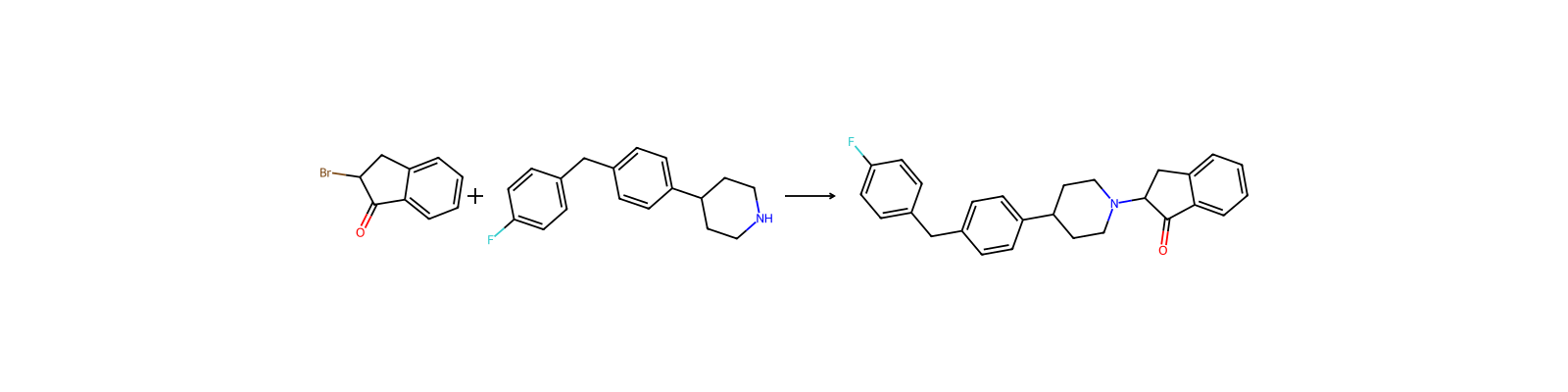

Basic information
- Standard SMILES
O=C1c2ccccc2CC1Br- InChIKey
UXVCSPSWUNMPMT-UHFFFAOYSA-N- Molecular formula
- C9H7BrO
- Average molar mass
- 211.05 g/mol
- Monoisotopic mass
- 209.96803
Names & identifiers
- Preferred name
- 2-Bromo-1-indanone
- IUPAC
- 2-bromo-2,3-dihydroinden-1-one
- English name
- 2-Bromo-1-indanone
- Molecular formula
- C9H7BrO
- Molecular weight
- 211.06
Names & synonyms
2-Bromo-1-indanone1775-27-5RefChem:85626627-652-4UXVCSPSWUNMPMT-UHFFFAOYSA-N2-Bromoindan-1-one2-Bromoindanone2-bromo-2,3-dihydroinden-1-one2-bromo-2,3-dihydro-1H-inden-1-one1H-Inden-1-one, 2-bromo-2,3-dihydro-MFCD000410301175-27-5
Show more names
6-Bromindan-1-on2-Bromo-1-indanone 90%2-Bromo-1-indanone ,85%2-BROMO-1-INDANONE: TECH.2-Bromo-1-indanone ,tech.2-Bromoindanone, tech., 90%2-BroMo-1-indanone, tech., 8
bromoindanone2-bromo indanone2-bromo-indan-1-one2-Bromo-1-indanone, 90%SCHEMBL296403SCHEMBL27490753SCHEMBL29752636DTXSID00938935
Database identifiers
- CAS
1775-27-5- PubChem CID
- 137203
- DTXSID
DTXSID00938935- EC Number
- 627-652-4
- Nikkaji
- J954.256F
Properties
Computed structural properties
- XLogP
- 2.6
- Topological polar surface area
- 17.1 Ų
- Hydrogen bond donors
- 0
- Hydrogen bond acceptors
- 1
- Rotatable bonds
- 0
- Heavy atoms
- 11
- Formal charge
- 0
- Complexity
- 178
Physicochemical properties
- Melting point
- 33 · 33-38 °C (lit.)
- Boiling point
- 110 · 110-112 °C/0.4 mmHg (lit.)
- Density
- 1.427 · 1.4270 (rough estimate)
- refractive index
- 1.572 · 1.5720 (estimate)
- Flash point
- 110 · 110-112°C/0.4mm
- storage temp.
- 2 · Storage temp. 2-8°C
- Appearance
- Off-white to light yellow Solid
- BRN
- 637789 · 637789
- InChI
- 1S/C9H7BrO/c10-8-5-6-3-1-2-4-7(6)9(8)11/h1-4,8H,5H2
- InChIKey
- UXVCSPSWUNMPMT-UHFFFAOYSA-N
- SMILES
- BrC1Cc2ccccc2C1=O
- CAS DataBase Reference
- 1775 · 1775-27-5(CAS DataBase Reference)
- UNSPSC Code
- 12352100 · 12352100
- NACRES
- 22 · NA.22
- Symbol(GHS)
- 5 · GHS05,GHS07
- Signal word
- Danger
- Hazard statements
- 315 · H315-H319-H335-H314
- Precautionary statements
- 261 · P261-P280a-P304+P340-P405-P501a-P280-P305+P351+P338-P310
- PPE
- 3 · Eyeshields, Faceshields, Gloves, type P3 (EN 143) respirator cartridges
- Hazard Codes
- C
- Risk Statements
- 36 · 36/37/38-34
- Safety Statements
- 24 · 24/25-36/37/39-27-26
- RIDADR
- 1759 · UN 1759
- WGK Germany
- 3 · 3
- HS Code
- 29147000 · 29147000
- Storage Class
- 8 A · 8A - Combustible corrosive hazardous materials
- Hazard Classifications
- 1 B · Skin Corr. 1B
Safety & regulation
GHS classification
GHS Classification
Danger
H314 (90.7%): Causes severe skin burns and eye damage [Danger Skin corrosion/irritation]
P260, P264, P280, P301+P330+P331, P302+P361+P354, P304+P340, P305+P354+P338, P316, P321, P363, P405, and P501 (click each P-code to see the statement)
Aggregated GHS information provided per 43 reports by companies from 2 notifications to the ECHA C&L Inventory.;Information may vary between notifications depending on impurities, additives, and other factors. The percentage value in parenthesis indicates the notified classification ratio from companies that provide hazard codes. Only hazard codes with percentage values above 10% are shown. For more detailed information, please visit ECHA C&L website.
Hazard information
Hazard Classes and CategoriesSkin Corr. 1B (90.7%)
Safety data
- PPE
- Eyeshields, Faceshields, Gloves, type P3 (EN 143) respirator cartridges
- wgk
- 3
- ridadr
- UN 1759
- hs_code
- 29147000
- risk_code
- 36/37/38-34
- Signal word
- Danger
- Symbol(GHS)
- GHS05,GHS07
- hazard_code
- C
- safety_code
- 24/25-36/37/39-27-26
- Storage Class
- 8A - Combustible corrosive hazardous materials
- Hazard statements
- H315-H319-H335-H314
- Hazard Classifications
- Skin Corr. 1B
- Precautionary statements
- P261-P280a-P304+P340-P405-P501a-P280-P305+P351+P338-P310
Chemistry & industry
Applications
Uses2-Bromo-1-indanone may be used in the preparation of trans-2-benzal-1-indanone epoxide via Darzens-type condensation with benzaldehyde. It may also be employed as substrate to investigate the substrate specificity of recombinant β-keto ester reductase (KER) of Penicillium citrinum.
General Description2-Bromo-1-indanone is a halogenated indanone. It can be obtained via bromination of 1-indanone.
Upstream & downstream products
Upstream raw materials
Suppliers50 total
上海康恩博医药科技有限公司17510465506 · [email protected]
Hebei Zhuanglai Chemical Trading Co Ltd+86-16264648883 · [email protected]
上海毕得医药科技股份有限公司400-1647117 13681763483 · [email protected]
北京依凯诺医药技术开发有限公司18518619637 · [email protected]
宁波季诺化学品有限公司0574-87314919 057487319282 · [email protected]
Dayang Chem (Hangzhou) Co.,Ltd.+86-0571-88938639 17705817739 · [email protected]
毕佳索(上海毕得医药科技股份有限公司)400-6005915 · [email protected]
Syntechem Co.,Ltd[email protected]
阿法埃莎(中国)化学有限公司400-6106006 · [email protected]
安耐吉化学&3A(安徽泽升科技股份有限公司)400-0056266 · [email protected]
广东云星生物技术有限公司0751-18902340975/189023400307 18902340307 · [email protected]
上海瀚鸿科技股份有限公司021-54306202 13764082696 · [email protected]
重庆科脉材料科技有限公司17830741407 · [email protected]
上海隆盛化工有限公司58099637 13585536065 · [email protected]
杭州扬德医药科技有限公司0571-81953185 +86-15381198709 · [email protected]
玛雅试剂+86 (573) 82222445 (0)18006601000 452520369 · [email protected]
Hebei Zhuanglai Chemical Trading Co.,Ltd13343047651 · [email protected]
赛默飞世尔科技(中国)有限公司800-810-5118 · [email protected]
陕西麟邦实业有限公司17709134430 · [email protected]
HBCChem, Inc.+1-510-219-6317 · [email protected]
上海毕得医药科技股份有限公司400-164-7117 18317119277 · [email protected]
成都零六生物科技有限公司400-1166-196 13458535857 · [email protected]
上海寰川实业有限公司021-61478794 · [email protected]
Sigma-Aldrich西格玛奥德里奇(上海)贸易有限公司021-61415566 800-8193336 · [email protected]
广东翁江化学试剂有限公司0751-2886766 13927870850 · [email protected]
上海超岚化工科技中心(原宁波市超明生物科技有限公司)13301662590 · [email protected]
山东领海生物科技有限公司15092083467 · [email protected]
上海西陇生化科技有限公司021-52907766-8042
Henan Bao Enluo International TradeCo.,LTD+86-17331933971 · [email protected]
郑州汇聚化工有限公司0371-55900031 18137872243 · [email protected]
山东小野化学股份有限公司0539-6362799 20)
陕西缔都医药化工有限公司029-81154043 17391733319 · [email protected]
杭州洁汉化工有限公司+86-571-86217390; +8618058761490 · [email protected]
江苏艾康生物医药研发有限公司025-58859352 19370895928 · [email protected]
北京珐默兹医药科技有限公司010-80339217; 13331045123 · [email protected]
厦门盈融达化工有限公司+86-0592-6210733 · [email protected]
career henan chemical co+86-0371-86658258 · [email protected]
湖北康鑫源顺医药化工有限公司027-51831887 15337167856 · [email protected]
聿锦(天津)科技有限公司13370351217 kungfu1217@1 · [email protected]
徐州砥研医药科技有限公司0516-0516-88997009 18651776937 · [email protected]
海蔚化学86-21-51086038 · [email protected]
Hebei Chuanghai Biotechnology Co., Ltd+86-15350571055 · [email protected]
湖北达豪化工有限公司027-027-59106191 13986034860 · [email protected]
上海皓鸿生物医药科技有限公司400-8210725 4008210725 · [email protected]
XIAMEN AMITY INDUSTRY AND TRADE CO., LTD.+8618950047208 · [email protected]
Alchem Pharmtech,Inc.8485655694 · [email protected]
南通韦恩迪医药科技有限公司18071612016 · [email protected]
广东元丰化学试剂有限公司0751-2829979 13318584237 · [email protected]
Capot Chemical Co., Ltd+86 (0) 571 85 58 67 18
上海捷世凯生物科技有限公司021-57520305 13795461237 · [email protected]
Related reactions
25 records


Linked notes
Loading…