Completing data — usually done within a minute
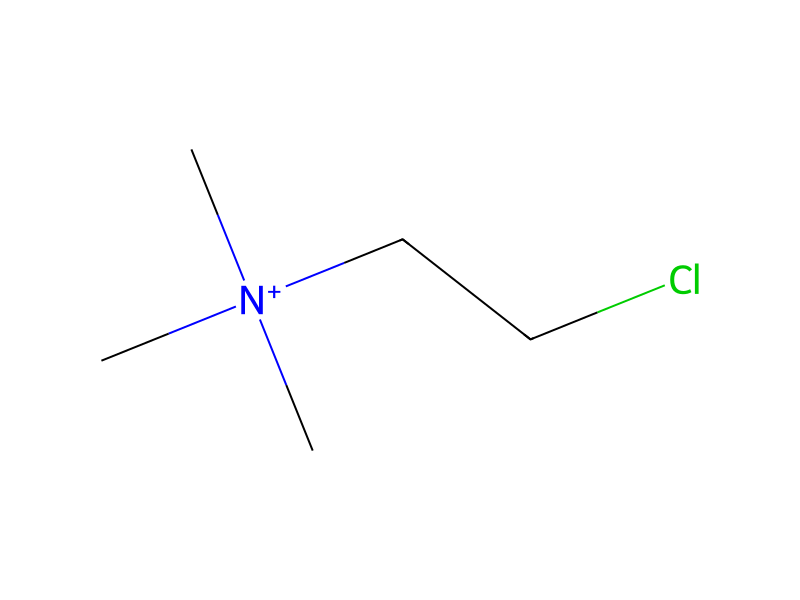
Basic information
- CAS
7003-89-6- Standard SMILES
C[N+](C)(C)CCCl- InChIKey
JUZXDNPBRPUIOR-UHFFFAOYSA-N- Molecular formula
- C5H13ClN+
- Average molar mass
- 122.619 g/mol
- Monoisotopic mass
- 122.07310352
Names & identifiers
- Preferred name
- Chlormequat
- IUPAC
- 2-Chloro-N,N,N-trimethylethan-1-aminium
- English name
- CHLORMEQUAT
- Molecular formula
- C5H13Cl2N
- Molecular weight
- 122.62
Names & synonyms
Database identifiers
- CAS
7003-89-6、999-81-5- PubChem CID
- 13837
- DTXSID
DTXSID4048064- ChEMBL
CHEMBL341956- ChEBI
CHEBI:81850- UNII
- 8SUZ1123XX
- Nikkaji
- J933D
Properties
Physicochemical properties
- LogP
- -3.8 · -3.800 (est)
- FDA UNII
- 8 SUZ1123XX · 8SUZ1123XX
Chemistry & industry
Applications
DescriptionChlormequat, usually used as the chloride derivative, is a plant growth retardant inhibiting cell elongation. It has a high aqueous solubility and does not tend to be persistent in the environment. It is moderately with some risk of it leaching to groundwater. It has a low to moderate toxicity to most species including mammals, birds, fish and honeybees. It is considered to be a reproduction/development toxin but no other serious health issues have been identified.
Suppliers12 total
Additional notes
DefinitionChEBI: Chlormequat is a quaternary ammonium ion that is choline in which the hydroxy group has been replaced by a chlorine. Its salts (particularly the chloride salt, known as chlormequat chloride) are used as plant growth retardants. It has a role as a plant growth retardant.
Related reactions
No reaction records under the current filter.
Compound notes
Loading…