
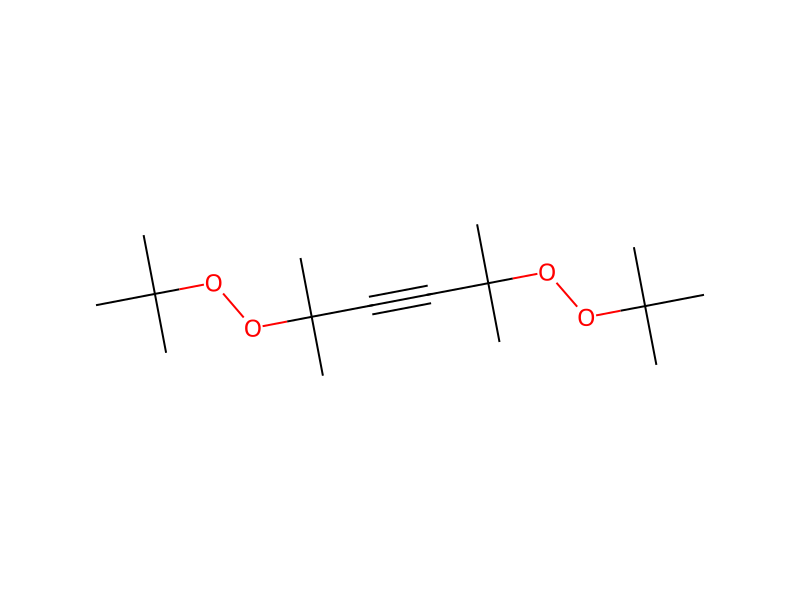
Basic information
- CAS
1068-27-5- Standard SMILES
CC(C)(C)OOC(C)(C)C#CC(C)(C)OOC(C)(C)C- InChIKey
ODBCKCWTWALFKM-UHFFFAOYSA-N- Molecular formula
- C16H30O4
- Average molar mass
- 286.41 g/mol
- Monoisotopic mass
- 286.21440943
Names & identifiers
- Preferred name
- 2,5-Bis(tert-butylperoxy)-2,5-dimethyl-3-hexyne
- IUPAC
- 2,5-bis(tert-butylperoxy)-2,5-dimethylhex-3-yne
- English name
- 2,5-Di(tert-butylperoxy)-2,5-dimethyl-3-hexyne
- Molecular formula
- C16H30O4
- Molecular weight
- 286.41
Names & synonyms
1068-27-52,5-Bis(tert-butylperoxy)-2,5-dimethyl-3-hexyne2,5-Dimethyl-2,5-di(t-butylperoxy)hexyne-3BRN 1711920EINECS 213-944-54O3I2IK0J0DTXSID10445122,5-dimethyl-2,5-di(tert-butylperoxy)hexyne-3Peroxide, (1,1,4,4-tetramethyl-2-butyne-1,4-diyl)bis((1,1-dimethylethyl)Di-tert-butyl 1,1,4,4-tetramethylbut-2-yn-1,4-ylene diperoxide4-01-00-02701 (Beilstein Handbook Reference)3-HEXYNE, 2,5-DIMETHYL-2,5-DI(t-BUTYLPEROXY)-
Show more names
VAROX 130Luperox 130Luperox-130VAROX 130-XLTrigonox 145Lupersol 130Perhexyne 25BCab-O-Cure 2PLuperco 130XL2,5-DIME-2,5-DI(T-BUTYLPEROXY)-3-HEXYNE,
2,5-dimethyl-2,5-di(t-butylperoxy)-hexyne2,5-dimethyl-2,5-di-tert-butylperoxyhexyne2,5-dimethyl-2,5-bis(tert-butylperoxy)hexynePeroxide, 1,1'-(1,1,4,4-tetramethyl-2-butyne-1,4-diyl)bis(2-(1,1-dimethylethyl)Peroxide, (1,1,4,4-tetramethyl-2-butyne-1,4-diyl)bis[(1,1-dimethylethyl)Peroxide, 1,1'-(1,1,4,4-tetramethyl-2-butyne-1,4-diyl)bis[2-(1,1-dimethylethyl)RefChem:444135DTXCID9024512
Database identifiers
- CAS
1068-27-5- PubChem CID
- 14037
- DTXSID
DTXSID1044512- UNII
- 4O3I2IK0J0
- EC Number
- 213-944-5
- Nikkaji
- J2.124E
Properties
Computed structural properties
- XLogP
- 3.2
- Topological polar surface area
- 36.9 Ų
- Hydrogen bond donors
- 0
- Hydrogen bond acceptors
- 4
- Rotatable bonds
- 8
- Heavy atoms
- 20
- Formal charge
- 0
- Complexity
- 335
Experimental & physicochemical properties
Physical Description
This liquid peroxide is particularly sensitive to temperature rises and contamination. Above a given "Control Temperature" they decompose violently. It is generally stored or transported as a mixture, with an inert solid.
Liquid; Other Solid
Physicochemical properties
- Melting point
- 88 °C · 88 °C (SADT)(lit.)
- Boiling point
- 348.77 °C · 348.77°C (rough estimate)
- Density
- 1.26 g/mL · 1.26 g/mL at 25 °C(lit.)
- vapor pressure
- 0.011 Pa · 0.011Pa at 20℃
- refractive index
- 1.434 · 1.4340 (estimate)
- Flash point
- 188 °F · 188 °F
- storage temp.
- 2 · 2-8°C
- form
- Solid
- color
- White to Off-White
- Water Solubility
- 2.2 mg/L · 2.2mg/L at 20℃
- InChI
- 1S/C16H30O4/c1-13(2,3)17-19-15(7,8)11-12-16(9,10)20-18-14(4,5)6/h1-10H3
- InChIKey
- ODBCKCWTWALFKM-UHFFFAOYSA-N
- SMILES
- CC(C)(C)OOC(C)(C)C#CC(C)(C)OOC(C)(C)C
- LogP
- 6.71 at · 6.71 at 25℃
- CAS DataBase Reference
- 1068 · 1068-27-5(CAS DataBase Reference)
- FDA UNII
- 4 O3I2IK0J0 · 4O3I2IK0J0
- EPA Substance Registry System
- 1 · Peroxide, 1,1'-(1,1,4,4-tetramethyl-2-butyne-1,4-diyl)bis[2-(1,1-dimethylethyl) (1068-27-5)
- UNSPSC Code
- 12162002 · 12162002
- NACRES
- 23 · NA.23
- Symbol(GHS)
- 2 · GHS02,GHS09
- Signal word
- Danger
- Hazard statements
- 242 · H242-H411
- Precautionary statements
- 210 · P210-P234-P235-P240-P280-P273-P370+P378-P391-P403-P410-P411-P420-P501
- PPE
- 95 · dust mask type N95 (US), Eyeshields, Gloves, type P3 (EN 143) respirator cartridges
- Hazard Codes
- O,Xi,Xn,F,E
- Risk Statements
- 8 · 8-38-36/37/38-7-41-37/38-20-11-36/38-2
- Safety Statements
- 7 · 7-17-36/37/39-36-26-3/7-14-47-35
- RIDADR
- 3106 · UN 3106 5.2
- WGK Germany
- 3 · 3
- RTECS
- 9750000 · MQ9750000
- TSCA
- TSCA listed
- HazardClass
- 5.2 · 5.2
- PackingGroup
- II
- HS Code
- 29096000 · 29096000
- Storage Class
- 5.2 · 5.2 - Organic peroxides and self-reacting hazardous materials
- Hazard Classifications
- 2 Org · Eye Irrit. 2Org. Perox. DSkin Irrit. 2
- REACH Registrations
- Active
Safety & regulation
GHS classification
GHS Classification
Danger
H241 (89.6%): Heating may cause a fire or explosion [Danger Self-reactive substances and mixtures; Organic peroxides];H242 (10.4%): Heating may cause a fire [Danger Self-reactive substances and mixtures; Organic peroxides];H315 (81.2%): Causes skin irritation [Warning Skin corrosion/irritation];H319 (81.2%): Causes serious eye irritation [Warning Serious eye damage/eye irritation];H411 (10.4%): Toxic to aquatic life with long lasting effects [Hazardous to the aquatic environment, long-term hazard]
P210, P234, P235, P240, P264, P264+P265, P273, P280, P302+P352, P305+P351+P338, P321, P332+P317, P337+P317, P362+P364, P370+P378, P370+P380+P375[+P378], P391, P403, P410, P411, P420, and P501 (click each P-code to see the statement)
Aggregated GHS information provided per 48 reports by companies from 3 notifications to the ECHA C&L Inventory. Each notification may be associated with multiple companies.;Information may vary between notifications depending on impurities, additives, and other factors. The percentage value in parenthesis indicates the notified classification ratio from companies that provide hazard codes. Only hazard codes with percentage values above 10% are shown. For more detailed information, please visit ECHA C&L website.
Hazard information
Regulatory Information
Chemical: Peroxide, (1,1,4,4-tetramethyl-2-butyne-1,4-diyl)bis[(1,1-dimethylethyl)
Hazard Traits - Bioaccumulation; Environmental Persistence;Authoritative List - Canada PBiTs;Report - if used as a fragrance or flavor ingredient
Peroxide, 1,1'-(1,1,4,4-tetramethyl-2-butyne-1,4-diyl)bis[2-(1,1-dimethylethyl) is listed on the EPA's Chemical Data Reporting (CDR) system. Manufacturers and importers of Peroxide, 1,1'-(1,1,4,4-tetramethyl-2-butyne-1,4-diyl)bis[2-(1,1-dimethylethyl) are required to report information about their production and use of this chemical to the EPA under the Toxic Substances Control Act (TSCA). (40 eCFR Part 711)
Status: Active Update: 02-08-2022 https://echa.europa.eu/registration-dossier/-/registered-dossier/21767
Peroxide, (1,1,4,4-tetramethyl-2-butyne-1,4-diyl)bis(1,1-dimethylethyl): Does not have an individual approval but may be used as a component in a product covered by a group standard. It is not approved for use as a chemical in its own right.
Other Safety InformationIMAP assessments - Peroxide, (1,1,4,4-tetramethyl-2-butyne-1,4-diyl)bis[(1,1-dimethylethyl): Human health tier I assessment
DOT LabelOrganic Peroxide Explosive
Fire Hazards
Excerpt from ERG Guide 146 [Organic Peroxides (Heat, Contamination and Friction Sensitive)]:;May explode from heat, shock, friction or contamination. May ignite combustibles (wood, paper, oil, clothing, etc.). May be ignited by heat, sparks or flames. May burn rapidly with flare-burning effect. Containers may explode when heated. Runoff may create fire or explosion hazard. (ERG, 2024)
Health Hazards
Excerpt from ERG Guide 146 [Organic Peroxides (Heat, Contamination and Friction Sensitive)]:;Fire may produce irritating, corrosive and/or toxic gases. Ingestion or contact (skin, eyes) with substance may cause severe injury or burns. Runoff from fire control or dilution water may cause environmental contamination. (ERG, 2024)
Reactive GroupHydrocarbons, Aliphatic Unsaturated;Peroxides, Organic;Alkynes, with No Acetylenic Hydrogen
Reactivity AlertsExplosive;Strong Oxidizing Agent
Reactivity Profile
Peroxides, such as 2,5-DIMETHYL-2,5-BIS(TERT-BUTYLPEROXY)-3-HEXYNE, are good oxidizing agents. Organic compounds can ignite on contact with concentrated peroxides. Strongly reduced material such as sulfides, nitrides, and hydrides may react explosively with peroxides. There are few chemical classes that do not at least produce heat when mixed with peroxides. Many produce explosions or generate gases (toxic and nontoxic). Generally, dilute solutions of peroxides (<70%) are safe, but the presence of a catalyst (often a transition metal such as cobalt, iron, manganese, nickel, or vanadium) as an impurity may even then cause rapid decomposition, a buildup of heat, and even an explosion. Solutions of peroxides often become explosive when evaporated to dryness or near-dryness. Danger of explosion when dry. May explode from heat, shock, friction or contamination. May ignite combustibles (wood, paper, oil, clothing, etc.). May be ignited by heat, sparks or flames.
Air and Water ReactionsNo rapid reaction with air. No rapid reaction with water.
Hazard Classes and Categories
Org. Perox. B (89.6%);Org. Perox. C (10.4%);Skin Irrit. 2 (81.2%);Eye Irrit. 2 (81.2%);Aquatic Chronic 2 (10.4%)
Flammable liquids - Category 3;Organic peroxides - Type B
Safety & protection
Fire Fighting
Excerpt from ERG Guide 146 [Organic Peroxides (Heat, Contamination and Friction Sensitive)]:;SMALL FIRE: Water spray or fog is preferred; if water not available use dry chemical, CO2 or regular foam.;LARGE FIRE: Flood fire area with water from a distance. Use water spray or fog; avoid aiming straight or solid streams directly onto the product. Do not move cargo or vehicle if cargo has been exposed to heat. If it can be done safely, move undamaged containers away from the area around the fire.;FIRE INVOLVING TANKS, RAIL TANK CARS OR HIGHWAY TANKS: Fight fire from maximum distance or use unmanned master stream devices or monitor nozzles. Cool containers with flooding quantities of water until well after fire is out. ALWAYS stay away from tanks in direct contact with flames. For massive fire, use unmanned master stream devices or monitor nozzles; if this is impossible, withdraw from area and let fire burn. (ERG, 2024)
First AidExcerpt from ERG Guide 146 [Organic Peroxides (Heat, Contamination and Friction Sensitive)]:;Refer to the "General First Aid" section. Specific First Aid: Contaminated clothing may be a fire risk when dry. (ERG, 2024)
Nonfire Spill Response
Excerpt from ERG Guide 146 [Organic Peroxides (Heat, Contamination and Friction Sensitive)]:;ELIMINATE all ignition sources (no smoking, flares, sparks or flames) from immediate area. Keep combustibles (wood, paper, oil, etc.) away from spilled material. Do not touch damaged containers or spilled material unless wearing appropriate protective clothing. Keep substance wet using water spray. Stop leak if you can do it without risk.;SMALL SPILL: Pick up with inert, damp, non-combustible material using clean, non-sparking tools and place into loosely covered plastic containers for later disposal.;LARGE SPILL: Wet down with water and dike for later disposal. Prevent entry into waterways, sewers, basements or confined areas. DO NOT CLEAN-UP OR DISPOSE OF, EXCEPT UNDER SUPERVISION OF A SPECIALIST. (ERG, 2024)
Isolation and Evacuation
Excerpt from ERG Guide 146 [Organic Peroxides (Heat, Contamination and Friction Sensitive)]:;IMMEDIATE PRECAUTIONARY MEASURE: Isolate spill or leak area in all directions for at least 50 meters (150 feet) for liquids and at least 25 meters (75 feet) for solids.;LARGE SPILL: Consider initial evacuation for at least 250 meters (800 feet) in all directions.;FIRE: If tank, rail tank car or highway tank is involved in a fire, ISOLATE for 800 meters (1/2 mile) in all directions; also, consider initial evacuation for 800 meters (1/2 mile) in all directions. (ERG, 2024)
Personal Protective Equipment (PPE)
Excerpt from ERG Guide 146 [Organic Peroxides (Heat, Contamination and Friction Sensitive)]:;Wear positive pressure self-contained breathing apparatus (SCBA). Wear chemical protective clothing that is specifically recommended by the manufacturer when there is NO RISK OF FIRE. Structural firefighters' protective clothing provides thermal protection but only limited chemical protection. (ERG, 2024)
Regulatory information
Regulatory Information
Chemical: Peroxide, (1,1,4,4-tetramethyl-2-butyne-1,4-diyl)bis[(1,1-dimethylethyl)
Hazard Traits - Bioaccumulation; Environmental Persistence;Authoritative List - Canada PBiTs;Report - if used as a fragrance or flavor ingredient
Peroxide, 1,1'-(1,1,4,4-tetramethyl-2-butyne-1,4-diyl)bis[2-(1,1-dimethylethyl) is listed on the EPA's Chemical Data Reporting (CDR) system. Manufacturers and importers of Peroxide, 1,1'-(1,1,4,4-tetramethyl-2-butyne-1,4-diyl)bis[2-(1,1-dimethylethyl) are required to report information about their production and use of this chemical to the EPA under the Toxic Substances Control Act (TSCA). (40 eCFR Part 711)
Status: Active Update: 02-08-2022 https://echa.europa.eu/registration-dossier/-/registered-dossier/21767
Peroxide, (1,1,4,4-tetramethyl-2-butyne-1,4-diyl)bis(1,1-dimethylethyl): Does not have an individual approval but may be used as a component in a product covered by a group standard. It is not approved for use as a chemical in its own right.
Safety data
- PPE
- dust mask type N95 (US), Eyeshields, Gloves, type P3 (EN 143) respirator cartridges
- wgk
- 3
- tsca
- TSCA listed
- rtecs
- MQ9750000
- ridadr
- UN 3106 5.2
- hs_code
- 29096000
- risk_code
- 8-38-36/37/38-7-41-37/38-20-11-36/38-2
- Signal word
- Danger
- Symbol(GHS)
- GHS02,GHS09
- hazard_code
- O,Xi,Xn,F,E
- safety_code
- 7-17-36/37/39-36-26-3/7-14-47-35
- hazard_class
- 5.2
- Storage Class
- 5.2 - Organic peroxides and self-reacting hazardous materials
- packing_group
- II
- Hazard statements
- H242-H411
- REACH Registrations
- Active
- Hazard Classifications
- Eye Irrit. 2Org. Perox. DSkin Irrit. 2
- Precautionary statements
- P210-P234-P235-P240-P280-P273-P370+P378-P391-P403-P410-P411-P420-P501
Chemistry & industry
Uses & manufacturing
U.S. Production2023: 50,000 - <250,000 lb;2022: 250,000 - <400,000 lb;2021: 400,000 - <550,000 lb;2020: 250,000 - <400,000 lb
Consumer UsesNot Known or Reasonably Ascertainable
Industry UsesIntermediate;Catalyst
General Manufacturing Information
All Other Chemical Product and Preparation Manufacturing;Plastics Product Manufacturing;All Other Basic Organic Chemical Manufacturing
Peroxide, 1,1'-(1,1,4,4-tetramethyl-2-butyne-1,4-diyl)bis[2-(1,1-dimethylethyl): ACTIVE
Applications
UsesFree radical polymerization initiator.
General Description2,5-Di(tert-butylperoxy)-2,5-dimethyl-3-hexyne is particularly sensitive to temperature rises and contamination. Above a given "Control Temperature" they decompose violently. 2,5-Di(tert-butylperoxy)-2,5-dimethyl-3-hexyne is generally stored or transported as a mixture, with an inert solid.
Suppliers47 total
Hebei Chuanghai Biotechnology Co., Ltd+86-17732866630 · [email protected]
Career Henan Chemica Co+86-0371-86658258 +86-13203830695 · [email protected]
湖南嘉航医药科技有限公司85521272 15200744171 · [email protected]
江苏艾康生物医药研发有限公司025-025-66113011 15955137747 · [email protected]
Baoji Guokang Healthchem co.,ltd+8615604608665 15604608665 · [email protected]
Dayang Chem (Hangzhou) Co.,Ltd.+86-0571-88938639 17705817739 · [email protected]
Syntechem Co.,Ltd[email protected]
上海迈瑞尔生化科技有限公司4006356688 18621169109 · [email protected]
江苏普乐司生物科技有限公司0513-66017706 18551496367 · [email protected]
南通合润生物科技有限公司18362409333 · [email protected]
ChemeGen 中国18818260767 · [email protected]
天津希恩思生化科技有限公司400 638 7771 · [email protected]
上海遐瑞医药科技有限公司+86 21 61551611
PT CHEM GROUP LIMITED+86-85511178; +86-85511178 · [email protected]
Sigma-Aldrich西格玛奥德里奇(上海)贸易有限公司021-61415566 800-8193336 · [email protected]
天津荣燊化工有限公司18317763565; 18317763565 · [email protected]
九鼎化学(上海)科技有限公司4009209199 · [email protected]
厦门志信化学有限公司+86-5922680277 +86-13806087780 · [email protected]
安耐吉化学&3A(安徽泽升科技股份有限公司)400-0056266 · [email protected]
广东翁江化学试剂有限公司0751-2886766 13927870850 · [email protected]
艾吉析科技(上海)有限公司17721401538;17717235263 17721401538 · [email protected]
常熟市新裕华进出口有限公司0512-52678575 13776233393 · [email protected]
陕西缔都医药化工有限公司029-029-81120477 17792793610 · [email protected]
南通市苏北化工原料有限公司0513-85290972 18762756250 · [email protected]
上海西陇生化科技有限公司021-52907766-8042
成都华纯科技有限公司400-1166-196 15982826727 · [email protected]
泰安市嘉叶生物科技有限公司15318151873;13127280945 · [email protected]
山东小野化学股份有限公司0539-6362799 20)
成都康巴斯生物科技有限公司18582381569 · [email protected]
巴师傅(上海)生物医药科技有限公司60662071 18117346937 · [email protected]
上海百舜生物科技有限公司021-37581181 · [email protected]
河南天孚化工有限公司+86-0371-55170693 +86-19937530512 · [email protected]
厦门盈融达化工有限公司+86-0592-6210733 · [email protected]
海蔚化学86-21-51086038 · [email protected]
济南国辰泰富化工有限公司0531-88162029 13256661585 · [email protected]
沈阳莫德医药科技有限公司024-23982345 · [email protected]
XIAMEN AMITY INDUSTRY AND TRADE CO., LTD.+8618950047208 · [email protected]
武汉吉鑫益邦生物科技有限公司59768661 13297943853 · [email protected]
SUZHOU SENFEIDA CHEMICAL CO.,LTD+86-0512-83500002 +86-15195660023 · [email protected]
重庆卡兰医药有限公司[email protected]
Henan Allgreen Chemical Co.,LTD+86-37155567971 +86-13633837469 · [email protected]
上海珅桔化工有限公司13167128868 13248068001 · [email protected]
Hefei TNJ Chemical Industry Co.,Ltd.+86-0551-65418671 +86-189 4982 3763 · [email protected]
CD Chemical Group Limited+86-13651442114 · [email protected]
江苏雷恩环保科技有限公司66814573 16651336298 · [email protected]
南通润丰石油化工有限公司66814565 18912298907 · [email protected]
南通众合化工新材料有限公司0513-85666561 15950816326 · [email protected]
Related reactions
4 records


Compound notes
Loading…