
HRID 65680As reactant
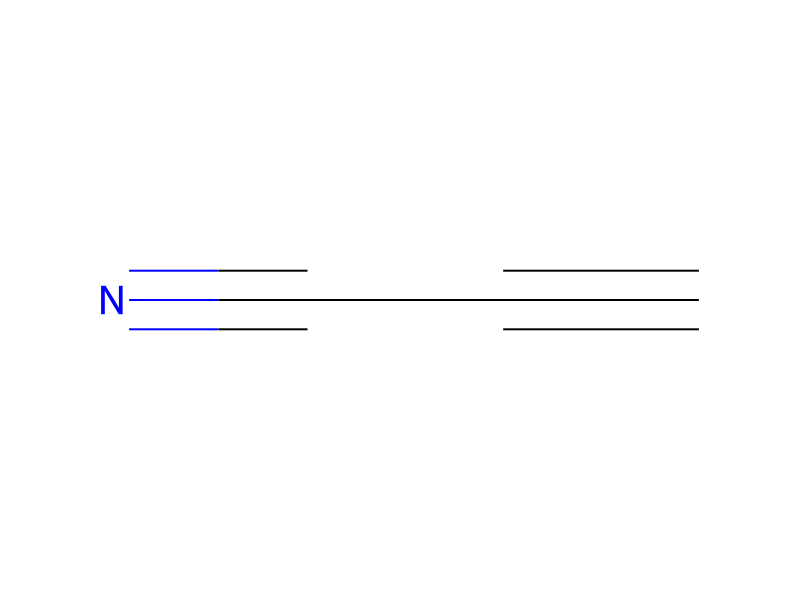
1070-71-9C#CC#NLNDJVIYUJOJFSO-UHFFFAOYSA-Nstructure in first source
1070-71-9DTXSID40147867Safety information is for reference only and does not replace the supplier’s Safety Data Sheet (SDS), applicable regulations, or professional assessment.
Danger
H225 (100%): Highly Flammable liquid and vapor [Danger Flammable liquids]
P210, P233, P240, P241, P242, P243, P260, P262, P264, P270, P271, P280, P284, P301+P316, P302+P352, P303+P361+P353, P304+P340, P316, P320, P321, P330, P361+P364, P370+P378, P403+P233, P403+P235, P405, and P501 (click each P-code to see the statement)
The GHS information provided by 1 company from 1 notification to the ECHA C&L Inventory.
Uses2-Propynenitrile, is the simplest cyanopolyyne. It has been detected by spectroscopic methods in interstellar clouds, in the coma of comet Hale–Bopp and in the atmosphere of Saturn''s moon Titan, where it sometimes forms expansive fog-like clouds.
PreparationCyanoacetylene is not commercially available, but can be prepared on a several gram scale by the dehydration of propynamide (propiolamide) with Phosphorus(V) Oxide (eq 1). The reactants are well ground together under nitrogen, and upon subjection of the resulting solid mixture to high temperature treatment, propynenitrile is collected as a distillate in a receiver held at 5 °C.


