Basic information
- CAS
1309-42-8- Standard SMILES
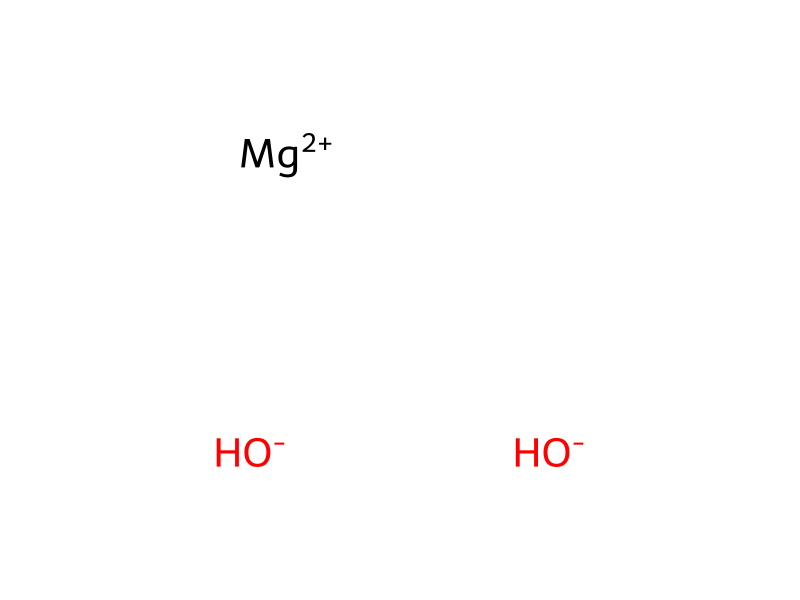
[Mg+2].[OH-].[OH-]- InChIKey
VTHJTEIRLNZDEV-UHFFFAOYSA-L- Molecular formula
- H2MgO2
- Average molar mass
- 58.32 g/mol
Overview
Magnesium hydroxide is an inorganic compound. It is naturally found as the mineral brucite. Magnesium hydroxide can be used as an antacid or a laxative in either an oral liquid suspension or chewable tablet form. Additionally, magnesium hydroxide has smoke suppressing and flame retardant properties and is thus used commercially as a fire retardant. It can also be used topically as a deodorant or for the relief of canker sores (aphthous ulcers).
Names & identifiers
- Preferred name
- Mint-O-Mag
- IUPAC
- magnesium dihydroxide
- English name
- Magnesium hydroxide
- Molecular formula
- H2MgO2
- Molecular weight
- 58.32
Names & synonyms
magnesium;dihydroxideBRUCITEMagnesium hydroxide, 99%(KT)MilmagMagmesia hydrateHydro-mag MADi-GelHaley's MOMint-O-MagKisuma 5B-NHydrofy G 1.0Asahi Glass 200-06
Show more names
Mg(OH)2MagnesiumhydroxidMAGNESIUM HYDRATEMagnesium hydroxide, Ph.Eur.4, BP2001, USP24, E528K537magoxs/g84FR-20MGH-93
CCRIS 3342CCRIS 6159HSDB 659Ki 22-5BEINECS 215-170-3EINECS 215-274-9Milmag (TN)Mint-o-mag (TN)
Database identifiers
- CAS
1309-42-8、1317-43-7- PubChem CID
- 14791
- EC Number
- 215-274-9
Properties
Computed structural properties
- Topological polar surface area
- 2 Ų
- Hydrogen bond donors
- 2
- Hydrogen bond acceptors
- 2
- Rotatable bonds
- 0
- Heavy atoms
- 3
- Formal charge
- 0
- Complexity
- 2.8
Physicochemical properties
- Melting point
- 350 °C · 350 °C (lit.)
- Density
- 2 · 2,36 g/cm3
- storage temp.
- Room Temperature
- solubility
- 5 M · 5 M HCl: 0.1 M, clear, yellow
- form
- powder
- color
- White
- Specific Gravity
- 2.36 · 2.36
- Odor
- Odorless
- PH Range
- 9.5 · 9.5 - 10.5
- PH
- 10.4 · 10.4(1 mM solution);10.4(10 mM solution);10.4(100 mM solution)
- Water Solubility
- 0.9 mg/100 · 0.9 mg/100 mL (18 ºC)
- Specific Heat Capacity
- 1.32 J/ · Cp(crystal): 1.32 J/(g·K), at 25℃
- λmax
- 260 nm · λ: 260 nm Amax: 0.030λ: 280 nm Amax: 0.025
- Sensitive
- Air Sensitive
- Merck
- 14 · 14,5670
- Solubility Product Constant (Ksp)
- 11.25 · pKsp: 11.25
Safety & regulation
Safety data
- F
- 3-9
- PPE
- dust mask type N95 (US), Eyeshields, Gloves
- wgk
- -
- tsca
- TSCA listed
- rtecs
- OM3570000
- hs_code
- 28161000
- Toxicity
- LD50 oral in rat: 8500mg/kg
- risk_code
- 36/37/38
- Signal word
- Warning
- Symbol(GHS)
- GHS07
- hazard_code
- Xi
- safety_code
- 26-36-37/39-24/25
- Storage Class
- 13 - Non Combustible Solids
- Hazard statements
- H315-H319-H335
- REACH Registrations
- Active
- Precautionary statements
- P261-P280a-P304+P340-P305+P351+P338-P405-P501a
- Hazardous Substances Data
- 1309-42-8(Hazardous Substances Data)
Chemistry & industry
Pharmacology
Protein BindingMagnesium hydroxide does not have any protein binding properties.
Pharmacodynamics
As an antacid, magnesium hydroxide suspension neutralizes gastric acid by reacting with hydrochloric acid in the stomach to form magnesium chloride and water. It is practically insoluble in water and does not have any effect until it reacts with the hydrochloric acid in the stomach. There, it decreases the direct acid irritant effect and increases the pH in the stomach leading to inactivation of pepsin. Magnesium hydroxide enhances the integrity of the mucosal barrier of the stomach as well as improving the tone of both the gastric and esophageal sphincters. As a laxative, the magnesium hydroxide works by increasing the osmotic effect in the intestinal tract and drawing water in. This creates distension of the colon which results in an increase in peristaltic movement and bowel evacuation.
Mechanism of Action
The suspension of magnesium hydroxide is ingested and enters the stomach. According to the amount ingested, the magnesium hydroxide will either act as an antacid or a laxative. Through the ingestion of 0.5-1.5 grams (in adults) the magnesium hydroxide will act by simple acid neutralization in the stomach. The hydroxide ions from the magnesium hydroxide suspension will combine with the acidic H+ ions of the hydrochloric acid made by the stomachs parietal cells. This neutralization reaction will result in the formation of magnesium chloride and water. Through the ingestion of 2-5 grams (in adults) the magnesium hydroxide acts as a laxative in the colon. The majority of the suspension is not absorbed in the intestinal tract and will create an osmotic effect to draw water into the gut from surrounding tissues. With this increase of water in the intestines, the feces will soften and the intraluminal volume of the feces will increase. These effects still stimulate intestinal motility and induce the urge to defecate. Magnesium hydroxide will also release cholecystokinin (CCK) in the intestines which will accumulate water and electrolytes in the lumen and furthermore increase intestinal motility.
Biological Half-LifeN/A
Metabolism/Metabolites
Related reactions
0 records
No reaction records under the current filter.
Compound notes
Loading…