
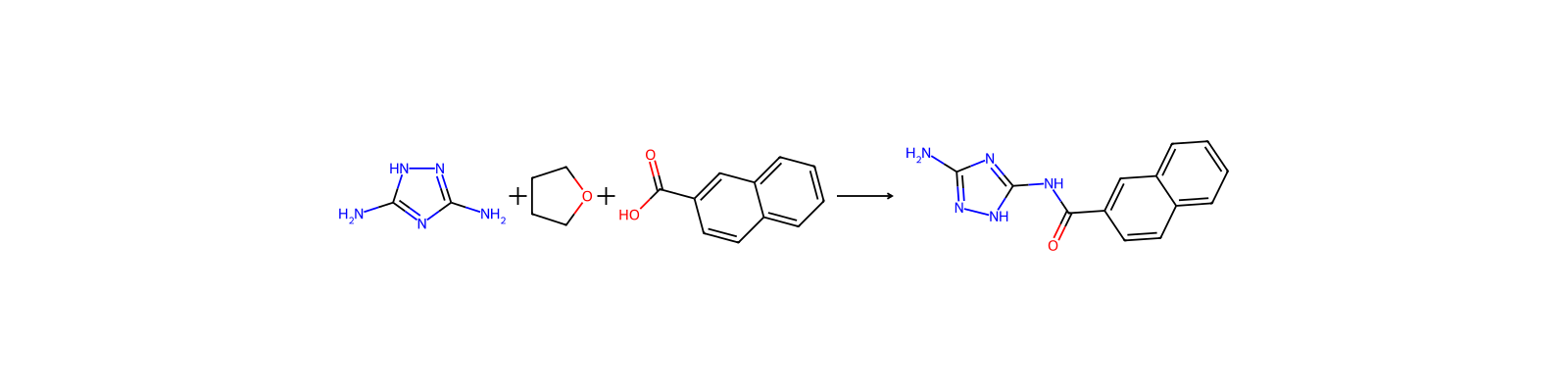
HRID 35069As reactant

1455-77-2Nc1n[nH]c(N)n1PKWIYNIDEDLDCJ-UHFFFAOYSA-NGuanazole appears as colorless crystals. (NTP, 1992)
1455-77-2DTXSID0025367CHEMBL56973CHEBI:75425Safety information is for reference only and does not replace the supplier’s Safety Data Sheet (SDS), applicable regulations, or professional assessment.
This chemical does not meet GHS hazard criteria for 31% (53 of 171) of reports.
Warning
H302+H312+H332 (16.4%): Harmful if swallowed, in contact with skin or if inhaled [Warning Acute toxicity, oral; acute toxicity, dermal; acute toxicity, inhalation]
P261, P264, P264+P265, P270, P271, P280, P301+P317, P302+P352, P304+P340, P305+P351+P338, P317, P321, P330, P332+P317, P337+P317, P362+P364, and P501 (click each P-code to see the statement)
Aggregated GHS information provided per 171 reports by companies from 7 notifications to the ECHA C&L Inventory. Each notification may be associated with multiple companies.
REACH registered substance: 1H-1,2,4-triazole-3,5-diamine (EC: 215-937-2)
1H-1,2,4-Triazole-3,5-diamine: Does not have an individual approval but may be used as a component in a product covered by a group standard. It is not approved for use as a chemical in its own right.
The triazoles, of which GUANAZOLE is a member, are a group of highly explosive materials that are sensitive to heat, friction, and impact. Sensitivity varies with the type of substitution to the triazole ring. The amine substituted derivatives, guanazole, tend not to be explosion sensitive. Metal chelated and halogen substitution of the triazol ring make for a particularly heat sensitive material. Azido and nitro derivatives have been employed as high explosives. No matter the derivative these materials should be treated as explosives. GUANAZOLE forms salts readily with acids. (NTP, 1992)
Uses3,5-Diamino-1,2,4-triazole is used as an inhibitor of DNA synthesis. It also serves as an antitumor agents in the treatment of epigenetically-based diseases. It acts as a corrosion inhibitor for copper.
General DescriptionColorless crystals.


EYES: First check the victim for contact lenses and remove if present. Flush victim's eyes with water or normal saline solution for 20 to 30 minutes while simultaneously calling a hospital or poison control center. Do not put any ointments, oils, or medication in the victim's eyes without specific instructions from a physician. IMMEDIATELY transport the victim after flushing eyes to a hospital even if no symptoms (such as redness or irritation) develop.
SMALL SPILLS AND LEAKAGE: If you spill this chemical, you should dampen the solid spill material with water, then transfer the dampened material to a suitable container. Use absorbent paper dampened with water to pick up any remaining material. Seal your contaminated clothing and the absorbent paper in a vapor-tight plastic bag for eventual disposal. Wash all contaminated surfaces with a soap and water solution. Do not reenter the contaminated area until the Safety Officer (or other responsible person) has verified that the area has been properly cleaned.
RECOMMENDED RESPIRATOR: Where the neat test chemical is weighed and diluted, wear a NIOSH-approved half face respirator equipped with an organic vapor/acid gas cartridge (specific for organic vapors, HCl, acid gas and SO2) with a dust/mist filter. (NTP, 1992)
DefinitionChEBI: An aromatic amine that is 1,2,4-triazole substituted at positions 3 and 5 by amino groups.