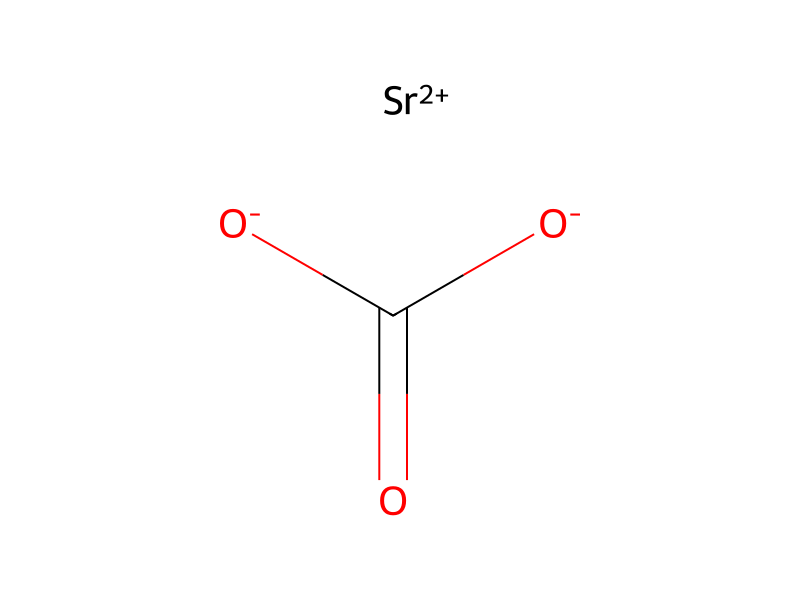
1633-05-2O=C([O-])[O-].[Sr+2]LEDMRZGFZIAGGB-UHFFFAOYSA-LStrontianite is a mineral with formula of SrCO3 or Sr(CO3). The IMA symbol is Str.
1633-05-2DTXSID3029651CHEMBL31884673.5 g/cu-cm
3.5 g/cm³
3.5 @25 °C
WHITE POWDER
Colorless or white rhombic crystalline solid transforming to hexagonal above 926 °C
White orthorhombic crystals
White crystalline powder
11 MG/L OF WATER AT 18 °C; 650 MG/L OF WATER AT 100 °C
Sol in ammonium salts
Sol in dilute acids
SOL IN 100,000 PARTS WATER; IN ABOUT 1000 PARTS WATER SATURATED WITH CARBON DIOXIDE.
Soluble in acids, carbonated water, and solutions of ammonium salts
Solubility in water, g/100ml at 18 °C: 0.011 (very poor)
1494 °C
1494 °C
This chemical does not meet GHS hazard criteria for 99.3% (398 of 401) of all reports.
Not Classified
Aggregated GHS information provided per 401 reports by companies from 5 notifications to the ECHA C&L Inventory.
Chemical: Carbonic acid, strontium salt (1:1)
Carbonic acid, strontium salt (1:1) is listed on the EPA's Chemical Data Reporting (CDR) system. Manufacturers and importers of Carbonic acid, strontium salt (1:1) are required to report information about their production and use of this chemical to the EPA under the Toxic Substances Control Act (TSCA). (40 eCFR Part 711)
Status: Active Update: 15-03-2023 https://echa.europa.eu/registration-dossier/-/registered-dossier/14362
Strontium carbonate: Does not have an individual approval but may be used under an appropriate group standard
An irritant to the eyes and the respiratory tract; Strontium ion has effects on the calcium content of the bones and teeth, but data concerning harmful doses of strontium carbonate are inadequate. [ICSC] May cause irritation; [MSDSonline] See Strontium.
(AL) ALABAMA 8 pCi/l /Strontium 90/
(CA) CALIFORNIA 8 pCi/l /Strontium 90/
Naturally found as the mineral strontianite; [Merck Index] Used in pyrotechnics, signals, ceramic ferrites, phosphors, iridescent glass, glass for color television tubes, oxide coatings, and fluxes for producing high-grade steels; Also used in refining sugar and as a lead scavenger in zinc production; [HSDB] Used in the electrical/electronic engineering industry; [IUCLID]
Steel Producing [Category: Industry]
IN PYROTECHNICS; MANUFACTURING IRIDESCENT GLASS; REFINING SUGAR
As a catalyst; in radiation-resistant glass for color television tubes, ceramic ferrites, pyrotechnics.
AS A FLUX IN THE PRODUCTION OF HIGH-GRADE ALLOY STEELS
Manufacture of glass faceplates for color television tubes (x-ray absorber)
(1986) 3.97X10+4 lb /Strontium carbonate not precipitated incl strontianite/
(1986) 1.20X10+7 lb /Strontium carbonate not precipitated incl strontianite/
CELESTITE IS BOILED WITH A SOLUTION OF AMMONIUM CARBONATE OR IS FUSED WITH SODIUM CARBONATE.
... Celestite ore is crushed, ground, & stored in bins before it is fed to rotary kilns. As ground ore is being conveyed to the kilns, it is mixed with ground coke. In the kilns, the celestite is reduced to strontium sulfide, which is known as black ash. ... The product ... from the kilns is collected in storage bins. Black ash ... is fine-ground in a ball mill & fed to a leacher circuit ... where it is dissolved in water & the muds are separated by counter current decantation. ... The filered product, a saturated soln containing 12-13% strontium sulfide, is sent to an agitation tank where soda ash is added to cause precipitation of strontium carbonate crystals ... After precipitation is complete, slurry is pumped to vacuum drum filters where nearly complete liq-solids separation is accomplished. The liq is dilute sodium sulfide soln, which is concentrated by evaporation. ... The filter cake is 60% strontium carbonate solid. ... Strontium carbonate also precipitates from strontium sulfide soln with carbon dioxide.
Loading…
Dry Powder
White odorless solid; [Merck Index] Colorless or white odorless hygroscopic solid; [HSDB] White odorless powder; [MSDSonline]
WHITE ODOURLESS POWDER.
DECOMPOSES AT 1100 °C INTO STRONTIUM OXIDE AND CARBON DIOXIDE
Liberates carbon dioxide at 1340 °C; impalpable
Enthalpy of formation (crystal): -1220.1 KJ/mol @ 25 °C; Gibbs Energy of formation (crystal): -1140.1 KJ/mol @ 25 °C; Entropy of formation (crystal): 97.1 J/mol-K @ 25 °C; Heat capacity @ constant pressure (crystal): 81.4 J/mol-K @ 25 °C
Hygroscopic
For more Other Experimental Properties (Complete) data for STRONTIUM CARBONATE (6 total), please visit the HSDB record page.
(CT) CONNECTICUT 8 pCi/l /Strontium 90/
(IL) ILLINOIS 8 pCi/l /Strontium 90/
For more State Drinking Water Standards (Complete) data for STRONTIUM CARBONATE (6 total), please visit the HSDB record page.
(FL) FLORIDA 4,200 ug/l /Strontium/
(ME) MAINE 4200 ug/l /Strontium/
Fresh air, rest.
Rinse and then wash skin with water and soap.
Rinse with plenty of water for several minutes (remove contact lenses if easily possible).
Rinse mouth. Give one or two glasses of water to drink.
SRP: At the time of review, criteria for land treatment or burial (sanitary landfill) disposal practices are subject to significant revision. Prior to implementing land disposal of waste residue (including waste sludge), consult with environmental regulatory agencies for guidance on acceptable disposal practices.
Cough.
Redness.
Strontium forms 0.02-0.03% of the earth's crust and is present in igneous rocks in amounts averaging 375 ppm(1). Of the naturally occurring strontium compounds, only the minerals strontianite (strontium carbonate) and celestite (strontium sulfate) are of economic importance(2).
OCCURS IN NATURE AS THE MINERAL STRONTIANITE.
More than 80% of all strontium consumed in 1995 was used in ceramic and glass manufacture, primarily in televison faceplate glass (strontium carbonate/oxide)(1). In addition, strontium (strontium carbonate) is used to remove lead impurities during the electrolytic production of zinc(1). The production and use of these strontium compounds may result in its release to the environment through various waste streams(SRC).
Major signs of chronic toxicity, which involve the skeleton, have been labeled as "strontium rickets". ... Rickets /have been produced/ in laboratory rats by feeding them strontium carbonate at 2% strontium in diet.
THE SKELETAL MALFORMATIONS INDUCED IN RATS OF WISTAR STRAIN BY STRONTIUM CARBONATE WERE STUDIED WITH SKELETAL PREPARATIONS (DAWSON'S & NOVAK'S METHODS) & FETUSES WITH MARKED CONGENITAL KYPHOSIS WERE EXAMINED HISTOLOGICALLY. STRONTIUM CARBONATE (200 MG/100 G BODY WT) MIXED WITH A PELLET (ORIENTAL KOBO LTD 15 G/DAY) OR A ROUTINE DIET WAS ADMINISTERED DURING PREGNANCY. THE VERTEBRAL COLUMN SHOWED KYPHOSIS AROUND THE JUNCTION OF THORACIC & LUMBAR VERTEBRAE, & DISARRANGEMENT OF VERTEBRAE WERE SOMETIMES SHOWN AT THE OTHER PARTS. THE VERTEBRAL BODY AT THE CURVED VERTEBRAL COLUMN WAS TRAPEZOID IN FIGURE. SKELETAL MALFORMATIONS OF A ROUTINE DIET GROUP WERE MORE FREQUENT & MORE MARKED THAN A PELLET GROUP.
A SINGLE INTRATRACHEAL INSTILLATION OF 50 MG STRONTIUM CARBONATE/RAT RESULTED IN HYPERVOLEMIA OF PULMONARY BLOOD VESSELS & HYPERPLASIA OF THE LYMPHOID FOLLICLES IN THE BRONCHIAL SUBMUCOSA AFTER 1 MONTH. AFTER 9 & 12 MONTHS, SCLEROSIS OF THE WALLS OF BLOOD VESSELS & BRONCHI WAS FOUND. THE BRONCHIAL EPITHELIUM WAS REGENERATED.
Adult white leghorn hens were fed a standard diet containing 2.93% calcium, 0.79% phosphorus & 17% protein & water ad libitum for a 4-wk period. The dietary calcium was fed at a constant level of 2.93% for all dietary treatments. Strontium carbonate was added to the diets of 10 birds to supply levels of 0, 1.5 & 3.0% strontium. These levels produced zero hatchability of fertile eggs & ash content of egg shells was increased as the dietary strontium level was increased. Embryo ash, calcium & phosphorus contents were reduced with incr dietary strontium level. Skeletal calcification in chick embryos appeared to be inhibited by retained transferred strontium.
(AL) ALABAMA 8 pCi/l /Strontium 90/
(CA) CALIFORNIA 8 pCi/l /Strontium 90/
(CT) CONNECTICUT 8 pCi/l /Strontium 90/
(IL) ILLINOIS 8 pCi/l /Strontium 90/
For more State Drinking Water Standards (Complete) data for STRONTIUM CARBONATE (6 total), please visit the HSDB record page.
(FL) FLORIDA 4,200 ug/l /Strontium/
(ME) MAINE 4200 ug/l /Strontium/
Paint and Coating Manufacturing
Carbonic acid, strontium salt (1:1): ACTIVE
DescriptionStrontium carbonate (SrCO3)(1633-05-2) belongs to the carbonate salt of strontium, which is found in nature as the mineral strontianite. It can be applied in a variety of industries. At present, strontium carbonates are commonly being applied as an inexpensive colorant in pyrotechnics since strontium and its salts produce a crimson read flame. Strontium carbonate, in general, is preferred in fireworks, compared with other strontium salts due to its inexpensive cost, nonhygroscopic property, and ability to neutralize acid. It can also be used as road flares and for preparing iridescent glass, luminous paints, strontium oxide or strontium salts and in refining sugar and certain drugs. It is also recommended as a substitute for barium to produce matte glazes. Besides, its applications involves in ceramics industry, where it serves as an ingredient in glazes, and in electric products, where it is used for the production of strontium ferrites to produce permanent magnets for loudspeakers and door magnets. Strontium carbonate is also used for manufacturing some superconductors such as BSCCO and also for electroluminescent materials.
DescriptionStrontium carbonate has the formula of SrCO3 and the molecular weight of 147.6326 g/mol. Strontium carbonate occurs in nature as the mineral “strontianite”. The name strontianite comes from a famous location for the mineral, Strontian, Scotland. Strontianite is strontium carbonate as found naturally. It occurs as white or slightly gray orthorhombic crystals with a refractive index of 1.518. The unit-cell parameters are: a = 5.107 , b = 8.414 , c = 6.029 , Z = 4; V = 259.07 3, Den(Calc) = 3.78. The crystal system is orthorhombic with space group Pmcn and point group 2/m, 2/m, 2/m. Strontium carbonate has only one stable form (aragonite-type structure) and temperature of precipitation has no effect on crystal form, unlike that of calcium or magnesium carbonates.
OccurrenceStrontium carbonate occurs in nature as mineral strontianite. The compound is used in pyrotechnics and ceramic ferrites. It also is used in making iridescent glass for color television tubes. Other uses are in refining sugar and preparing other strontium salts.
UsesThe compound, SrCO3, is used in pyrotechnics and ceramic ferrites. It is also used in making iridescent glass for color television tubes. Other uses are in refining sugar and preparing other strontium salts. The most common use is as an inexpensive fireworks colorant. Strontium and its salts emit a brilliant red color in flame. Its ability to neutralize acid is also very helpful in pyrotechnics. Another similar application is in road flares. Strontium carbonate is used for electronic applications. It is used for manufacturing glass colortelevision tubes to absorb X-rays resulting from the bombardment of the cathode rays on the glass enclosure of the cathode-ray gun. SrCO3 is used in the preparation of iridescent glass, strontium oxide or strontium salts and in refining sugar.It is widely used in the ceramics industry as an ingredient in glazes. It acts as a flux and also modifies the color of certain metallic oxides. It is also used in the manufacturing of strontium ferrites for permanent magnets that are used in loudspeakers and door-magnets. Strontium carbonate can be used to produce many different strontium compounds by simply dissolving it in the corresponding acid. Strontium bicarbonate has not been isolated.
UsesUsed in the preparation ofiridescent glass, luminous paints, strontium oxide or strontium salts and in refining sugar and certain drugs
UsesUsed for electronic applications. It is used for manufacturing CTV to absorb electrons resulting from the cathode
UsesStrontium carbonate (SrCO3) is used to make radiation-resistant glass and TV picture tubes, as well as pyrotechnics.
General DescriptionStrontium carbonate is insoluble in water. It is used predominantly in producing other strontium salts.
General DescriptionStrontianite is a strontium carbonate mineral (SrCO3). It is the original and principal source of strontium. It often occurs in white masses of radiating fibres, although pale green, yellow, or gray colours are also known. Strontianite forms soft, brittle crystals that are commonly associated with barite, celestine, and calcite in low-temperature veins. Strontianite is used in pyrotechnics to impart a red colour and in sugar refining as a clarifying agent.
PreparationStrontium carbonate occurs in nature as strontianite and can be mined from its deposit. It is, however, usually made commercially from the mineral “celestite”. Celestite is fused with sodium carbonate at elevated temperatures or boiled with a solution of ammonium carbonate.Strontium carbonate is insoluble in water. It precipitates from the product mixture in the second reaction. If fused with sodium carbonate, the product mixture is leached with water. Insoluble carbonate separates from the water-soluble sodium sulfate.
Definitionstrontianite: A mineral form ofstrontium carbonate, SrCO3.
Definitionstrontium carbonate: A whitesolid, SrCO3; orthorhombic; r.d. 3.7;decomposes at 1340°C. It occurs naturallyas the mineral strontianite andis prepared industrially by boiling celestine(strontium sulphate) with ammoniumcarbonate. It can also beprepared by passing carbon dioxideover strontium oxide or hydroxide orby passing the gas through a solutionof strontium salt. It is a phosphor,used to coat the glass of cathode-rayscreens, and is also used in the refiningof sugar, as a slagging agent incertain metal furnaces, and to providea red flame in fireworks.