1,4-Butane sultone
butanesultone · -Sultone · 1,4-Butane · 1,4-BUTANE SULTON · 1,4-butylenesulfone · Busulfan Impurity 7 · butanesulfone · 1,4-Butane suL
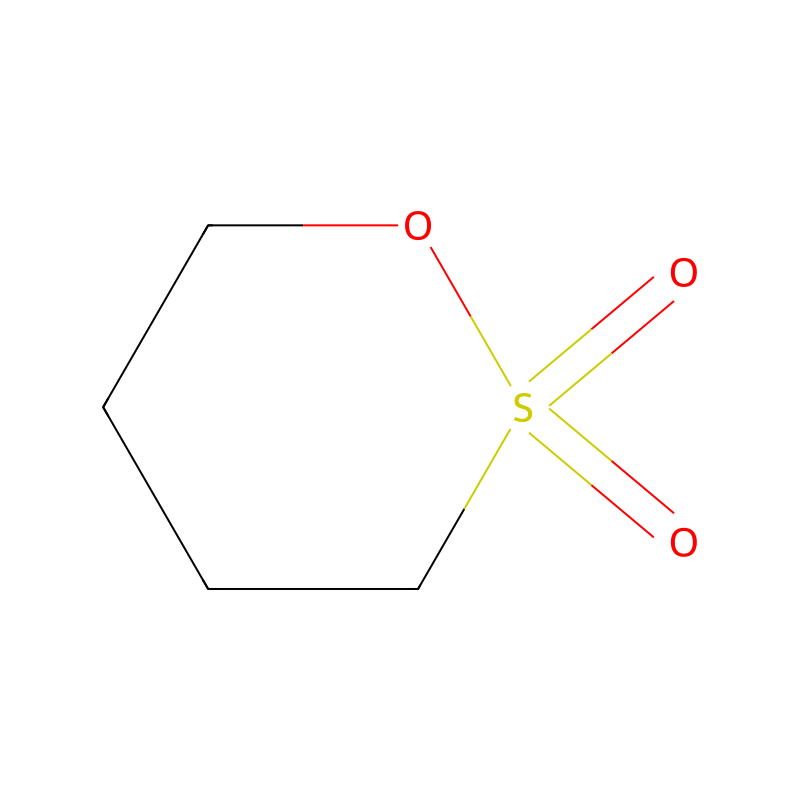
Identifiers & Physical Properties
| CAS No. | 1633-83-6 |
|---|---|
| Molecular formula | C4H8O3S |
| Average molar mass | 136.17 g/mol |
| Monoisotopic mass | 136.01941529 g/mol |
| SMILES | O=S1(=O)CCCCO1 |
| InChIKey | MHYFEEDKONKGEB-UHFFFAOYSA-N |
| PubChem CID | 15411 |
| EC No. | 216-647-9 |
| DTXSID | DTXSID4061836 |
Chemical & Physical Properties
| XLogP | 0.1 |
|---|---|
| Topological polar surface area | 51.8 |
| Hydrogen bond donors | 0 |
| Hydrogen bond acceptors | 3 |
| Rotatable bonds | 0 |
| Heavy atoms | 8 |
| Formal charge | 0 |
| Complexity | 153 |
| Physical Description | LiquidClear faintly brownish-yellow liquid[MSDSonline] |
| Melting point | 12-15 °C (lit.) |
| Boiling point | >165 °C/25 mmHg (lit.) |
| Density | 1.331 g/mL at 25 °C (lit.) |
| Refractive index | n20/D 1.464(lit.) |
| Flash point | >230 °F |
| Storage conditions | Store below +30°C. |
| Solubility | 54g/l (decomposition)54 g/L (20 ºC) decomposes |
| Physical state | Liquid |
| Color | Clear colorless to yellow |
| Sensitivity | Moisture Sensitive |
| BRN | 110588 |
| InChI | 1S/C4H8O3S/c5-8(6)4-2-1-3-7-8/h1-4H2 |
| InChIKey | MHYFEEDKONKGEB-UHFFFAOYSA-N |
| SMILES | O=S1(=O)CCCCO1 |
| CAS DataBase Reference | 1633-83-6(CAS DataBase Reference) |
| FDA UNII | 4E0C1CLI2C |
| EPA Substance Registry System | 1,2-Oxathiane, 2,2-dioxide (1633-83-6) |
| UNSPSC Code | 41116107 |
| NACRES | NA.24 |
| GHS pictogram | GHS07,GHS08 |
| Signal word | Warning |
| GHS hazard statements | H302-H315-H317-H319-H335-H351 |
| GHS precautionary statements | P201-P280-P301+P312-P302+P352-P305+P351+P338-P308+P313 |
| Target organs | Respiratory system |
| Personal protective equipment (PPE) | Eyeshields, Faceshields, Gloves, type ABEK (EN14387) respirator filter |
| Hazard symbols | Xn |
| Risk statements (R) | 22-40-68-20/21/22 |
| Safety statements (S) | 22-36/37-45-36 |
| UN transport number | 2810 |
| Water hazard class (WGK) | 3 |
| RTECS number | RP4300000 |
| TSCA inventory status | TSCA listed |
| Hazard class | 6.1(b)Acute Tox. 4 OralCarc. 2Eye Irrit. 2Skin Irrit. 2Skin Sens. 1STOT SE 3 |
| Packing group | III |
| Customs code | 29349990 |
| Storage class | 11 - Combustible Solids |
| Hazardous substances data | 1633-83-6(Hazardous Substances Data) |
| Toxicity | LD50 orally in Rabbit: 500 mg/kg |
| REACH registrations | Active |
Safety & Regulations
| GHS classification | This chemical does not meet GHS hazard criteria for 0.6% (1 of 167) of reports.WarningH302 (99.4%): Harmful if swallowed [Warning Acute toxicity, oral]H315 (65.3%): Causes skin irritation [Warning Skin corrosion/irritation]H319 (65.3%): Causes serious eye irritation [Warning Serious eye damage/eye irritation]H335 (65.3%): May cause respiratory irritation [Warning Specific target organ toxicity, single exposureRespiratory tract irritation]H341 (66.5%): Suspected of causing genetic defects [Warning Germ cell mutagenicity]H351 (95.8%): Suspected of causing cancer [Warning Carcinogenicity]H412 (62.9%): Harmful to aquatic life with long lasting effects [Hazardous to the aquatic environment, long-term hazard]P203, P261, P264, P264+P265, P270, P271, P273, P280, P301+P317, P302+P352, P304+P340, P305+P351+P338, P318, P319, P321, P330, P332+P317, P337+P317, P362+P364, P403+P233, P405, and P501 (click each P-code to see the statement)Aggregated GHS information provided per 167 reports by companies from 12 notifications to the ECHA C&L Inventory. Each notification may be associated with multiple companies.Reported as not meeting GHS hazard criteria per 1 of 167 reports by companies.There are 11 notifications provided by 166 of 167 reports by companies with hazard statement code(s).Information may vary between notifications depending on impurities, additives, and other factors. The percentage value in parenthesis indicates the notified classification ratio from companies that provide hazard codes. Only hazard codes with percentage values above 10% are shown. For more detailed information, please visit ECHA C&L website. |
|---|---|
| Regulatory information | 1,2-Oxathiane, 2,2-dioxide is listed on the EPA's Chemical Data Reporting (CDR) system. Manufacturers and importers of 1,2-Oxathiane, 2,2-dioxide are required to report information about their production and use of this chemical to the EPA under the Toxic Substances Control Act (TSCA). (40 eCFR Part 711)Status: Active Update: 30-07-2020 https://echa.europa.eu/registration-dossier/-/registered-dossier/260871,4-Butanesultone: Does not have an individual approval but may be used under an appropriate group standard |
| Hazards summary | A mutagen and equivocal tumorigen[RTECS] May cause irritation[MSDSonline] See Propane sultone. |
| Special Reports | THIS IS A REVIEW OF THE HOST MEDIATED ASSAY AND BODY FLUID ASSAY AS REPORTED FOR 208 CHEMICALS. 1,4-BUTANE SULTONE WAS POSITIVE FOR AN UNSPECIFIED STRAIN OF SALMONELLA TYPHIMURIUM.[LEGATOR MS ET ALAN EVALUATION OF THE HOST MEDIATED ASSAY AND BODY FLUID ANALYSIS A REPORT OF THE USA ENVIRONMENTAL PROTECTION AGENCY GENE-TOX PROGRAMMUTAT RES 98 (3): 319-74 (1982)] |
| Hazard Classes and Categories | Acute Tox. 4 (99.4%)Skin Irrit. 2 (65.3%)Eye Irrit. 2 (65.3%)STOT SE 3 (65.3%)Muta. 2 (66.5%)Carc. 2 (95.8%)Aquatic Chronic 3 (62.9%) |
| Non-Human Toxicity Excerpts | FEMALE ICR/HA SWISS MICE WERE INJECTED SC WITH 1,4-BUTANE SULTONE ONCE/WK FOR 580 DAYS @ 1.0 MG/0.05 ML TRICAPRYLIN. NO SIGNIFICANT TUMORIGENIC EFFECT WAS NOTED.1,4-BUTANE SULTONE WAS TESTED IN THE IP HOST-MEDIATED ASSAY, USING ADULT MALE SWISS-WEBSTER MICE AS THE HOST ANIMAL AND SALMONELLA TYPHIMURIUM AS A TEST ORGANISM. IT TESTED POS @ A CONCN OF 106.4 MG/KG IN STRAINS TA1530 AND TA1538 & @ A CONCN OF 138 MG/KG IN STRAIN TA1535.1,4-BUTANE SULTONE WAS POS FOR RECOMBINOGENIC ACTIVITY IN SACCHAROMYCES CEREVISIAE D3 WHEN ADMIN @ A CONCN OF 1.0% WITHOUT METABOLIC ACTIVATION.1,4-BUTANE SULTONE WAS TESTED IN THE AMES REVERSION TEST IN SALMONELLA TYPHIMURIUM STRAINS TA1535, TA1536, TA1537, TA1538, TA98 AND TA100 WITHOUT ACTIVATION @ 100 UG (0.73 UMOL/PLATE). IT WAS MUTAGENIC IN STRAINS TA1535, TA1537, AND TA100, CAUSING 500, 66, AND 470 HIS+ REVERTANTS/PLATE (MINUS BACKGROUND), RESPECTIVELY.For more Non-Human Toxicity Excerpts (Complete) data for 1,4-BUTANE SULTONE (6 total), please visit the HSDB record page. |
| Personal protective equipment (PPE) | Eyeshields, Faceshields, Gloves, type ABEK (EN14387) respirator filter |
| Water hazard class (WGK) | 3 |
| TSCA inventory status | TSCA listed |
| RTECS number | RP4300000 |
| UN transport number | 2810 |
| Customs code | 29349990 |
| Toxicity | LD50 orally in Rabbit: 500 mg/kg |
| Risk statements (R) | 22-40-68-20/21/22 |
| Signal word | Warning |
| GHS pictogram | GHS07,GHS08 |
| Hazard symbols | Xn |
| Safety statements (S) | 22-36/37-45-36 |
| Hazard class | 6.1(b)Acute Tox. 4 OralCarc. 2Eye Irrit. 2Skin Irrit. 2Skin Sens. 1STOT SE 3 |
| Storage class | 11 - Combustible Solids |
| Packing group | III |
| Target organs | Respiratory system |
| GHS hazard statements | H302-H315-H317-H319-H335-H351 |
| REACH registrations | Active |
| GHS precautionary statements | P201-P280-P301+P312-P302+P352-P305+P351+P338-P308+P313 |
| Hazardous substances data | 1633-83-6(Hazardous Substances Data) |
Applications & Uses
Description
1,4-Butane sultone is an impurity in sulfobutyl ether β-cyclodextrin (SBE-β-CD), and has been reported to be a weak carcinogen. 1,4-Butane sultone can be used for preparation of Brnsted acidic ionic liquids and the ionic liquid is green, highly water soluble, thermally stable, specific and catalytically stable, and can be used for the preparation of symmetrical 3,3'-diaryloxyoctanone compounds[1-2].
Uses
1,4-Butane Sultone is an alkylating agent with weak carcinogenic activity.
Uses
1,4-Butane sultone can be employed as a reactant in the preparation of conjugated polymers which include polybetaine, poly[2-ethynyl-N-(4-sulfobutyl)pyridinium betaine] (PESPB).It can also be used in the preparation of Bronsted acid catalysts such as 4-(succinimido)-1-butane sulfonic acid and poly(4-vinylpyridinium butane sulfonic acid) hydrogen sulfate. These catalysts facilitate the synthesis of 1-amidoalkyl-2-naphthols, substituted quinolines, and pyrano[4,3-b]pyran derivatives.