

Basic information
- CAS
1817-73-8- Standard SMILES
Nc1c(Br)cc([N+](=O)[O-])cc1[N+](=O)[O-]- InChIKey
KWMDHCLJYMVBNS-UHFFFAOYSA-N- Molecular formula
- C6H4BrN3O4
- Average molar mass
- 262.02 g/mol
- Monoisotopic mass
- 260.93851771
Overview
2-bromo-4,6-dinitroaniline is a bright yellow powder. (NTP, 1992)
Names & identifiers
- Preferred name
- 2-Bromo-4,6-dinitroaniline
- IUPAC
- 2-bromo-4,6-dinitroaniline
- English name
- 2-Bromo-4,6-dinitroaniline
- Molecular formula
- C6H4BrN3O4
- Molecular weight
- 262.02
Names & synonyms
2-BROMO-4,6-DINITROANILINE1817-73-8Benzenamine, 2-bromo-4,6-dinitro-6-Bromo-2,4-dinitroaniline2,4-Dinitro-6-bromoanilineBromo DNA2-Bromo-4,6-dinitroaminobenzeneAniline, 2-bromo-4,6-dinitro-NCI-C60844DTXSID40246462,4-Dinitro-6-bromoanilinBenzenamide, 2-bromo-4,6-dinitro-
Show more names
bromodna2-Bromo-4,6-dinitroa2-bromo-4,6-dinitro-anilin2-BROMO-4,6-DINITRONANILINE2,4-DINITRO-6-BROMO ANILINE2-Bromo-4,6-dinitroaniline,97%
NSC-16572DTXCID204646105X73C593RefChem:466406217-329-22,4-Dinitro-6-bromanilinAniline, 2,4-dinitro-6-bromo-MFCD00007146
Database identifiers
- CAS
1817-73-8- PubChem CID
- 15752
- DTXSID
DTXSID4024646- ChEMBL
CHEMBL167513- UNII
- 105X73C593
- EC Number
- 217-329-2
- Nikkaji
- J38.265E
Properties
Computed structural properties
- XLogP
- 2.1
- Topological polar surface area
- 118 Ų
- Hydrogen bond donors
- 1
- Hydrogen bond acceptors
- 5
- Rotatable bonds
- 0
- Heavy atoms
- 14
- Formal charge
- 0
- Complexity
- 250
Experimental & physicochemical properties
Chemical ClassesNitrogen Compounds -> Nitroanilines
Color/FormYELLOW NEEDLES FROM ACETIC ACID OR ALCOHOL
Solubility
less than 1 mg/mL at 70 °F (NTP, 1992)
SOL IN HOT ACETIC ACID; VERY SOL IN HOT ALCOHOL & ACETONE
Boiling PointSublimes (NTP, 1992)
Melting Point
307 to 309 °F (NTP, 1992)
153 °C
Physical Description
2-bromo-4,6-dinitroaniline is a bright yellow powder. (NTP, 1992)
Yellow solid; [HSDB] Powder; [MSDSonline]
Other Experimental PropertiesSUBLIMES BEFORE REACHING BP
Physicochemical properties
- Melting point
- 151 · 151-153 °C (lit.)
- Boiling point
- 400.8 · 400.8±40.0 °C(Predicted)
- Density
- 2.1534 · 2.1534 (rough estimate)
- refractive index
- 1.62 · 1.6200 (estimate)
- storage temp.
- 2 · 2-8°C(protect from light)
- solubility
- Chloroform (Slightly), Methanol (Slightly, Sonicated)
- pka
- 1 · pK1: -6.94(+1) (25°C)
- form
- Solid
- color
- Pale Yellow to Light Yellow
- Henry's Law Constant
- 3.9 · 3.9×104 mol/(m3Pa) at 25℃, Zhang et al. (2010)
- CAS DataBase Reference
- 1817 · 1817-73-8(CAS DataBase Reference)
- FDA UNII
- 105 X73C593 · 105X73C593
- EPA Substance Registry System
- 2 · 2-Bromo-4,6-dinitroaniline (1817-73-8)
- UNSPSC Code
- 12352100 · 12352100
- Symbol(GHS)
- 2 · GHS02,GHS07,GHS08
- Signal word
- Warning
- Hazard statements
- 303 · H303-H341-H228-H315-H319
- Precautionary statements
- 210 · P210-P240-P241-P264-P280-P302+P352+P332+P313+P362+P364-P305+P351+P338+P337+P313-P201-P202-P308+P313-P405-P501a
- Hazard Codes
- Xi,F
- Risk Statements
- 36 · 36/37/38-11
- Safety Statements
- 37 · 37/39-26-16
- RIDADR
- 1325 · 1325
- WGK Germany
- 2 · 2
- RTECS
- 9303000 · BW9303000
- TSCA
- TSCA listed
- HS Code
- 2921.42 · 2921.42.9000
- HazardClass
- 4.1 · 4.1
- PackingGroup
- III
- Hazardous Substances Data
- 1817 · 1817-73-8(Hazardous Substances Data)
- Toxicity
- 50 · rat,LD50,oral,4100mg/kg (4100mg/kg),BRAIN AND COVERINGS: RECORDINGS FROM SPECIFIC AREAS OF CNSBEHAVIORAL: SOMNOLENCE (GENERAL DEPRESSED ACTIVITY),Office of Toxic Substances Report. Vol. OTS,
- REACH Registrations
- Active
- Limited Quantities
- 5 Kg · 5.0 Kg (11 lbs) (solid)
- Excepted Quantities
- Max Inner Pack (30g or 30ml) and Max Outer Pack (1Kg or 1L)
Safety & regulation
GHS classification
GHS Classification
Danger
H228 (16.7%): Flammable solid [Danger Flammable solids]
P203, P210, P240, P241, P261, P264, P264+P265, P271, P280, P302+P352, P304+P340, P305+P351+P338, P318, P319, P321, P332+P317, P337+P317, P362+P364, P370+P378, P403+P233, P405, and P501 (click each P-code to see the statement)
Aggregated GHS information provided per 6 reports by companies from 3 notifications to the ECHA C&L Inventory. Each notification may be associated with multiple companies.
Hazard information
Regulatory Information
Status: Active Update: 29-07-2022 https://echa.europa.eu/registration-dossier/-/registered-dossier/33891
Benzenamine, 2-bromo-4,6-dinitro-: Does not have an individual approval but may be used under an appropriate group standard
Fire HazardsFlash point data for this chemical are not available, but it is probably combustible. (NTP, 1992)
Health HazardsSYMPTOMS: Symptoms following exposure to this compound may include eye irritation.
Hazards SummaryA mutagen and mild eye irritant; Causes somnolence and weight loss in lethal-dose feeding studies of rats; [RTECS] Emergency treatment: Methemoglobinemia; [HSDB] An eye irritant; [CAMEO] An irritant; [MSDSonline]
Reactive GroupNitro, Nitroso, Nitrate, and Nitrite Compounds, Organic
Reactivity Profile
A halogenated and nitrated aryl amine. Amines are chemical bases. They neutralize acids to form salts plus water. These acid-base reactions are exothermic. The amount of heat that is evolved per mole of amine in a neutralization is largely independent of the strength of the amine as a base. Amines may be incompatible with isocyanates, halogenated organics, peroxides, phenols (acidic), epoxides, anhydrides, and acid halides. Flammable gaseous hydrogen is generated by amines in combination with strong reducing agents, such as hydrides.
Air and Water ReactionsThis material may be sensitive to exposure to air (NTP, 1992). Insoluble in water.
Hazard Classes and CategoriesFlam. Sol. 2 (16.7%)
Safety & protection
Fire FightingFires involving this compound can be controlled using a dry chemical, carbon dioxide or Halon extinguisher. (NTP, 1992)
First Aid
EYES: First check the victim for contact lenses and remove if present. Flush victim's eyes with water or normal saline solution for 20 to 30 minutes while simultaneously calling a hospital or poison control center. Do not put any ointments, oils, or medication in the victim's eyes without specific instructions from a physician. IMMEDIATELY transport the victim after flushing eyes to a hospital even if no symptoms (such as redness or irritation) develop.
Nonfire Spill Response
SMALL SPILLS AND LEAKAGE: If a spill of this chemical occurs, FIRST REMOVE ALL SOURCES OF IGNITION, then you should dampen the solid spill material with acetone and transfer the dampened material to a suitable container. Use absorbent paper dampened with acetone to pick up any remaining material. Seal your contaminated clothing and the absorbent paper in a vapor-tight plastic bag for eventual disposal. Solvent wash all contaminated surfaces with acetone followed by washing with a soap and water solution. Do not reenter the contaminated area until the Safety Officer (or other responsible person) has verified that the area has been properly cleaned.
Personal Protective Equipment (PPE)
RECOMMENDED RESPIRATOR: Where the neat test chemical is weighed and diluted, wear a NIOSH-approved half face respirator equipped with an organic vapor/acid gas cartridge (specific for organic vapors, HCl, acid gas and SO2) with a dust/mist filter. (NTP, 1992)
Toxicology
Adverse EffectsMethemoglobinemia - The presence of increased methemoglobin in the blood; the compound is classified as secondary toxic effect
TSCA Test Submissions
The ability of 2-bromo-4,6-dinitroaniline (BDNA) to induce morphological transformation in the BALB/3T3 mouse cell line (Cell Transformation Assay) was evaluated in the absence of added metabolic activation. Based on preliminary clonal toxicity determinations (exposure time=24 hrs), BDNA, in 0.1% (v/v) aqueous acetone, was tested at 5, 15 and 50 ug/ml, with cell survival ranging from 89.6-36.9% relative to solvent control. None of the tested concentrations produced significantly greater transformation frequencies (p > 0.05, Modified Poisson Distribution) relative to the solvent control.
The ability of 2-bromo-4,6-dinitroaniline (BDNA) to induce morphological transformation in the BALB/3T3 mouse cell line (Cell Transformation Assay) was evaluated in the absence of added metabolic activation. Based on preliminary clonal toxicity determinations (exposure time=24 hrs), BDNA, in 0.1% (v/v) aqueous acetone, was tested at 5, 15 and 50 ug/ml, with cell survival ranging from 94.0-77.3% relative to solvent control. At 15 ug/ml, a statistically significant (P<0.05, Modified Poisson Distribution) increase in the number of transformed foci was observed relative to the solvent control.
The ability of 2-bromo-4,6-dinitroaniline (BDNA) to induce morphological transformation in the BALB/3T3 mouse cell line (Cell Transformation Assay) was evaluated in the presence of added metabolic activation by Aroclor-induced rat liver S9 fraction. Based on preliminary clonal toxicity determinations (exposure time=2 hrs), BDNA, in 0.06% (v/v) aqueous acetone, was tested at 3, 10 and 30 ug/ml, with cell survival ranging from 94.8-94.5% relative to solvent control. None of the tested concentrations produced detectable transformation frequencies.
The mutagenicity of 2-bromo-4,6-dinitroaniline (BDNA) was evaluated in Salmonella tester strains TA98, TA100, TA1535, TA1537 and TA1538 (Ames Test), both in the presence and absence of added metabolic activation by Aroclor-induced rat liver S9 fraction. BDNA was tested for mutagenicity at concentrations ranging from 10-1000 ug/plate using the plate incorporation method. BDNA caused a positive response in all of the bacterial tester strains except TA1535, both in the presence and absence of metabolic activation.
The ability of trichlorobutylene oxide (TCBO) to cause unscheduled DNA synthesis in human lung fibroblast cells (WI-38) in vitro was evaluated both with and without metabolic activation by mouse liver S9 fraction. TCBO, dissolved in DMSO, was tested at concentrations of 0, 51, 128, 320, 800 or 2000 ug/ml in the absence of activation and at concentrations of 0, 1447, 1736, 2083, 2500 or 3000 ug/ml with activation. None of the tested concentrations caused an increase in unscheduled DNA synthesis as measured by the amount of tritiated thymidine incorporated into DNA of treated vs control cultures. Evidence of cytotoxicity was observed at each tested concentration.
Safety data
- wgk
- 2
- tsca
- TSCA listed
- rtecs
- BW9303000
- ridadr
- 1325
- hs_code
- 2921.42.9000
- Toxicity
- rat,LD50,oral,4100mg/kg (4100mg/kg),BRAIN AND COVERINGS: RECORDINGS FROM SPECIFIC AREAS OF CNSBEHAVIORAL: SOMNOLENCE (GENERAL DEPRESSED ACTIVITY),Office of Toxic Substances Report. Vol. OTS,
- risk_code
- 36/37/38-11
- Signal word
- Warning
- Symbol(GHS)
- GHS02,GHS07,GHS08
- hazard_code
- Xi,F
- safety_code
- 37/39-26-16
- hazard_class
- 4.1
- packing_group
- III
- Hazard statements
- H303-H341-H228-H315-H319
- Limited Quantities
- 5.0 Kg (11 lbs) (solid)
- Excepted Quantities
- Max Inner Pack (30g or 30ml) and Max Outer Pack (1Kg or 1L)
- REACH Registrations
- Active
- Precautionary statements
- P210-P240-P241-P264-P280-P302+P352+P332+P313+P362+P364-P305+P351+P338+P337+P313-P201-P202-P308+P313-P405-P501a
- Hazardous Substances Data
- 1817-73-8(Hazardous Substances Data)
Chemistry & industry
Uses & manufacturing
Uses
Used in the synthesis of monoazo dyes; [ChemIDplus] Used as a chemical intermediate for azo derivatives; [HSDB]
CHEM INT FOR AZO DERIVS (PROBABLE AZO DYE INT)
CHEM INT FOR DISPERSE VIOLET 7 & 24-NO CURRENT U.S. PRODN
U.S. Exports
(1979) No Data
(1981) No Data
U.S. Imports
(1979) 1.25X10+7 GRAMS (PRINCPL CUSTMS DISTS)
(1981) 4.54X10+7 GRAMS (PRINCPL CUSTMS DISTS)
U.S. Production
(1979) PROBABLY GREATER THAN 4.54X10+6 GRAMS
(1981) PROBABLY GREATER THAN 4.54X10+6 GRAMS
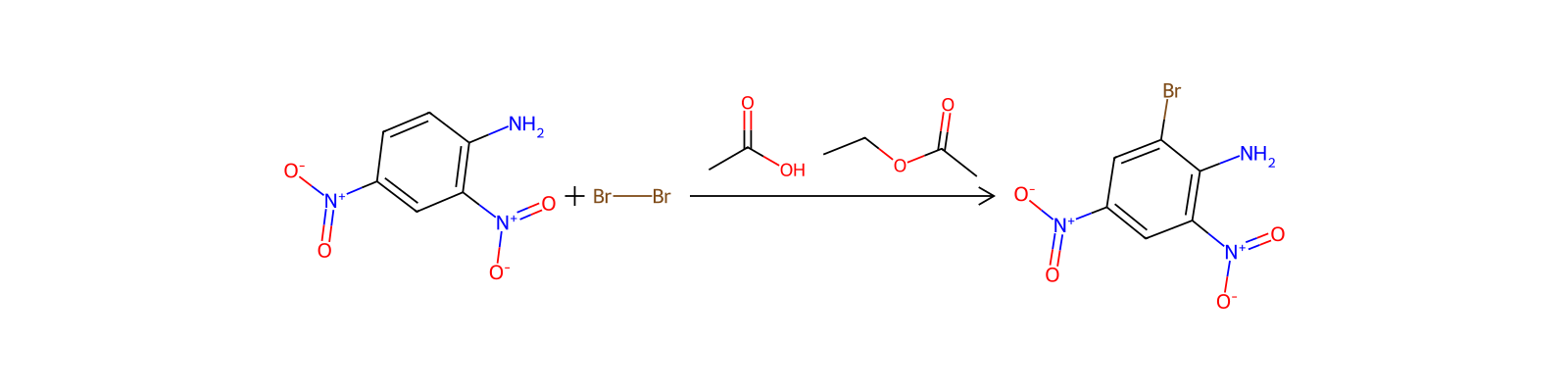
Methods of ManufacturingBROMINATION OF 2,4-DINITROANILINE SUSPENDED IN WATER
General Manufacturing InformationBenzenamine, 2-bromo-4,6-dinitro-: ACTIVE
Applications
Uses2-Bromo-4,6-dinitroaniline was used as a model chemical in the inter-laboratory evaluation of the bioluminescent Salmonella reverse mutation assay for detecting mutagenicity.
General DescriptionBright yellow powder.
Upstream & downstream products
Upstream raw materials
Downstream products
Suppliers100 total
国药集团化学试剂有限公司86-21-63210123 · [email protected]
梯希爱(上海)化成工业发展有限公司021-67121386 · [email protected]
上海阿拉丁生化科技股份有限公司400-6206333 13167063860 · [email protected]
宁波君龙新材料有限公司0574 88552216 19032109277 · [email protected]
上海凌富药物研究有限公司+86(21)5895 0110 19945755304 · [email protected]
上海伟聂化工科技有限公司13046668259 · [email protected]
毕佳索(上海毕得医药科技股份有限公司)400-6005915 · [email protected]
上海麦克林生化科技股份有限公司021-50706066 15221275939 · [email protected]
武汉欣扬瑞和化学科技有限公司13720274133 · [email protected]
杭州景优化工有限公司87211835 13957193240 · [email protected]
天津瑞德法莫科技有限公司13821803402 · [email protected]
武汉欣扬瑞和化学科技有限公司153-07155313 15307155313 · [email protected]
上海腾准生物科技有限公司19821570922 · [email protected]
上海泰矶林实业有限公司02150630626 17717886015 · [email protected]
寿光市兴海化工有限公司15666881566 · [email protected]
爱斯特(成都)生物制药股份有限公司+86-28-85122536 85324413 · [email protected]
山东前元高分子材料有限公司18678041314 18765609661 · [email protected]
Dayang Chem (Hangzhou) Co.,Ltd.+86-0571-88938639 17705817739 · [email protected]
衢州明锋化工有限公司0570-3062502 13819002126;13819008176 · [email protected]
Syntechem Co.,Ltd[email protected]
上海迈瑞尔生化科技有限公司4006356688 18621169109 · [email protected]
北京索莱宝科技有限公司010-50973130 17801761073 · [email protected]
上海颖心实验室设备有限公司021-59178156 17002132182 · [email protected]
阿法埃莎(中国)化学有限公司400-6106006 · [email protected]
安耐吉化学&3A(安徽泽升科技股份有限公司)400-0056266 · [email protected]
Allfluoro Pharmaceutical Company Limited+86-400-0216110 +86-15958047586 · [email protected]
湖北兴琰新材料科技有限公司13129948835 · [email protected]
梯希爱(上海)化工贸易有限公司021-61109150 · [email protected]
广东云星生物技术有限公司0751-18902340975/189023400307 18902340307 · [email protected]
上海瀚鸿科技股份有限公司021-54306202 13764082696 · [email protected]
广州济成进出口贸易有限公司13682223272 · [email protected]
上海毕楷科技有限公司18516304666
山东西亚化学有限公司13355009207 13355009207 · [email protected]
武汉盈邦医药有限公司+86-13296627870; +86-13971566811 · [email protected]
玛雅试剂+86 (573) 82222445 (0)18006601000 452520369 · [email protected]
北京泰亚杰科技有限公司021-33690831-8001 13552411790;18616022633 · [email protected]
TCI AMERICA800-4238616 · [email protected]
TOKYO CHEMICAL INDUSTRY CO., LTD.03-36680489 · [email protected]
TCI Europe320-37350700 · [email protected]
上海倍卓生物科技有限公司021-61119791,13386096464 · [email protected]
上海毕得医药科技股份有限公司400-164-7117 18317119277 · [email protected]
南京多隆生物科技有限公司18905173768 · [email protected]
Sigma-Aldrich西格玛奥德里奇(上海)贸易有限公司021-61415566 800-8193336 · [email protected]
潍坊市前进精细化工有限公司18753684562 · [email protected]
九鼎化学(上海)科技有限公司4009209199 · [email protected]
Henan Alfa Chemical Co., Ltd+8618339805032 · [email protected]
广东翁江化学试剂有限公司0751-2815987 13927875076 · [email protected]
武汉峰耀同辉化学制品有限公司027-87466205 15377579727 · [email protected]
武汉欣扬瑞和化学科技有限公司13720181483 13720181483 · [email protected]
Alfa Chemistry+1-5166625404 · [email protected]
Related reactions
17 records



Compound notes
Loading…